
Choosing among solar battery systems means balancing usable storage, inverter power, solar input, portability, and installation requirements. The right setup depends on whether you need occasional backup, mobile power, or dependable off-grid electricity.
This roundup compares ten options ranging from portable Jackery power stations to larger ECO-WORTHY battery banks and complete solar kits, helping you narrow the field by application and scale.
Best 10 Solar Battery Systems Picks for 2026
Best Complete Off-Grid Kit
ECO-WORTHY 1200W 24V Solar System

- 1,170W of bifacial solar panel capacity
- 7.168kWh of LiFePO4 storage
- Includes MPPT controller and 3000W inverter
Best For: RVs, cabins, trailers, and fixed off-grid installations
Best Portable 2kWh Option
Jackery Explorer 2000 v2 Solar Generator

- 2,042Wh capacity with 2,200W AC output
- Includes two 200W solar panels
- 20ms UPS switching and quiet operation
Best For: Camping, portable backup, and essential electronics
Best High-Capacity Battery Bank
ECO-WORTHY Powermega 48V 314Ah

- 16.07kWh stated LiFePO4 capacity
- UL 1973 certified with 10-year warranty
- Active-balancing BMS and parallel expansion
Best For: Large off-grid and whole-home backup installations
Best Home Backup Power Station
Jackery HomePower 3000 Solar Generator

- 3,072Wh capacity and 3,600W output
- 7,200W surge capacity for demanding starts
- 20ms UPS and multiple household-friendly ports
Best For: Home outage backup and essential appliances
Complete Off-Grid Power
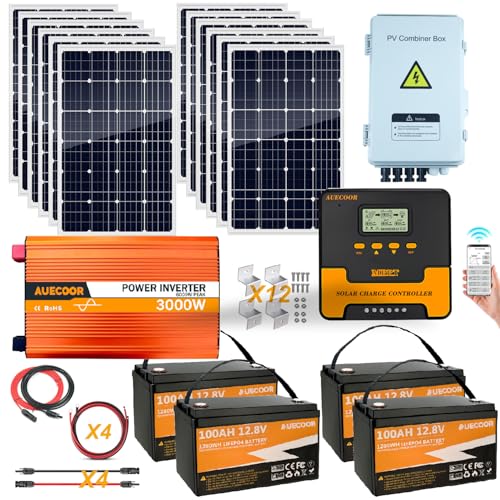
- 1,440W solar array with 5.12kWh battery
- 3,000W pure sine wave inverter
- MPPT controller and combiner box included
Best For: Off-grid homes, RVs, and emergency backup
Portable Home Backup

- 3,584Wh capacity and 3,600W output
- Includes two 200W solar panels
- Wheeled design with four charging options
Best For: Portable household outage backup
High-Capacity Off-Grid Kit

- 2,340W array from 12 mono panels
- 5,000W 48V off-grid inverter
- 51.2V 100Ah LiFePO4 battery included
Best For: DIY cabins, homes, RVs, and backup systems
Best Balanced Solar Battery System

- 1,170W bifacial solar array
- 2.56kWh LiFePO4 battery
- 3,500W inverter with Wi-Fi
Best For: Cabins, sheds, and moderate appliance backup
Best High-Output Solar Battery System

- 10,000W continuous inverter output
- Approximately 10.24kWh battery storage
- 120/240V split-phase support
Best For: Larger homes, farms, and high-demand off-grid loads
Best Large-Capacity Solar Battery System

- 16.076kWh LiFePO4 battery
- 10kW 120/240V split-phase inverter
- 2,950W solar array with 590W panels
Best For: High-capacity home backup and scalable off-grid power
Best Complete Off-Grid Kit – ECO-WORTHY 1200W 24V Solar System
For shoppers comparing solar battery systems for an RV, cabin, shed, or other off-grid setup, this ECO-WORTHY kit combines solar panels, lithium storage, a charge controller, and an inverter in one package. Its six bifacial panels provide 1,170W of rated solar capacity, while the dual batteries offer 7.168kWh of storage.
Best For: Off-grid cabins, RVs, trailers, and backup systems needing substantial battery storage and a complete component package.
Pros:
- Includes six 195W bifacial panels, two 280Ah LiFePO4 batteries, a 60A MPPT controller, and a 3000W pure sine wave inverter.
- 7.168kWh battery capacity with a stated cycle life exceeding 6,000 cycles.
- Panel shading design is intended to limit the effect of partial shade, while Bluetooth monitoring adds convenience.
Cons:
- This is a component-based installation rather than a compact plug-and-play power station.
- The included panels and equipment require considerable mounting and setup space.
Choose this system when storage capacity, expandability of the installation, and included hardware matter more than portability. It is a strong fit for fixed off-grid applications, but buyers should plan for installation and wiring.
Best Portable 2kWh Option – Jackery Explorer 2000 v2 Solar Generator
The Jackery Explorer 2000 v2 is a practical choice for shoppers seeking portable solar battery systems for camping, home backup, or small-business use. It pairs a 2,042Wh battery with two 200W solar panels and delivers 2,200W of AC output from a compact power station.
Best For: Camping, portable backup, and essential electronics that benefit from quiet operation and fast charging.
Pros:
- Provides 2,042Wh of capacity, 2,200W of AC output, three AC ports, and a 100W USB-C PD port.
- LiFePO4 battery, temperature control, and quiet charging support indoor and overnight use.
- UPS switching is rated at 20ms, and the unit can reach 80% charge in 66 minutes with AC charging.
Cons:
- Its 400W solar input setup is less suited to high-demand whole-home power use.
- Connecting the included panels requires using the specified straight DC8020 plug configuration.
This Jackery is easier to transport and deploy than a fixed solar installation. Its capacity and output suit essentials, devices, and smaller appliances, while the UPS function adds value for outage protection.
Best High-Capacity Battery Bank – ECO-WORTHY Powermega 48V 314Ah
For larger solar battery systems, the ECO-WORTHY Powermega 48V 314Ah battery offers a substantial storage foundation. This two-pack provides 16.07kWh of stated capacity per 48V 314Ah battery specification and supports parallel expansion for demanding off-grid or whole-home backup installations.
Best For: Permanent home backup and off-grid systems designed around 48V equipment and high storage capacity.
Pros:
- UL 1973 certified and covered by a stated 10-year warranty.
- 200A active-balancing BMS, circuit-breaker protection, and aerosol fire-suppression modules add safety features.
- Supports up to 15 units in parallel, with Wi-Fi, Bluetooth, touchscreen, RS485, and CAN monitoring or communication options.
Cons:
- This is a large, heavy battery system rather than a portable power station.
- Truck-and-pallet delivery requires an address able to accommodate freight delivery.
- It is a battery bank, so an appropriate inverter and compatible solar equipment are needed for a complete system.
Consider the Powermega when your priority is scalable storage and integrated monitoring. Its size, delivery requirements, and 48V compatibility make it better suited to planned installations than casual or temporary use.
Best Home Backup Power Station – Jackery HomePower 3000 Solar Generator
The Jackery HomePower 3000 is a convenient solar battery system for keeping household essentials running during outages. It combines 3,072Wh of capacity with 3,600W output, 7,200W surge capability, and two 200W solar panels for replenishment.
Best For: Home backup for refrigerators, routers, lights, fans, medical refrigerators, and other essential loads.
Pros:
- Delivers 3,600W output with 7,200W surge capacity and a 3,072Wh battery.
- UL-certified UPS switching within 20ms supports uninterrupted operation for selected essential devices.
- Offers AC, USB-C, USB-A, DC, and TT-30 RV connectivity, plus a five-year manufacturer warranty.
Cons:
- The included 400W solar setup is listed to recharge to 80% in about nine hours, so solar replenishment is not especially fast.
- At 59.5 pounds, it is portable but not lightweight for frequent carrying.
- As a battery-powered station, runtime depends on the connected load and available recharge opportunities.
This model is a useful middle ground between a small portable station and a permanent battery installation. Its high output and UPS capability make it particularly appealing for outage readiness, while the integrated design keeps setup simpler.
Complete Off-Grid Power – 3000W 24V Solar Power System
This complete solar battery systems kit combines 1,440W of solar input, a 5.12kWh battery, and a 3,000W pure sine wave inverter. It is designed for off-grid homes, RVs, and emergency backup, with included power-management and connection components.
Best For: Off-grid users who want a comprehensive system for essential household loads, RV appliances, and backup power.
Pros:
- Includes 12 solar panels, a 5.12kWh battery, inverter, MPPT controller, and PV combiner box.
- Pure sine wave output supports sensitive electronics and motor-driven appliances.
- LiFePO4 battery includes a built-in BMS and is rated for more than ten years under optimal conditions.
- MPPT controller offers over 99% tracking efficiency, LCD monitoring, and app control.
Cons:
- The system requires more involved installation than a portable power station.
- Its 24V architecture and multiple components may require careful wiring and system planning.
With substantial solar input and integrated protection features, this kit is a strong option when you need a permanent-style solar battery system rather than a plug-and-play unit. Confirm your load requirements, mounting space, and installation capabilities before buying.
Portable Home Backup – Jackery HomePower 3600 Plus
The Jackery HomePower 3600 Plus is a portable solar battery system with 3,584Wh of capacity, 3,600W output, and two 200W solar panels. Its wheeled design and multiple charging methods make it convenient for outage backup without a complex installation.
Best For: Households seeking portable backup for high-demand appliances, with the flexibility to move the unit between rooms or locations.
Pros:
- Provides 3,600W output and can deliver 7,200W in parallel, with 120V and 240V support when paralleled.
- Supports AC, solar, hybrid AC-plus-DC, and gas-generator charging.
- Wheels and a telescoping handle make the 77.2-pound unit easier to move.
- LFP battery is rated for 6,000 cycles and a ten-year lifespan.
Cons:
- The included 400W of solar panels is smaller than the system’s maximum output capability.
- At 77.2 pounds, it is portable but not lightweight for carrying.
This Jackery is a practical middle ground between a small power station and a permanently installed solar battery system. Its plug-and-play format is especially useful for outage preparation, while expansion and parallel operation add flexibility for larger backup needs.
High-Capacity Off-Grid Kit – ECO-WORTHY 5KW Solar System
The ECO-WORTHY complete kit is built around a 2,340W array, a 48V 5,000W off-grid inverter, and a 51.2V 100Ah Cubix LiFePO4 battery. As solar battery systems go, it offers a higher-voltage setup for cabins, RVs, homes, and backup applications, with cables and mounting brackets included.
Best For: DIY-minded off-grid users who need a 5kW inverter and substantial battery storage for essential appliances.
Pros:
- Complete package includes 12 monocrystalline panels, inverter, lithium battery, cables, and Z brackets.
- 5,000W, 48V inverter is designed to run lights, appliances, televisions, refrigerators, and other essentials.
- 51.2V 100Ah LiFePO4 battery provides deep-cycle energy storage for night use.
- Panels are suitable for roof, ground, or shed mounting.
Cons:
- The kit is intended for DIY installation, so planning and wiring are still required.
- The supplied battery capacity is 5.12kWh, which may not cover extended operation of high-draw appliances.
Choose this ECO-WORTHY kit when you want a more substantial off-grid foundation than a portable unit and are comfortable organizing a solar installation. Its 48V design, 5kW inverter, and included hardware make it well suited to planned stationary setups.
Best Balanced Solar Battery System – 1170W 48V Home Backup Kit
For shoppers comparing solar battery systems for a cabin, shed, or smaller home backup setup, this ECO-WORTHY kit combines 1,170W of bifacial solar panels, a 48V 50Ah LiFePO4 battery, and a 3,500W inverter. Its 2.56kWh usable battery capacity and 110/120V output make it suited to common appliances, while built-in Wi-Fi monitoring adds convenience.
Best For: Cabins, sheds, and homes needing moderate off-grid power for appliances such as refrigerators, televisions, coffee makers, or microwaves.
Pros:
- Complete system includes six 195W bifacial panels, battery, inverter, cables, and mounts.
- LiFePO4 battery is rated for more than 4,000 cycles and weighs 58.4 pounds.
- 3,500W inverter provides 7,000W surge power, 80A MPPT charging, Wi-Fi control, and 20ms UPS switching.
Cons:
- Its 2.56kWh battery is considerably smaller than the storage in larger home systems.
- The kit is designed around 110/120V output rather than 240V split-phase appliances.
- The product ships in multiple packages, so buyers should verify that all components arrive.
This is a practical middle-ground option among solar battery systems: more capable than a basic portable setup, but not intended for extensive whole-home loads or long-duration backup without additional battery capacity.
Best High-Output Solar Battery System – 10kW Split-Phase Home Kit
This ECO-WORTHY kit is a strong choice for shoppers seeking solar battery systems with higher output and larger storage. It pairs 2,340W of bifacial panels with two 48V 100Ah lithium batteries and a 10,000W inverter capable of 120/240V split-phase output for demanding home, farm, cabin, or backup applications.
Best For: Homes, farms, and larger off-grid installations that need split-phase power for air conditioners and other higher-demand appliances.
Pros:
- Provides 10kW continuous output with 120/240V split-phase support and up to 60kW when using six parallel inverters.
- Two batteries provide approximately 10.24kWh of stated storage, with Bluetooth and Wi-Fi monitoring.
- Panels use N-type cells with 25% conversion efficiency, bifacial generation, IP68 protection, and a stated 30-year lifespan.
- Supports multiple charging and output modes, including solar-only, mains-priority, and hybrid charging.
Cons:
- Professional installation is recommended; novice installation may create safety and performance risks.
- The larger system requires more space, planning, and installation work than a compact kit.
- Its 2,340W solar array may not replenish the full battery capacity quickly under limited sunlight.
With certified inverter hardware, communication-enabled batteries, and scalable parallel support, this kit offers a more substantial home-energy platform. It is best evaluated with an installer who can confirm wiring, loads, battery placement, and local requirements.
Best Large-Capacity Solar Battery System – 16.1kWh Portable Home Kit
Among solar battery systems for substantial home backup, this ECO-WORTHY package stands out for its 16.076kWh LiFePO4 battery and 10kW split-phase inverter. Its five 590W panels provide a 2,950W PV array, while the integrated battery includes wheels, handles, a display, and wireless monitoring for easier management and positioning.
Best For: Homeowners needing high-capacity storage, 120/240V power, and a scalable off-grid or backup system.
Pros:
- Large 48V 314Ah battery supplies 16.076kWh of energy capacity and can support up to 15 units in parallel.
- 10,000W inverter supports 120V/240V split-phase output, 20,000W peak power, dual MPPT controllers, and up to 200A battery charging.
- Integrated battery has a 7-inch color display, Bluetooth, Wi-Fi, PC connectivity, RS485/CAN communication, wheels, and handles.
- System can generate up to 11.8kWh per day under optimal conditions according to the supplied specifications.
Cons:
- The large system is shipped on a pallet by truck, so the delivery address must accommodate truck access.
- Professional installation is recommended because of the system’s size, capacity, and electrical output.
- The listed 2,950W solar array may produce less energy than the battery can store in a single day.
This is the most storage-focused option in the group and offers meaningful expansion potential. Its pallet delivery, substantial battery, and high-voltage electrical equipment make careful site planning and professional installation especially important.
How We Picked These Solar Battery Systems
We focused on systems that represent the main buying categories: portable power stations, modular LiFePO4 batteries, and complete off-grid packages. We compared stated battery capacity, AC output, solar-panel wattage, voltage, expandability, and intended use. We also considered whether a product is a ready-to-use system or requires additional components, wiring, configuration, and professional installation.
Specifications are manufacturer claims, so verify current listings, included accessories, warranty terms, and local electrical requirements before buying. Battery capacity in watt-hours is not the same as usable output; inverter losses and reserve limits reduce the energy available to connected loads.
Quick Comparison
| System type | Best for | What to check |
|---|---|---|
| Portable power station | Camping, travel, and emergency loads | Runtime, charging speed, weight, and outlet selection |
| Modular LiFePO4 battery | Custom 24V or 48V installations | Inverter, charger, battery management, and compatibility |
| Complete off-grid kit | Cabins, workshops, and larger backup systems | Installation, panel layout, protections, and permitting |
Key Buying Factors for Solar Battery Systems
Capacity and Runtime
Estimate daily watt-hours by adding the consumption of essential appliances, then account for inverter losses and several days of reserve if outages are common. A 2,000Wh-class unit can cover electronics, lights, routers, and selected small appliances, while whole-home or off-grid use typically calls for substantially more storage.
Inverter Output and Surge Capacity
Continuous AC output determines which devices can run simultaneously. Refrigerators, pumps, compressors, and power tools may need a higher startup surge, so compare both continuous and peak ratings. A large battery cannot compensate for an undersized inverter.
Solar Input and Battery Chemistry
More panel wattage can shorten recharge time, but the controller must support the array’s voltage and current. LiFePO4 batteries are widely preferred for cycle life, stability, and usable depth of discharge. Confirm the battery voltage matches the inverter and that the system includes appropriate balancing and protection.
Installation and Safety
Portable units are usually straightforward, whereas 24V and 48V kits may require fuses, disconnects, grounding, suitable cables, mounting hardware, and code-compliant installation. Have permanent home systems reviewed by a qualified electrician, especially when connecting to a building’s circuits.
Who Should Buy Which Solar Battery Systems?
Choose a portable Jackery system if you want a simple solution for camping, travel, communications, or short outages. These units reduce setup work but generally offer less storage and expansion than fixed systems.
Choose a modular ECO-WORTHY battery setup if you already understand off-grid components or want to build around a compatible inverter and solar array. This route offers flexibility, but it places more responsibility on the installer.
Choose a complete off-grid kit if you need higher output for a cabin, workshop, or larger home backup application. Confirm what is actually included, calculate your loads carefully, and plan installation before ordering. For the best long-term result, size the battery for your energy needs rather than choosing solely by the largest advertised wattage.
