
The best off-grid solar kits make it easier to generate, store, and use electricity without relying entirely on the utility grid. The right setup depends on your power demand, battery capacity, installation space, and whether you need portable RV power or permanent home backup.
We selected options ranging from compact 12V starter systems to high-output 120/240V packages. Use the guide below to compare system size, battery storage, inverter capability, and the practical trade-offs that matter most before you buy.
Best 10 Off-Grid Solar Kits Picks for 2026
Best High-Capacity Pick
SUNGOLDPOWER 8,000W Off-Grid Solar Kit

- 3,600W bifacial solar array
- 10.24kWh LiFePO4 storage
- 8,000W split-phase output
Best For: Large cabins, homes, and backup systems
Best Compact 12V Starter

- 400W of monocrystalline panels
- 40A MPPT charge controller
- Bluetooth phone monitoring
Best For: Small 12V off-grid setups
Best Balanced RV System
ECO-WORTHY 1200W 24V Lithium Solar System

- Six 195W solar panels
- 7.168kWh listed battery storage
- 3,000W pure sine inverter
Best For: RVs, cabins, and moderate backup power
Best Midrange 48V System

- 6,500W 120/240V inverter
- 5.12kWh LiFePO4 battery
- Six 370W solar panels
Best For: Cabins and small off-grid properties
Best Starter Kit
- Complete package with battery and inverter
- Novice-friendly four-step setup
- Compact choice for modest RV loads
Best For: RV trips and first-time off-grid solar users
Best High-Capacity System
- 5.12kWh LiFePO4 battery capacity
- 3000W pure sine wave inverter
- MPPT control and surge-protected combiner box
Best For: Off-grid homes, RVs, and emergency backup loads
Best Whole-Home Option

- 2340W array with twelve 195W panels
- 5KW 48V off-grid inverter
- 51.2V 100Ah LiFePO4 storage battery
Best For: Off-grid cabins, homes, and larger backup systems
Best Compact RV Kit

- 1.6 kWh stated daily output under ideal conditions
- Two 12V 100Ah lithium batteries included
- 2,000W pure sine wave inverter
Best For: RV, shed, cabin, and small backup-power needs
Best High-Output Home System

- 9.36 kWh stated daily output
- 120V/240V split-phase inverter
- Expandable through inverter paralleling
Best For: Large cabins, farms, homes, and high-power backup
Best RV Battery Capacity

- Two 12.8V 280Ah lithium batteries
- 3,000W UPS inverter charger
- 3.2 kWh stated daily output
Best For: RV owners needing extended battery storage and flexible charging
Best High-Capacity Pick – SUNGOLDPOWER 8,000W Off-Grid Solar Kit
For demanding off-grid solar kits applications, this SUNGOLDPOWER system combines 3,600W of bifacial solar panels, an 8,000W 120/240V split-phase inverter, and 10.24kWh of LiFePO4 storage. It is designed for homes, cabins, RVs, vans, and backup power systems, with an estimated 14.4kWh of daily solar energy under four hours of full sunlight.
Best For: Larger off-grid properties and backup systems needing split-phase output, substantial storage, and expansion potential.
Pros:
- 8,000W AC output supports 120V/240V loads.
- Includes two 51.2V 100Ah LiFePO4 batteries with 10.24kWh total storage.
- Dual MPPT accepts up to 11,000W of PV input.
- Includes mounting brackets, cables, and breakers.
Cons:
- At 788 pounds, this is a substantial system to transport and install.
- Its three-year inverter warranty is shorter than the listed panel and battery warranties.
This is the most capable and expandable option in the group, but its size and weight make it better suited to a planned installation than a highly mobile setup.
Best Compact 12V Starter – Renogy 400W Premium Solar Kit
This Renogy kit is a straightforward entry point for smaller off-grid solar kits setups. It includes four 100W monocrystalline panels, a 40A MPPT Rover controller, mounting hardware, cables, an adapter kit, and a Bluetooth module for monitoring and adjustment from a phone.
Best For: Small 12V installations where simple setup, MPPT charging, and phone monitoring are priorities.
Pros:
- 400W total panel capacity from four 100W monocrystalline panels.
- 40A MPPT controller is included.
- Bluetooth module supports phone-based monitoring and adjustment.
- Includes Z-brackets, cables, and an adapter kit.
Cons:
- This kit is centered on 12V systems and is not a high-output whole-home solution.
- The supplied notes list a five-year panel materials and workmanship warranty, but no broader system warranty details.
Choose this kit when you want a manageable solar foundation for a modest 12V setup; larger loads will require a more powerful system and additional components.
Best Balanced RV System – ECO-WORTHY 1200W 24V Lithium Solar System
This ECO-WORTHY system offers a useful middle ground among off-grid solar kits, pairing six 195W panels with two 12.8V 280Ah lithium batteries, a 60A MPPT controller, and a 3,000W pure sine wave inverter. The company estimates 4.68kWh of daily generation under four hours of sunlight, while total listed battery storage is 7.168kWh.
Best For: RVs, travel trailers, fifth-wheel trailers, sheds, cabins, and moderate backup-power needs.
Pros:
- Includes six 195W panels for a 1,170W solar array.
- Provides 7.168kWh of listed lithium battery storage.
- 3,000W pure sine wave inverter supports common AC equipment.
- Bluetooth monitoring is rated for up to 82 feet.
Cons:
- The listed daily generation varies with sunlight, orientation, weather, and shading.
- Its 24V configuration is less suited to very large loads than higher-voltage systems.
- The supplied notes describe the battery chemistry as Li-ion rather than specifically LiFePO4.
With substantial storage and a pure sine wave inverter, this is a versatile choice for mobile or small-property use, provided the panel array can receive direct, minimally shaded sunlight.
Best Midrange 48V System – SUNGOLDPOWER 6,500W Solar Kit
This SUNGOLDPOWER kit is a midrange option among off-grid solar kits, combining six 370W monocrystalline panels with a 6,500W 48V inverter and a 51.2V 100Ah LiFePO4 battery. It is rated to produce approximately 8.88kWh per day under four hours of full sunlight and supports both 120V and 240V appliances.
Best For: Homes, cabins, RVs, vans, and small off-grid applications needing 48V operation and higher AC output.
Pros:
- 6,500W inverter provides 120/240V AC output.
- Includes a 51.2V 100Ah LiFePO4 battery with 7,000-plus deep cycles listed.
- Dual MPPT supports up to two 5,000W, 500V PV arrays.
- Up to six inverters can be connected in parallel.
Cons:
- The included battery capacity is 5.12kWh, less than the larger SUNGOLDPOWER kit in this roundup.
- The listed warranty is three years from the manufacturer.
- Installation still requires careful planning for the 48V battery, inverter, breakers, and PV wiring.
This kit offers a strong balance of output and scalability for users who want 48V architecture without stepping up to the largest system in the selection.
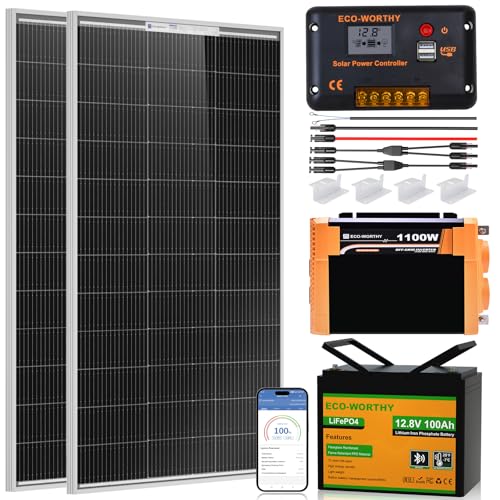
Best Starter Kit – 200W RV Solar Kit
If you want a straightforward entry point into off-grid solar kits, this 200W ECO-WORTHY system bundles the main components in one package. It includes two 100W panels, a 12.8V 100Ah lithium battery, a 30A PWM controller, a 1100W inverter, and cables for a compact RV setup.
Best For: RV trips, small off-grid loads, and first-time solar users who prefer a bundled system with a guided four-step installation process.
Pros:
- Complete package with panels, lithium battery, inverter, controller, and cables.
- Designed for novice-friendly installation.
- Includes a 1100W inverter and 1.28kWh stated storage capacity.
Cons:
- The 200W panel array is better suited to modest power needs than whole-home loads.
- Uses a PWM controller rather than the more efficient MPPT design.
This is a practical, compact choice when simplicity and RV portability matter more than maximum output. Its included battery and inverter reduce the need to source compatible parts separately.
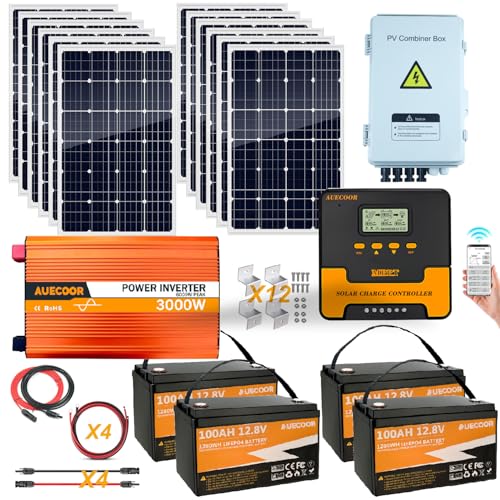
Best High-Capacity System – 3000W 24V Solar Backup Kit
This 24V system is one of the more capable off-grid solar kits for users who need substantial storage and clean AC power. It combines 1,440W of solar input, a 5.12kWh LiFePO4 battery, a 60A MPPT controller, a combiner box, and a 3,000W pure sine wave inverter.
Best For: Off-grid homes, RVs, and emergency backup applications requiring power for essential appliances, refrigerators, pumps, laptops, and other sensitive electronics.
Pros:
- 5.12kWh battery capacity paired with 1,440W of solar input.
- Pure sine wave inverter provides stable power for sensitive and motor-driven appliances.
- MPPT controller includes app control, LCD monitoring, and multiple protective functions.
- PV combiner box adds organized connections and DC surge protection.
Cons:
- Its larger, modular design may require more installation space and planning.
- The supplied information does not specify panel mounting hardware or detailed component dimensions.
With more storage, higher solar input, and pure sine wave output, this kit is better suited to demanding backup or off-grid use than basic RV starter systems. Its monitoring and protection features also support more structured installations.
Best Whole-Home Option – 5KW 48V Solar System
For buyers comparing off-grid solar kits intended to power more than a few small devices, this ECO-WORTHY package offers a higher-voltage, higher-output configuration. It includes twelve 195W monocrystalline panels for 2,340W total, a 48V 5KW off-grid inverter, and a 51.2V 100Ah Cubix LiFePO4 battery.
Best For: Off-grid cabins, homes, sheds, and larger backup systems that need to run essentials such as lights, televisions, refrigerators, and other appliances.
Pros:
- 2,340W of total solar panel capacity from twelve monocrystalline panels.
- 5KW, 48V inverter supports larger off-grid loads.
- 51.2V 100Ah LiFePO4 battery provides deep-cycle energy storage.
- Includes necessary cables and brackets for DIY-oriented setup.
Cons:
- The twelve-panel layout requires considerably more mounting area than compact kits.
- The supplied notes do not identify a separate charge-controller component, so buyers should confirm the inverter’s charging specifications.
This is the strongest fit of the three for larger installations, thanks to its 48V architecture, 5KW inverter, and 2,340W array. Confirm available mounting space and system compatibility before committing to the installation.
Best Compact RV Kit – 400W 12V Solar Kit
If you need approachable off-grid solar kits for an RV, shed, cabin, or emergency backup setup, this 400W ECO-WORTHY system combines bifacial panels, lithium storage, an MPPT controller, and a pure sine wave inverter in one package. Its stated daily output is up to 1.6 kWh under four hours of sunlight, depending on conditions.
Best For: RV owners and small off-grid spaces needing 12V battery storage and AC power for appliances rated within the inverter’s capacity.
Pros:
- Includes four 100W bifacial panels, two 12V 100Ah lithium batteries, and a 40A MPPT controller.
- Upgraded 2,000W pure sine wave inverter supports 110V AC devices within its rated limits.
- Lithium batteries offer more than 3,000 deep cycles and include built-in battery management.
- Bluetooth monitoring and optional mounting or tracking upgrades add convenience and potential energy gains.
Cons:
- The stated output depends on ideal sunlight and may be lower in poor weather or limited exposure.
- At 400W of panel capacity and 12V storage, it is better suited to moderate loads than whole-home power.
This is a well-rounded entry point among off-grid solar kits, especially when portability and a complete 12V setup matter more than maximum daily production. Confirm appliance startup requirements and installation space before buying.
Best High-Output Home System – 10kW 48V Solar Kit
For buyers comparing off-grid solar kits for a home, cabin, farm, or larger backup installation, this system is built around 2,340W of bifacial solar capacity, two 48V 100Ah lithium batteries, and a 10kW split-phase inverter. The manufacturer states up to 9.36 kWh of daily production under four hours of full sunlight.
Best For: Larger off-grid properties that need 120V/240V output for high-power appliances and may expand the inverter system over time.
Pros:
- 10kW inverter provides 120V/240V split-phase output for compatible household loads.
- Inverters can be paralleled, with support for up to six units and a stated 60kW combined output.
- 48V server-rack batteries support CAN/RS485 communication plus Bluetooth and Wi-Fi monitoring.
- Panels use N-type bifacial cells, have a stated 25% conversion efficiency, and carry IP68-rated construction.
Cons:
- Professional installation is recommended, making this a more involved and costly setup than small kits.
- Its output and battery runtime depend on sunlight, load size, and operating settings.
- The 2,340W panel array may not replenish the full storage capacity quickly during limited-sun conditions.
This is the strongest choice here for substantial 120V/240V requirements and future expansion. Because it involves high-voltage equipment and split-phase wiring, plan for professional design and installation.
Best RV Battery Capacity – 780W 12V Solar Kit
This ECO-WORTHY system is one of the more substantial off-grid solar kits for RV use, pairing four 195W bifacial panels with two 12.8V 280Ah lithium batteries. It includes a 60A MPPT controller and a 3,000W inverter charger with UPS functionality, while the supplied notes state up to 3.2 kWh of daily generation under four hours of sunlight.
Best For: RV travelers who want high battery capacity, broad appliance compatibility, and the option to charge from solar or mains power.
Pros:
- 780W of panel capacity and two 12.8V 280Ah batteries provide a large 12V storage bank.
- 3,000W inverter charger includes UPS functionality and can use mains charging as well as solar.
- Complete package includes panels, batteries, controller, Bluetooth module, and required cables.
- The manufacturer presents a four-step installation process designed to be more beginner-friendly than a fully custom build.
Cons:
- The panels are large, measuring approximately 58.86 by 26.18 inches each, so roof space must be checked carefully.
- Connecting batteries and panels in the specified configurations still requires careful electrical work.
- The stated 3.2 kWh daily generation assumes four hours of sunlight and may vary substantially by conditions.
Choose this kit when battery capacity and RV appliance support are priorities. Its mains-charging and UPS features add flexibility, but verify roof dimensions, wiring, and inverter requirements before installation.
How We Picked These Off-Grid Solar Kits
We focused on complete or near-complete systems covering common use cases, including RV travel, cabins, workshops, emergency backup, and larger residential installations. Selection criteria included usable solar generation, battery chemistry and capacity, inverter output, voltage compatibility, included components, expandability, and the clarity of the product specifications.
Because installation requirements vary, treat listed wattage and storage as starting points rather than guaranteed daily output. Shade, season, roof orientation, temperature, battery limits, and inverter losses all affect real-world performance.
Quick Comparison
| System type | Best suited to | What to prioritize |
|---|---|---|
| 200W–400W, 12V | Small RVs and basic loads | Portability, charge-controller quality, and simple setup |
| 800W–1,440W, 24V | Medium RVs, cabins, and appliances | Battery capacity, inverter surge rating, and expansion options |
| 2,340W–3,600W, 48V | Cabins, workshops, and backup circuits | Battery voltage, safety certifications, and wiring requirements |
| 5,000W or more | Large homes and high-demand loads | 120/240V compatibility, installation, and load management |
Key Buying Factors for Off-Grid Solar Kits
Power Output and Daily Energy Use
List the appliances you plan to run, their wattage, and how many hours each operates. Solar-panel wattage determines how quickly the system can replenish energy, while inverter wattage determines which devices can run simultaneously. Check the inverter’s continuous and peak ratings, especially for pumps, refrigerators, compressors, and power tools.
Battery Capacity and Chemistry
Battery capacity is commonly shown in watt-hours or kilowatt-hours. Lithium iron phosphate batteries generally offer longer cycle life, lower weight, and greater usable capacity than traditional lead-acid batteries, but they can cost more initially. Confirm the battery-management system, low-temperature protections, warranty, and whether additional batteries can be added.
Voltage, Compatibility, and Installation
12V systems are convenient for smaller loads and RVs; 24V and 48V systems are usually more efficient for higher power. A 120/240V split-phase inverter may be necessary for well pumps, electric dryers, central HVAC equipment, or a home transfer setup. Verify panel connectors, grounding requirements, disconnects, wire sizes, and local electrical-code rules before installation.
Solar Conditions and Expandability
Compare the included panel capacity with your available roof or ground space. Ensure the charge controller supports the panel voltage and current, and look for MPPT control on systems where efficiency matters. If your needs may grow, choose a kit with compatible expansion ports and a clearly documented maximum array and battery size.
Who Should Buy Which Off-Grid Solar Kits?
Choose a compact 200W or 400W kit for phones, lights, small electronics, and modest RV use. A 1,200W–1,440W system is a better fit for larger recreational vehicles, cabins, and occasional appliance use. For a workshop, remote office, or frequent backup operation, consider a 24V or 48V system with several kilowatt-hours of battery storage. High-output 5KW–10KW packages are intended for substantial home loads and should usually be evaluated with a qualified electrician.
Before ordering, confirm exactly what is included: panels, inverter, batteries, charge controller, cables, mounting hardware, and monitoring equipment may not all be bundled. Match the kit to your real load profile rather than choosing solely by maximum wattage.
