
Premium off-grid solar kits can simplify the move toward reliable backup power or full energy independence by combining panels, batteries, inverters, and essential controls in one system.
These 10 options span compact 24V setups, high-capacity 48V home systems, and large installations designed for substantial daily loads. Compare usable storage, inverter capability, panel capacity, installation requirements, and expansion potential before choosing.
Best 10 Premium Off-Grid Solar Kits Picks for 2026
Maximum Whole-Home Capacity

- 10,620W solar array
- 32.2kWh combined LiFePO4 storage
- 120V/240V split-phase output
Best For: Large homes needing substantial off-grid capacity
Balanced Starter System

- 5,000W pure sine wave inverter
- 5.12kWh LiFePO4 battery
- Six 200W panels with mounting hardware
Best For: Cabins, RVs, sheds, and smaller backup systems
Compact Whole-House Option

- 10,000W split-phase inverter
- 16.1kWh LiFePO4 storage
- 2,950W solar array
Best For: Homes wanting high output with a smaller solar footprint
High-Output Midrange Pick

- 6,500W 120V/240V inverter
- UL1973 5.12kWh LiFePO4 battery
- Approximately 8.88kWh daily output
Best For: Cabins, RVs, and homes needing moderate split-phase backup
Whole-Home Powerhouse

- 12,000W 120V/240V hybrid inverter
- 12KWh LiFePO4 battery rated for 8,000+ cycles
- WiFi monitoring and expandable system design
Best For: Whole-home backup and permanent off-grid installations
High-Capacity Home System

- 9,440W of 590W N-type bifacial panels
- 30.72kWh total LiFePO4 storage
- 10kW 120V/240V split-phase inverter
Best For: High-demand homes needing extensive battery storage
Compact Backup Choice
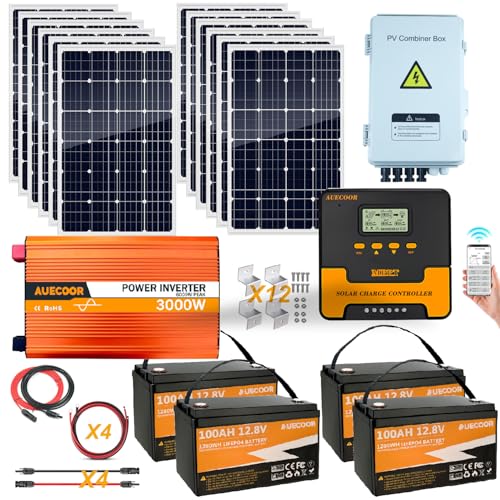
- 1,440W solar input with 5.12kWh LiFePO4 storage
- 3,000W pure sine wave inverter with 6,000W peak
- MPPT controller, combiner box, and app monitoring included
Best For: RV use, cabins, and essential-load backup power
Best Flexible Home Backup
10kW ECO-WORTHY Off-Grid Solar Kit

- 10kW 120V/240V split-phase inverter
- 2,340W bifacial N-type solar array
- Bluetooth/Wi-Fi battery monitoring
Best For: Homes, cabins, and backup power users needing flexible split-phase operation
Best High-Capacity Mid-Size System
11kW Dawnice Off-Grid Solar Kit

- Twenty 550W bifacial solar panels
- 10kW 120V/240V pure-sine inverter
- Listed 21kWh LiFePO4 storage
Best For: Remote homes and properties needing a large array with substantial battery storage
Best Maximum-Scale Setup
30kW Dawnice Off-Grid Solar System

- 34.8kW solar capacity from 60 panels
- Three 10kW MPPT inverters
- Nine listed 16kWh LiFePO4 batteries
Best For: Large homes, businesses, and demanding remote installations
Maximum Whole-Home Capacity – 10kW Split-Phase Solar Kit
For shoppers seeking premium off-grid solar kits with substantial daily generation and storage, this ECO-WORTHY system is built for demanding home power needs. It pairs an 10,620W solar array with a 10kW split-phase inverter and two LiFePO4 batteries totaling 32.2kWh of storage.
Best For: Larger homes needing high output, 120V/240V split-phase power, and extended battery storage.
Pros:
- 10,000W continuous inverter output with 120V/240V split-phase support and up to 20,000W peak output.
- 18 high-power 590W panels provide 10,620W of PV capacity and up to 39.36kWh daily generation under optimal conditions.
- Two 48V 314Ah LiFePO4 batteries provide 32.2kWh of combined storage, with monitoring through the display, Bluetooth, Wi-Fi, and PC connectivity.
- Inverter supports dual MPPT controllers, up to 200A battery charging, and parallel connection of up to six units.
Cons:
- Professional installation is recommended because of the system’s size and electrical complexity.
- Large panels and batteries ship by truck on a pallet, so the delivery location must accommodate freight delivery.
- The substantial equipment footprint and capacity may exceed the needs of smaller cabins or RVs.
This is the most expansive option in the group for whole-home off-grid power. Its high PV capacity and large battery bank offer strong energy autonomy, but buyers should plan carefully for professional installation, freight delivery, and system space.
Balanced Starter System – 5kW 48V Off-Grid Solar Kit
This SUNGOLDPOWER package offers a more approachable entry into premium off-grid solar kits, combining a 5kW hybrid inverter, six 200W panels, and a 5.12kWh LiFePO4 battery. Its included mounting brackets and extension cables make it a practical choice for smaller off-grid installations.
Best For: Cabins, RVs, sheds, and smaller homes needing 120V backup or off-grid power.
Pros:
- Complete package includes a 5,000W 48V inverter, six solar panels, battery, mounting brackets, and extension cables.
- Pure sine wave inverter includes a 100A MPPT, 40A AC charger, and up to 10,000W peak output.
- 51.2V 100Ah LiFePO4 battery offers safer, longer-life storage than traditional lead-acid batteries.
- Inverter can be connected in parallel with up to six units for future expansion.
Cons:
- The included battery capacity is smaller than the storage offered by the larger systems in this roundup.
- Wi-Fi monitoring requires a separately sold Wi-Fi module.
- The inverter output is 120V rather than 120V/240V split-phase.
With core components and mounting hardware included, this kit keeps the system straightforward while leaving room for expansion. Its 5kW output suits essential loads, but buyers with large 240V appliances or extended overnight demand should consider a larger system.
Compact Whole-House Option – 10kW Split-Phase Solar Kit
This ECO-WORTHY kit combines the high-output capability of a 10kW split-phase inverter with a smaller 2,950W solar array and one 16.1kWh battery. It is a useful middle ground for shoppers comparing premium off-grid solar kits who want strong appliance-handling capacity without the largest panel package.
Best For: Homes needing 120V/240V output and substantial battery storage with a more compact PV array.
Pros:
- 10,000W continuous output supports 120V/240V split-phase household power, with up to 20,000W peak output.
- One 48V 314Ah LiFePO4 battery provides approximately 16.1kWh of energy storage and supports scalable parallel expansion.
- Dual MPPT controllers, up to 200A charging, Wi-Fi monitoring, and multiple operating modes provide flexible energy management.
- Five 590W monocrystalline panels produce 2,950W of PV capacity and up to 11.8kWh per day under optimal conditions.
Cons:
- The 2,950W panel array may replenish the battery more slowly than the larger 10,620W configuration.
- Professional installation is recommended.
- Panels and battery ship by truck on a pallet, requiring suitable freight access.
This configuration prioritizes inverter capacity and battery storage over maximum solar generation. It can handle substantial household loads, but buyers should match expected daily consumption and recharge needs to the more modest PV array.
High-Output Midrange Pick – 6.5kW UL Solar Kit
The SUNGOLDPOWER SGM-655M is a strong midrange choice among premium off-grid solar kits, pairing a 6,500W 120V/240V inverter with six 370W panels and a wall-mounted 51.2V battery. It is sized for essential home loads, cabins, RVs, and backup applications.
Best For: Users wanting 120V/240V capability, moderate solar production, and a compact wall-mounted battery.
Pros:
- 6,500W inverter supports 120V/240V AC output and can deliver up to 39kW when as many as six units are connected in parallel.
- Six 370W UL61730 monocrystalline panels provide 2,220W of solar capacity and approximately 8.88kWh daily output under four hours of full sunlight.
- Wall-mounted 51.2V 100Ah LiFePO4 battery uses UL1973 Grade A cells rated for over 7,000 deep cycles and up to a 15-year lifespan.
- Package includes mounting brackets, 50-foot solar extension cables, and PV and battery breakers.
Cons:
- The included 5.12kWh battery is smaller than the storage in the ECO-WORTHY whole-home systems.
- Its 2,220W PV array provides less solar capacity than the larger kits.
- System expansion requires additional compatible inverter units and equipment.
This kit balances useful split-phase output with a relatively modest solar array and wall-mounted battery. It is a practical fit for essential loads and backup power, while larger households may need more storage or additional equipment.
Whole-Home Powerhouse – 12kW Split-Phase Solar Kit
For shoppers comparing premium off-grid solar kits, this 12kW system stands out as a whole-home solution with split-phase output, substantial battery storage, and a complete solar array. It combines 26 rigid 120W panels, a 12,000W hybrid inverter, and a 51.2V 230Ah LiFePO4 battery in one package.
Best For: Whole-home backup, off-grid cabins, and users who want expandable 48V storage with 120V/240V power.
Pros:
- 12,000W pure sine wave split-phase inverter supports 120V/240V output.
- LiFePO4 battery is rated for 8,000+ cycles and includes extensive BMS protection.
- Dual 200A MPPT controllers, touchscreen monitoring, WiFi, and multiple charging modes add flexibility.
- Battery can be rolled on casters or wall-mounted, and the system supports expansion.
Cons:
- At approximately 910 pounds, this is not a simple portable setup.
- Professional electrical installation is required.
- The included 120W panels provide a lower total array capacity than some similarly sized systems.
This is a strong choice when high inverter output and a flexible, long-life battery are more important than easy transport. Its large footprint and installation demands make it better suited to a permanent home, garage, or cabin installation.
High-Capacity Home System – 10kW N-Type Solar Kit
This ECO-WORTHY package is one of the more storage-focused premium off-grid solar kits, pairing 9,440W of N-type bifacial panels with six 48V 100Ah LiFePO4 batteries. The 10kW split-phase inverter and server-rack battery layout make it well suited to substantial household energy needs.
Best For: Homes needing extensive battery storage, organized rack-mounted equipment, and 120V/240V split-phase capability.
Pros:
- Six batteries provide a stated 30.72kWh of total energy storage.
- Sixteen 590W N-type bifacial panels offer 9,440W of PV capacity and up to 23.23% efficiency.
- 10,000W continuous inverter output supports 120V or 120V/240V split-phase operation.
- Server-rack batteries include metal casings, 100A BMS protection, circuit breakers, and CAN/RS485 communication.
Cons:
- Large panels ship by pallet and may require truck delivery coordination.
- Installation should be handled by a professional electrician.
- The complete system requires dedicated space for the rack and substantial equipment.
Choose this kit if battery autonomy and high solar collection are priorities. Its rack-based architecture is tidy and expandable in concept, but the shipping, space, and installation requirements make it better for a planned home energy project than a quick backup setup.
Compact Backup Choice – 3kW 24V Solar Kit
For buyers who need a more manageable entry into premium off-grid solar kits, this 24V system balances 1,440W of solar input with a 5.12kWh LiFePO4 battery. Its 3,000W pure sine wave inverter, MPPT controller, and combiner box are aimed at essential loads, RV use, and backup power rather than whole-home demand.
Best For: RVs, cabins, essential household circuits, and users seeking clean power for appliances and electronics.
Pros:
- 3,000W pure sine wave inverter provides 6,000W peak output for compatible startup loads.
- 1,440W solar array and 5.12kWh battery offer a balanced small-system configuration.
- 60A MPPT controller includes app control, LCD monitoring, and multiple protective functions.
- Included PV combiner box adds DC surge protection and organizes panel connections.
Cons:
- Lower output and storage capacity limit it to essential loads and moderate appliance use.
- The 24V architecture is less suited to very large household systems than 48V alternatives.
- Actual daily generation depends on sunlight and may vary from the stated estimate.
This kit is the practical pick for smaller off-grid applications where clean AC power and straightforward monitoring matter. It can run many common appliances, but shoppers planning whole-home operation should consider a higher-capacity system.
Best Flexible Home Backup – 10kW ECO-WORTHY Off-Grid Solar Kit
For shoppers comparing premium off-grid solar kits, this ECO-WORTHY system combines 2,340W of bifacial solar capacity, a 10kW 120V/240V inverter, and two 48V 100Ah lithium batteries. It is designed for homes, cabins, sheds, farms, and backup applications, with flexible charging modes and expandable inverter support.
Best For: Homeowners who need split-phase power, battery monitoring, and flexibility for larger appliances.
Pros:
- Provides 120V/240V split-phase output and up to 10kW of continuous inverter power.
- Includes UL 1741 inverter certification and UL 1973/UL 9540A battery testing claims.
- Offers app-based battery monitoring through Bluetooth and Wi-Fi, plus multiple charging modes.
- N-type bifacial panels feature a stated 25% conversion efficiency and IP68 protection.
Cons:
- The 2,340W panel array is smaller than the arrays in the other kits here.
- Professional installation is recommended, which adds planning and installation costs.
- Daily output depends on the stated four hours of full sunshine.
This is a well-equipped option when inverter capability, monitoring, and flexible operation matter more than maximum panel and storage capacity. Its split-phase output suits many household loads, but professional installation should be part of the purchase plan.
Best High-Capacity Mid-Size System – 11kW Dawnice Off-Grid Solar Kit
This Dawnice kit is one of the premium off-grid solar kits aimed at substantial household or property energy needs. It pairs twenty 550W bifacial panels with a 10kW pure-sine inverter and a listed 21kWh LiFePO4 battery configuration, targeting homes, cabins, farms, and backup use.
Best For: Buyers seeking a large solar array and substantial lithium storage for household backup or remote properties.
Pros:
- Includes 20 bifacial 550W panels for a listed 11,000W system capacity.
- Provides a 10kW 120V/240V pure-sine-wave inverter with built-in MPPT charging.
- Lists 21kWh LiFePO4 battery storage with Grade A cells, 6,000+ cycles, and a stated 15-year lifetime.
- Includes 100m each of black and red solar cable.
Cons:
- The full kit has a substantial physical footprint and installation requirement.
- Advertised daily generation depends on four hours of full sunshine.
- Specifications describe the battery as “21KWh LiFePO4 Batteries*2,” so buyers should confirm the exact configuration before ordering.
With its large panel count and sizeable LiFePO4 storage, this system is positioned for higher-demand off-grid applications. Confirm the battery configuration, site layout, and installation requirements before committing to this larger system.
Best Maximum-Scale Setup – 30kW Dawnice Off-Grid Solar System
For very high energy requirements, this 30kW Dawnice package stands out among premium off-grid solar kits. The configuration lists 34.8kW of solar panels, three 10kW inverters, and nine 16kWh lithium batteries, making it better suited to substantial homes, businesses, or demanding remote installations than small backup projects.
Best For: Large properties and commercial-style off-grid installations requiring extensive generation, inverter capacity, and battery storage.
Pros:
- Lists 34.8kW of solar capacity from 60 panels, supporting large-scale energy production.
- Includes three 10kW 48V pure-sine inverters with built-in MPPT controllers.
- Lists nine 16kWh 51.2V LiFePO4 batteries for extensive energy storage.
- Includes a stated 10-year limited warranty and lifetime technical support.
Cons:
- The system is far larger and more complex than typical residential backup kits.
- Its size requires significant space, electrical planning, and professional installation.
- The supplied notes do not specify a single total battery capacity or detailed panel-generation estimate beyond the component configuration.
This is the choice for buyers planning a serious, high-demand off-grid installation rather than a compact residential system. Its scale can provide substantial generation and storage, but site design, compatibility checks, and qualified installation are essential.
How We Picked These Premium Off-Grid Solar Kits
We focused on complete systems that combine the major components needed for off-grid operation: solar panels, a battery bank, an inverter or inverter-charger, and charge-control functionality. The shortlist covers different system sizes, from compact 3kW configurations to large 30kW packages, so buyers can match equipment to actual energy demand rather than choosing by panel wattage alone.
We also considered battery chemistry, nominal storage capacity, split-phase support, inverter output, panel configuration, stated certifications, monitoring features, and likely installation complexity. Product listings can vary by configuration, so verify the exact included components, wiring, disconnects, racking, and warranty terms before purchase.
Quick Comparison
| System range | Best suited to | What to prioritize |
|---|---|---|
| 3kW to 5kW | Cabins, small homes, essential loads | Battery capacity, surge rating, 24V or 48V design |
| 6kW to 12kW | Full-time homes and larger backup loads | Split-phase output, usable battery storage, MPPT capacity |
| 16kW to 30kW | Large homes, workshops, farms, and high demand | Service sizing, multiple inverters, installation and permitting |
Key Buying Factors for Premium Off-Grid Solar Kits
Size the System Around Your Loads
List daily energy use in kilowatt-hours and identify high-demand appliances such as well pumps, air conditioners, electric ranges, heaters, and workshop tools. Inverter continuous output handles running loads, while surge capacity handles motor starts. A large panel array cannot compensate for an undersized inverter or battery.
Compare Usable Battery Storage
LiFePO4 batteries are common in premium systems because they offer long cycle life, stable operation, and useful depth of discharge. Compare usable capacity—not only the advertised nominal kWh—and check whether the battery management system supports the inverter. Cold-weather charging limits and battery heating may matter in unconditioned spaces.
Check Voltage, Phases, and Solar Input
For a typical home, 48V systems generally reduce current and cable requirements compared with 24V designs. Confirm whether the inverter provides 120V only or 120/240V split-phase output. Also compare MPPT voltage ranges, maximum PV input, string limits, and whether the included panels can fully use the controller.
Plan Installation and Expansion
These systems may require professional electrical work, permits, grounding, disconnects, battery ventilation or clearances, and structural roof or ground-mount equipment. Confirm what is actually included and leave room for future batteries or panels if your energy needs may grow.
Who Should Buy Which Premium Off-Grid Solar Kits?
Choose a smaller 3kW to 5kW kit for essential circuits, a cabin, RV-adjacent property, or modest daily consumption. A 6kW to 12kW 48V system is a better fit for many full-time homes needing refrigeration, pumps, electronics, and selected large appliances. Large 11kW to 30kW packages are best for substantial properties, workshops, farms, or whole-home loads, but they demand careful load calculations and more involved installation.
Before ordering, confirm local code compliance, utility-interconnection rules if applicable, battery and inverter compatibility, delivery contents, warranty support, and the availability of replacement components.
