
Lightweight off-grid solar kits make it easier to build dependable power for an RV, cabin, workshop, or emergency backup setup without sourcing every component separately. The options in this roundup range from compact 12V starter systems to higher-capacity 24V and 48V packages.
Before choosing, match the kit’s battery storage, inverter output, solar array, and charge-controller type to the devices you need to run. A larger wattage rating does not automatically mean a better fit if the system is difficult to install, transport, or expand.
Best 10 Lightweight Off-Grid Solar Kits Picks for 2026
Best Complete Kit

- All-in-one 12V system with battery and inverter
- 240W monocrystalline panels with MPPT controller
- Includes cables and Z-brackets for installation
Best For: RVs, cabins, sheds, boats, and emergency backup
Best Expandable 12V Kit

- Four 100W monocrystalline solar panels
- 40A MPPT Rover controller included
- Bluetooth monitoring and adjustment support
Best For: 12V systems with an existing battery and inverter
Best High-Capacity System
ECO-WORTHY 48V 1600W Solar Kit

- Eight 195W bifacial panels and 48V battery
- 3500W inverter with 7000W peak output
- WiFi, Bluetooth, and touchscreen monitoring
Best For: Cabins, sheds, and larger home off-grid systems
Best Lightweight Starter

- Compact 14.1-pound starter setup
- 100W monocrystalline panel and 30A controller
- Expandable up to 400W with compatible batteries
Best For: Beginners, RVs, campers, and basic 12V charging
High-Capacity Choice

- 2,340W of solar panels
- 5KW 48V inverter included
- 100Ah LiFePO4 battery
Best For: Cabins, homes, RVs, and backup power
Compact Starter Pick

- 100W mono solar panel
- 12V 20Ah LiFePO4 battery
- 10A controller with display
Best For: Small RV, marine, and 12V projects
Balanced RV Setup

- Four 100W bifacial panels
- Two 100Ah lithium batteries
- 2,000W pure sine inverter
Best For: RV, cabin, shed, and backup power
High-Capacity Off-Grid Backup
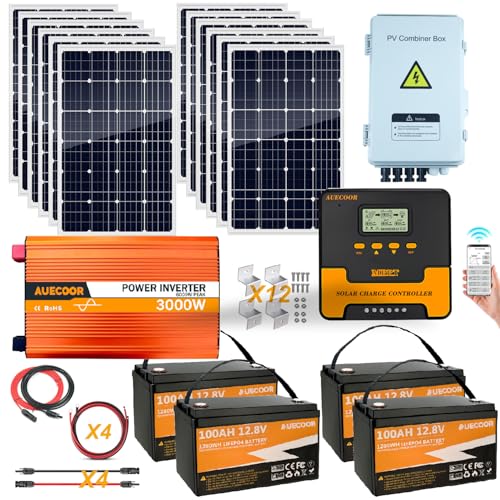
- 1,440W solar input with a 5.12kWh LiFePO4 battery
- 3,000W pure sine wave inverter with 6,000W peak
- MPPT controller, combiner box, app control, and LCD monitoring
Best For: Off-grid homes, RVs, and serious emergency backup
Simple RV Solar Starter

- Two 100W monocrystalline panels for 12V or 24V wiring
- Includes 30A PWM controller, brackets, cables, and connectors
- Outdoor-rated aluminum frames and IP65 junction box
Best For: Basic RV, camper, cabin, shed, and battery-charging needs
Compact Emergency Solar Kit
100W Panel and Inverter Package

- Includes 100W panel, inverter, controller, adapter, and battery clips
- Supports 12V/24V systems and lead-acid or lithium batteries
- Waterproof panel with multiple controller protection features
Best For: Camping, car-battery charging, and limited emergency power
Best Complete Kit – 1280Wh 240W LiFePO4 Solar Kit
For shoppers comparing lightweight off-grid solar kits, this package stands out as a ready-to-install option with a 100Ah LiFePO4 battery, 240W of solar input, and a 1000W pure sine wave inverter. It is designed for RVs, cabins, sheds, boats, and emergency backup use without requiring separate purchases for the core components.
Best For: Buyers who want an all-in-one 12V system for light-to-moderate AC and DC power needs.
Pros:
- Includes panels, battery, inverter, MPPT controller, cables, and mounting brackets.
- LiFePO4 battery includes built-in BMS protection.
- Pure sine wave inverter can power sensitive electronics such as laptops and CPAP machines.
- MPPT controller is designed to improve energy harvest over PWM technology.
Cons:
- The 240W array is smaller than systems intended for heavier daily loads.
- Rigid panels and included hardware may require dedicated mounting space.
This is a practical choice when convenience and included components matter most. Its 12V design suits mobile and small off-grid installations, while the LiFePO4 battery and pure sine inverter add useful capability for everyday electronics.
Best Expandable 12V Kit – Renogy 400W MPPT Solar Kit
Among lightweight off-grid solar kits, this Renogy package offers a higher-capacity 400W panel array while keeping the system centered on a 12V setup. It includes a 40A MPPT Rover controller, Bluetooth module, mounting brackets, cables, and an adaptor kit for a more connected installation.
Best For: RV and other 12V users who want a larger solar array with phone-based monitoring and room to expand.
Pros:
- Four 100W monocrystalline panels provide a 400W solar array.
- 40A MPPT controller supports efficient charging.
- Bluetooth module enables monitoring and adjustment from a phone.
- Includes Z-brackets, cables, and an adaptor kit.
Cons:
- The kit does not list a battery or inverter, so those components must be supplied separately.
- At 56.4 pounds, it is less portable than smaller starter kits.
This kit makes sense for buyers building around an existing 12V battery and inverter. Its larger panel capacity and MPPT controller offer a stronger foundation than a basic starter setup, but the missing storage and AC-conversion components should be included in the total budget.
Best High-Capacity System – ECO-WORTHY 48V 1600W Solar Kit
This ECO-WORTHY package is a substantially larger choice than most lightweight off-grid solar kits, combining eight bifacial panels, a 48V 100Ah LiFePO4 server-rack battery, and a 3500W inverter. It is built for cabins, sheds, and home-oriented off-grid applications where higher AC loads and remote monitoring are priorities.
Best For: Larger off-grid installations needing substantial storage, 110/120V AC output, and smart system monitoring.
Pros:
- Includes eight 195W N-type bifacial panels and a 48V 100Ah LiFePO4 battery.
- 3500W inverter provides 7000W peak output for startup surges.
- Built-in 80A MPPT controller and 20ms UPS switching support.
- Touchscreen, Bluetooth, and WiFi enable local and remote monitoring.
Cons:
- The panels and server-rack battery make this a heavier, less portable setup.
- The package arrives in multiple packages, so buyers should verify that all components are received.
- Its larger installation requires considerably more space than a small 12V kit.
This system is aimed at serious home, cabin, or shed installations rather than quick mobile use. The 48V architecture, large battery, and high inverter rating provide considerably more capacity, but the physical scale and installation requirements should be planned carefully.
Best Lightweight Starter – Renogy 100W 12V Solar Kit
For buyers prioritizing portability, this Renogy starter kit is one of the more approachable lightweight off-grid solar kits. It pairs a 100W monocrystalline panel with a 30A PWM controller, cables, and Z-brackets, making it suitable for basic 12V charging in an RV, camper, or small off-grid setup.
Best For: Beginners and mobile users needing a compact 12V solar charging system.
Pros:
- Lightweight 14.1-pound design is easier to handle and install.
- 100W panel is rated at 22.5% cell efficiency.
- 30A controller supports expansion up to 400W and multiple battery types.
- Panel includes weather-focused certifications and a long power-output service plan.
Cons:
- The 100W array is intended for modest energy needs rather than large appliances.
- Bluetooth monitoring requires adding a separate BT-1 module.
- The PWM controller is less energy-efficient than an MPPT design.
This is a sensible entry point for small 12V systems where low weight and simple installation matter more than maximum output. Its expansion capability leaves room to grow, although users seeking efficient harvesting or substantial AC power will need a more advanced system.
High-Capacity Choice – 5KW Off-Grid Solar System
For buyers comparing lightweight off-grid solar kits, this ECO-WORTHY system is a complete, high-capacity setup rather than a small portable package. It combines twelve 195W monocrystalline panels, a 5KW 48V inverter, and a 51.2V 100Ah LiFePO4 battery, with cables and mounting hardware included.
Best For: Off-grid cabins, homes, RVs, sheds, and backup power users who need substantial storage and up to 5,000W of inverter capacity.
Pros:
- Includes 2,340W of panel capacity, a 5KW inverter, and a 100Ah LiFePO4 battery.
- LiFePO4 storage is designed for deep-cycle use and long service life.
- Includes necessary cables and brackets for a DIY-oriented installation.
Cons:
- The 12-panel configuration is a substantial installation, not a compact portable kit.
- Its 48V architecture may require more planning than a simple 12V system.
This is the strongest fit for shoppers prioritizing capacity and whole-system integration over portability. Confirm available mounting space, wiring requirements, and installation needs before buying.
Compact Starter Pick – 100W 12V Solar Power Kit
This 100W kit is a practical entry point for lightweight off-grid solar kits, pairing a rigid monocrystalline panel with a 12V 20Ah LiFePO4 battery and 10A PWM controller. It also includes MC4 cables, battery cables, and mounting brackets for smaller RV, trailer, camper, marine, and project installations.
Best For: Small 12V off-grid projects and users who want a compact kit with built-in battery protection and a simple digital monitoring display.
Pros:
- Includes the panel, LiFePO4 battery, controller, cables, and mounting brackets.
- The controller automatically recognizes 12V and 24V systems.
- Controller protections cover overcharge, over-discharge, overload, and short circuit conditions.
- Battery is rated for at least 2,000 cycles at 80% depth of discharge.
Cons:
- At 100W with a 20Ah battery, it is intended for smaller loads rather than whole-home power.
- The included PWM controller is less advanced than an MPPT design.
Choose this kit when low complexity and a smaller footprint matter more than maximum output. Its 12V format and included accessories make it approachable for basic mobile or project-based applications.
Balanced RV Setup – 400W 12V Solar Panel Kit
For shoppers seeking lightweight off-grid solar kits with more reserve than a basic starter package, this 400W ECO-WORTHY system adds two 12V 100Ah lithium batteries, a 40A MPPT controller, and a 2,000W pure sine wave inverter. Four bifacial panels and a Bluetooth module round out the package for RV, shed, cabin, and backup use.
Best For: RV and cabin users needing a 12V system for selected AC appliances and up to 2,000W of rated inverter output.
Pros:
- Includes four 100W bifacial panels and two 100Ah lithium batteries.
- 40A MPPT controller provides up to 99% tracking efficiency according to the supplied specifications.
- Pure sine wave inverter is rated at 2,000W and includes Bluetooth monitoring.
- Battery system includes built-in BMS and is rated for more than 3,000 deep cycles.
Cons:
- The complete setup has more components to install and configure than a small starter kit.
- Its stated daily output depends on ideal sunlight and site conditions.
This kit offers a useful middle ground: more battery and inverter capacity than compact 100W systems without moving to a large 48V installation. Review appliance startup demands and available panel-mounting space before committing.
High-Capacity Off-Grid Backup – 3000W 24V Solar Power System
For shoppers comparing lightweight off-grid solar kits, this complete 24V system is a substantial home, RV, or emergency-backup option. It combines 1,440W of solar input, a 5.12kWh LiFePO4 battery, a 3,000W pure sine wave inverter, an MPPT controller, and a PV combiner box for a more integrated installation.
Best For: Off-grid homes, RVs, and backup users who need to run essential loads and appliances such as refrigerators, pumps, laptops, or TVs.
Pros:
- Large 5.12kWh LiFePO4 battery and 1,440W solar array support meaningful daily energy production.
- 3,000W pure sine wave inverter provides clean AC power for sensitive electronics and motor-driven appliances.
- MPPT controller offers over 99% tracking efficiency, protective features, app control, and an LCD display.
- Included combiner box adds organized connections and DC surge protection.
Cons:
- The complete system includes many components, so installation is more involved than with a small plug-and-play kit.
- Its larger capacity and modular design are less convenient for highly portable use.
- Stated daily production depends on receiving good sunlight.
This is the most capable option in the group for sustained off-grid power. It is better suited to a planned installation or serious RV setup than to buyers seeking the lightest, simplest camping kit.
Simple RV Solar Starter – ECO-WORTHY 200W Panel Kit
This ECO-WORTHY kit is a practical entry point for lightweight off-grid solar kits when you need basic 12V or 24V charging rather than a full household power system. It includes two 100W monocrystalline panels, mounting brackets, cables, connectors, and a 30A PWM controller.
Best For: RVs, campers, caravans, boats, sheds, cabins, and other modest 12V or 24V off-grid charging applications.
Pros:
- Two 100W panels can be wired in series for 24V or parallel for 12V use.
- Pre-drilled panels, mounting hardware, cables, and connectors simplify installation.
- Monocrystalline panels are rated at up to 21.5% efficiency under suitable conditions.
- Aluminum frames and an IP65-rated junction box support outdoor use.
Cons:
- The 200W array and PWM controller are intended for smaller loads, not high-demand appliances.
- The listed daily output of 800Wh assumes four hours of full sunshine.
- At 31.6 pounds, it is portable for a fixed setup but not especially lightweight to carry frequently.
Choose this kit for straightforward battery charging and basic off-grid equipment. Its included hardware makes it easier to deploy than a bare panel, but you will still need a suitable battery and should match expectations to its modest output.
Compact Emergency Solar Kit – 100W Panel and Inverter Package
This compact package is one of the more approachable lightweight off-grid solar kits for occasional outdoor use or emergency charging. It pairs a 100W 12V solar panel with an inverter, charge controller, cigarette-lighter adapter, and battery clips for a flexible small-scale setup.
Best For: Camping, car-battery charging, small outdoor electronics, and limited emergency power needs.
Pros:
- Compact kit includes the panel, inverter, controller, adapter, and battery clips.
- Waterproof panel design is intended to withstand outdoor conditions.
- Controller supports automatic 12V/24V recognition and protection against overcharging, short circuits, and overheating.
- Compatible with lead-acid and lithium batteries.
Cons:
- The 100W panel is a relatively small solar source for sustained off-grid power.
- The supplied notes describe usable connected-device output as limited to 300W/500W, despite the inverter’s higher surge figures.
- It is not positioned as a replacement for a larger home-backup system.
This kit makes sense when portability and basic versatility matter more than high energy production. For larger appliances or extended backup, the small panel and stated device-output limits make a higher-capacity system a better fit.
How We Picked These Lightweight Off-Grid Solar Kits
We selected kits across several common use cases, including RV travel, remote cabins, small backup systems, and larger household power setups. Our comparisons focus on the relationship between panel wattage, battery capacity, system voltage, inverter output, charge-controller technology, and included components.
We also considered whether each package appears suited to beginners or requires more involved electrical planning. Product listings can vary by seller and configuration, so verify the exact battery chemistry, panel count, inverter specifications, certifications, wiring, mounting hardware, and warranty before ordering.
Quick Comparison
| Best suited to | Typical system size | What to prioritize |
|---|---|---|
| Small electronics and basic RV use | 100–200W solar, 12V battery | Simple setup, portability, USB and DC compatibility |
| Moderate RV or cabin loads | 400–1,440W solar | LiFePO4 storage, MPPT charging, usable inverter output |
| Home backup or larger off-grid loads | 1,600W or more, 24V/48V | Scalable batteries, high-voltage architecture, installation support |
Key Buying Factors for Lightweight Off-Grid Solar Kits
Battery Capacity and Chemistry
Battery capacity, measured in watt-hours or kilowatt-hours, determines how long appliances can run after sunset. LiFePO4 batteries generally offer longer cycle life, strong usable capacity, and lower maintenance than traditional lead-acid batteries, but they can increase the upfront cost. Calculate your daily watt-hour demand and include reserve capacity for cloudy weather.
Solar Output and Charge Control
Panel wattage affects how quickly the battery can recharge. MPPT controllers usually extract energy more effectively than PWM controllers, especially in colder conditions or when panel and battery voltages differ. Confirm the controller’s maximum solar input and ensure the array stays within its voltage and current limits.
Inverter Capacity and System Voltage
Choose an inverter based on both continuous wattage and startup surge. Motors, refrigerators, pumps, and power tools may need substantially more power during startup. Pure sine wave output is the safer choice for sensitive electronics. Larger systems often use 24V or 48V batteries to reduce current and wiring losses, while 12V kits remain convenient for smaller loads.
Portability, Expansion, and Installation
“Lightweight” can describe the panels or the overall kit, but batteries and inverters may still be heavy. Check dimensions, component weights, cable lengths, connectors, and mounting requirements. If you may add panels or batteries later, confirm that the controller, inverter, and battery-management system support expansion.
Who Should Buy Which Lightweight Off-Grid Solar Kits?
Choose a 100W to 200W 12V kit for lights, phones, small electronics, and occasional RV use. A 400W to 1,440W system is a better middle ground for refrigerators, communications equipment, laptops, and longer off-grid stays. Select a 24V or 48V package when you need higher inverter output, more storage, or a permanent installation for a cabin or home backup application.
For any system connected to household circuits, high-current batteries, or fixed wiring, use appropriate fusing, disconnects, grounding, ventilation, and professional installation where required. Treat advertised peak power as a short-duration limit and size the system around continuous loads and realistic solar conditions.
