
Reliable off-grid power depends on more than panel wattage. The right solar kit must balance usable battery capacity, inverter output, charging speed, system voltage, and the demands of your appliances.
We selected 10 complete systems spanning compact RV setups, mid-size backup solutions, and high-capacity home installations. Use the guide below to compare configurations and identify the best fit for your loads, location, and installation plans.
Best 10 Durable Off-Grid Solar Kits Picks for 2026
Maximum-Capacity Pick
ECO-WORTHY 10kW Whole-House Solar Kit

- 10kW split-phase inverter output
- 16.1kWh LiFePO4 storage
- Expandable battery architecture
Best For: Whole-house off-grid power and future storage expansion
Balanced Home Kit
ECO-WORTHY 5kW 2340W Off-Grid System

- 2,340W panel array
- 5kW 48V inverter
- 100Ah LiFePO4 battery
Best For: Cabins, RVs, sheds, and essential backup power
Long-Life Battery Pick
SUNGOLDPOWER 6500W Off-Grid Kit

- 6,500W 120/240V inverter
- UL1741 and UL1973 components
- Battery rated for 7,000+ cycles
Best For: Split-phase backup and longevity-focused installations
RV Adventure Pick
ECO-WORTHY 780W 7.168kWh RV Solar Kit

- 7.168kWh stated storage
- 780W bifacial solar array
- 3,000W UPS inverter charger
Best For: RV travel and 12V off-grid living
High-Capacity Homestead Power

- 20 bifacial 550W IP68 panels
- 10kW 120V/240V pure sine inverter
- LiFePO4 storage with 6,000+ cycles
Best For: Large homes, farms, cabins, and substantial backup loads
Scalable Home Energy Reserve

- 10,620W solar array with 10kW output
- 32.2kWh combined LiFePO4 storage
- Wi-Fi, Bluetooth, and expansion support
Best For: Large homes needing split-phase power and scalable storage
Compact Protected Backup Power
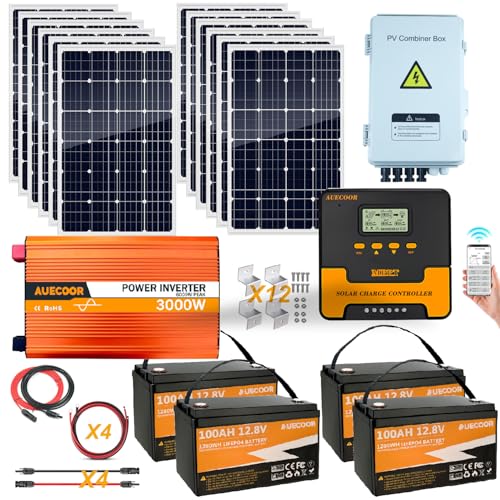
- 1,440W solar input and 5.12kWh battery
- 3,000W pure sine output, 6,000W peak
- MPPT, BMS, and DC surge protection
Best For: RVs, cabins, essential loads, and emergency backup
High-Capacity Home Backup

- 10kW 120V/240V split-phase inverter
- Two 48V 100Ah lithium batteries
- Bifacial IP68 panels with app monitoring
Best For: Homes, cabins, farms, and expandable backup power
Maximum Storage Package
9.44kW Solar and 30.72kWh Battery Kit

- 9.44kW array with sixteen 590W panels
- 30.72kWh from six LiFePO4 batteries
- 10kW split-phase inverter with dual MPPT
Best For: Large homes and high-demand off-grid installations
Compact Cabin Power
3.5kW 48V Solar Starter System

- 3.5kW inverter with 7,000W peak output
- Eight 195W bifacial panels
- Cold-weather battery charging and app monitoring
Best For: Cabins, sheds, and modest 110V/120V loads
Maximum-Capacity Pick – ECO-WORTHY 10kW Whole-House Solar Kit
For shoppers comparing durable off-grid solar kits for substantial home power needs, this ECO-WORTHY system stands out with a 10kW split-phase inverter, 16.1kWh LiFePO4 battery, and 2,950W of solar generation capacity. Its integrated monitoring and scalable battery design add flexibility, though professional installation is recommended.
Best For: Whole-house off-grid power and buyers who want high output with expandable storage.
Pros:
- 10,000W continuous output with 120V/240V split-phase support.
- 16.1kWh 48V LiFePO4 battery includes display, Bluetooth, Wi-Fi, and communication ports.
- Battery system can support up to 15 units in parallel, according to the supplied specifications.
- Dual MPPT controllers and up to 200A battery charging support.
Cons:
- Professional installation is recommended; setup may be unsuitable for novices.
- Large panels and battery ship by pallet and require truck-accessible delivery.
- The 2,950W PV array may not match the inverter’s full 10kW output capacity.
This is the strongest choice here for high-demand residential use, especially if future storage expansion matters. Confirm installation, delivery access, and local electrical requirements before ordering.
Balanced Home Kit – ECO-WORTHY 5kW 2340W Off-Grid System
This ECO-WORTHY package is a practical middle-ground among durable off-grid solar kits, pairing twelve 195W monocrystalline panels with a 5kW 48V inverter and 100Ah LiFePO4 battery. It includes mounting hardware and cables for a more complete installation package.
Best For: Cabins, sheds, RVs, and essential home backup where a 5kW inverter is sufficient.
Pros:
- Complete 2,340W solar array with twelve monocrystalline panels.
- 5,000W 48V inverter can support lights, appliances, televisions, and refrigerators.
- 51.2V 100Ah Cubix LiFePO4 battery provides deep-cycle energy storage.
- Includes necessary cables and brackets for the listed installation.
Cons:
- The 100Ah battery offers less storage than the larger systems in this roundup.
- Its 2,340W panel array may limit sustained high-load operation.
- Installation still requires careful wiring and mounting despite the DIY-oriented design.
With a useful 5kW inverter and straightforward component list, this kit offers a sensible balance for moderate off-grid loads. It is best matched with realistic energy planning rather than whole-house, high-demand use.
Long-Life Battery Pick – SUNGOLDPOWER 6500W Off-Grid Kit
For buyers seeking durable off-grid solar kits with a strong inverter and long-life storage, the SUNGOLDPOWER package combines a 6,500W 120/240V inverter, six 370W panels, and a 51.2V 100Ah LiFePO4 battery. The inverter is ETL-listed to UL1741, while the battery is specified for more than 7,000 deep cycles.
Best For: Homes, cabins, RVs, and backup systems needing split-phase output and dependable battery longevity.
Pros:
- 6,500W inverter supports 120/240V AC output.
- UL1741-listed inverter and UL1973 battery provide documented product certifications.
- Battery uses automotive-grade cells rated for over 7,000 deep cycles.
- System can be expanded by paralleling up to six inverters, according to the supplied notes.
Cons:
- The included 100Ah battery provides less storage than the 16.1kWh system in this roundup.
- Six 370W panels provide a smaller array than the 10kW system’s 2,950W PV capacity.
- Expansion and installation may require additional planning and equipment.
This kit is compelling when battery lifespan, certification, and split-phase capability matter more than maximum stored energy. Its approximately 8.88kWh daily generation estimate assumes four hours of full sunlight.
RV Adventure Pick – ECO-WORTHY 780W 7.168kWh RV Solar Kit
This ECO-WORTHY package is tailored to mobile use, making it one of the more accessible durable off-grid solar kits for RV travelers. It includes four bifacial 195W panels, two 12.8V 280Ah lithium batteries, a 60A MPPT controller, and a 12V 3000W inverter charger with UPS functionality.
Best For: RV owners who want substantial 12V storage, solar charging, and backup charging from shore or mains power.
Pros:
- 7.168kWh stated battery storage from two 12.8V 280Ah lithium batteries.
- Four bifacial panels provide 780W of rated solar capacity.
- 3,000W inverter charger includes UPS functionality and mains charging.
- Includes a 60A MPPT controller, Bluetooth module, and required cables.
Cons:
- The 12V architecture is less suited to large whole-house installations.
- Panel output and estimated 3.2kWh daily generation depend on available sunlight and installation conditions.
- Parallel battery and 2S2P panel connections require careful adherence to the stated wiring sequence.
For RV use, the combination of sizable storage, UPS transfer, and mains charging is practical for travel and campsite flexibility. Verify available mounting space, battery placement, and the power demands of high-wattage appliances before installation.
High-Capacity Homestead Power – 11kW Off-Grid Solar Kit
For buyers comparing durable off-grid solar kits for a home, cabin, farm, or shed, this system emphasizes substantial generation and storage. It pairs 20 bifacial 550W panels with a 10kW 120V/240V pure sine wave inverter and two LiFePO4 battery units listed at 21kWh each.
Best For: Large off-grid properties and backup applications requiring high output for appliances such as refrigerators, air conditioners, microwaves, and coffee makers.
Pros:
- 20 bifacial 550W panels provide an 11,000W-rated solar array and are IP68 waterproof.
- 10kW inverter supports 120V/240V AC output and includes MPPT charging.
- LiFePO4 storage is specified with 6,000+ cycles and an approximately 15-year lifetime.
- Includes panels, inverter, batteries, and 100m each of red and black solar cable.
Cons:
- The large panel array and battery package require considerable installation space and planning.
- The listed generation estimate depends on receiving about four hours of full sunshine.
- Its high-capacity design may be more system than a small cabin or occasional-use setup needs.
This is the strongest fit of the three for demanding household-scale loads. Its durable-oriented panel construction and long-cycle LiFePO4 storage are appealing, but buyers should plan carefully for installation, wiring, and the physical footprint of a system this large.
Scalable Home Energy Reserve – ECO-WORTHY 10kW Solar Kit
This ECO-WORTHY system is one of the more durable off-grid solar kits for buyers prioritizing substantial storage and expandable operation. It combines 18 590W panels, a 10kW split-phase inverter, and two 48V 314Ah LiFePO4 batteries with monitoring and communication features.
Best For: Homeowners seeking high-capacity 120V/240V support, sizeable battery storage, and room to expand the battery bank or inverter setup.
Pros:
- Provides 10,620W of listed PV capacity and 10kW continuous inverter output with 120V/240V split-phase support.
- Two batteries provide a combined listed storage capacity of 32.2kWh.
- Battery monitoring includes a 7-inch display, Bluetooth, Wi-Fi, and PC connectivity.
- Supports parallel battery expansion and up to six parallel inverters according to the supplied specifications.
Cons:
- Professional installation is recommended; the manufacturer does not recommend novice installation.
- The palletized shipment requires an address capable of accepting truck delivery.
- The system’s size and weight make transport, placement, and installation more involved.
Choose this kit when storage capacity and future expansion matter as much as basic generation. Its integrated battery controls and split-phase output add flexibility, though the professional-installation recommendation and freight requirements make it a serious home-energy project.
Compact Protected Backup Power – 3kW 24V Solar Kit
For smaller off-grid needs, this 24V system offers a more manageable alternative among durable off-grid solar kits. It combines 1,440W of solar input, a 5.12kWh LiFePO4 battery, a 3,000W pure sine wave inverter, and protection hardware for home essentials, RV use, and emergency backup.
Best For: RV owners, cabins, and households needing dependable power for essential appliances rather than whole-home high-demand loads.
Pros:
- 3,000W pure sine wave output with a 6,000W peak is designed for electronics and motor-driven appliances.
- LiFePO4 battery includes a BMS and is specified for more than ten years under optimal conditions.
- 60A MPPT controller offers over 99% tracking efficiency, monitoring, and multiple protection functions.
- Included PV combiner box adds organized connections and DC surge protection.
Cons:
- Its 1,440W array and 5.12kWh battery are considerably smaller than the two larger systems.
- Daily production depends on sunlight and is listed at about 4–5kWh or more in good conditions.
- At 24V, it is aimed at moderate loads rather than the largest 120V/240V household demands.
This kit is the practical choice when portability, straightforward monitoring, and protected essential-load power matter more than maximum capacity. The combiner box, BMS, and pure sine inverter strengthen its backup credentials for RVs and smaller off-grid spaces.
High-Capacity Home Backup – 10kW Split-Phase Solar System
For shoppers comparing durable off-grid solar kits, this ECO-WORTHY system emphasizes substantial inverter capacity, lithium storage, and weather-resistant bifacial panels. Its 10kW inverter provides 120V/240V split-phase output, while the included 2,340W panel array and two 48V 100Ah batteries are designed for home, cabin, farm, or backup use.
Best For: Homes, cabins, farms, and users who need split-phase power for larger appliances and future expansion.
Pros:
- 10kW continuous inverter output with 120V/240V split-phase support.
- Includes two 48V 100Ah lithium batteries with Bluetooth/WiFi monitoring and CAN/RS485 communication.
- N-type bifacial panels feature 25% stated efficiency, IP68 protection, and a claimed 30-year lifespan.
- Inverter can support parallel connection of up to six units.
Cons:
- Professional installation is recommended, increasing setup complexity and cost.
- The 2,340W solar array may produce less energy than the inverter can handle.
- Large appliances and daily energy output depend on sunlight, battery charge, and system configuration.
This is a strong choice when high-output split-phase capability matters more than portability. Its certifications, monitoring features, and expandable inverter design add useful reassurance, but installation should be planned carefully.
Maximum Storage Package – 9.44kW Solar and 30.72kWh Battery Kit
This is one of the largest durable off-grid solar kits in the lineup, pairing sixteen 590W panels with six 48V 100Ah LiFePO4 batteries. The 10kW inverter supports 120V/240V split-phase output, while the rack-mounted battery bank provides substantial storage for household power support.
Best For: Large homes or serious off-grid installations needing high solar production, extensive battery storage, and rack-based organization.
Pros:
- 9,440W solar array and stated potential of up to 37.76kWh per day under optimal conditions.
- Six batteries provide 30.72kWh of stated energy storage.
- 10kW continuous inverter output, 20,000W peak output, dual MPPT, and 120V/240V support.
- Rack batteries include a 100A BMS, 125A circuit breaker, monitoring connectivity, and UL 1973, UL 9540A, and CEC certifications.
Cons:
- Sixteen large panels ship on a pallet by truck, so delivery and handling require planning.
- Professional installation is recommended.
- The system is substantial in size and capacity, making it less suitable for small cabins or portable setups.
With the largest array and battery bank here, this kit is aimed at buyers building a serious home energy system rather than a compact backup solution. Its rack batteries and inverter features support an organized, configurable installation, but the shipping and installation demands are significant.
Compact Cabin Power – 3.5kW 48V Solar Starter System
For buyers seeking durable off-grid solar kits with a more manageable footprint, this 48V system combines eight 195W bifacial panels, one 48V 100Ah LiFePO4 battery, and a 3,500W inverter. It is designed for homes, sheds, and cabins needing 110V/120V power, remote monitoring, and backup-style operation.
Best For: Cabins, sheds, small homes, and users running standard 110V/120V appliances without split-phase requirements.
Pros:
- 3,500W rated output and 7,000W peak capacity for startup surges.
- Includes an 80A MPPT controller, 20ms UPS switching, and WiFi monitoring.
- 48V 100Ah battery supports stated operation down to -4°F and 6,000-plus life cycles.
- Eight n-type bifacial panels feature 25% stated conversion efficiency and 18 busbars.
Cons:
- Provides 110V/120V output rather than 240V split-phase power.
- Its single 48V 100Ah battery offers less storage than the larger kits.
- The product ships in multiple packages, so buyers should verify that the complete system arrives.
This kit offers a practical middle ground for modest off-grid loads, especially where low-temperature charging and remote status checks are useful. Its lower inverter and storage capacity make it less appropriate for high-demand whole-home applications.
How We Picked the Best Durable Off-Grid Solar Kits
We compared these kits by looking at the parts that most affect real-world reliability: solar-array size, battery storage, inverter capacity, system voltage, charging hardware, and intended use. We also considered whether each package is better suited to an RV, cabin, emergency backup application, or full-time off-grid home.
Complete kits can simplify system planning, but included components still require careful compatibility checks. Confirm the battery chemistry, battery-management system, inverter certifications, panel dimensions, cabling, mounting hardware, and any components that must be purchased separately.
Quick Comparison
| Best For | Typical Configuration | What to Prioritize |
|---|---|---|
| RV and small loads | 24V or compact 48V system | Low weight, simple installation, efficient storage |
| Cabins and moderate backup | 2–5kW solar array with LiFePO4 storage | Usable battery capacity and inverter surge rating |
| Large home loads | 8–11kW inverter with high-capacity 48V batteries | Split-phase output, expansion support, and proper permitting |
Key Buying Factors for Durable Off-Grid Solar Kits
Battery Capacity and Chemistry
Battery capacity determines how long loads can run after sunset or during cloudy weather. LiFePO4 batteries generally offer strong cycle life, stable performance, and useful depth of discharge. Compare usable watt-hours rather than only the advertised nominal capacity, and verify whether the battery bank includes protection and monitoring.
Inverter Output and System Voltage
Choose an inverter that can handle both continuous demand and startup surges from pumps, refrigerators, tools, and compressors. A 48V architecture is usually more efficient for larger systems because it reduces current and cable losses. If you need standard household 120/240V power, confirm that the inverter provides genuine split-phase output.
Solar Input, Durability, and Expansion
Review the inverter’s maximum PV voltage, current, and charging wattage before connecting the included panels. Bifacial and N-type panels may improve production in suitable conditions, but installation angle, shading, snow, heat, and roof or ground-mount quality matter just as much. Look for replaceable components, accessible wiring, weather-appropriate enclosures, and clear documentation.
Installation and Safety
Large off-grid systems are not plug-and-play. Plan for disconnects, fuses or breakers, grounding, surge protection, battery ventilation requirements, and code-compliant mounting. Have a qualified electrician review high-voltage or split-phase installations, especially when powering a home or connecting to existing circuits.
Who Should Buy Which Durable Off-Grid Solar Kits?
RV owners and occasional campers should favor the compact 24V or smaller 48V kit with manageable panel count and storage capacity. Cabin owners and backup-power users should focus on LiFePO4 storage, a pure-sine inverter, and enough PV input to restore the battery during limited daylight. Full-time off-grid households should consider the highest-capacity 48V systems, provided the site can accommodate the panels and the installation includes professional electrical planning.
Before buying, list essential loads, estimate daily watt-hours, account for seasonal sunlight, and reserve battery capacity for cloudy periods. The most Durable Off-Grid Solar Kits are the ones sized conservatively for your actual usage and installed with quality protection, cabling, and mounting hardware.
