
A dependable bike GPS computer should do more than record speed and distance. It needs reliable positioning, readable navigation, useful sensor compatibility, and enough weather resistance to handle real-world rides.
We compared 10 durable bike GPS computers across navigation features, display design, battery claims, connectivity, ruggedness, and overall practicality for commuters, road cyclists, gravel riders, and mountain bikers.
Best 10 Durable Bike GPS Computers Picks for 2026
Best Value

- Up to 40-hour battery life
- IPX7 waterproof construction
- 40+ metrics with ANT+ and Bluetooth
Best For: Everyday and long-distance riders needing reliable essentials
Training Pick

- Multi-band GNSS positioning
- Adaptive workouts and ClimbPro
- Up to 42 hours in battery-saver mode
Best For: Structured training with compatible performance sensors
Navigation Pick

- 3.3-inch touch-and-button display
- Dual-band satellite positioning
- Voice cues and automatic rerouting
Best For: Touring and route-focused recreational riding
Best for MTB

- Rugged Gorilla Glass display
- Trailforks and TopoActive maps
- MTB metrics for enduro and downhill
Best For: Technical trail, enduro, and downhill riding
Flexible Navigation Pick

- Color route navigation with automatic rerouting
- ANT+/Bluetooth support for many cycling devices
- 100-hour storage and indoor smart-trainer training
Best For: Riders wanting customizable navigation and broad training connectivity
Touchscreen Mapping Choice
- Worldwide offline maps with turn prompts
- Off-course warnings and real-time group tracking
- Supports e-bikes, ANT+, and Bluetooth 5.0
Best For: Riders seeking offline navigation for road, MTB, or e-bike use
Long-Battery Simplicity Pick

- Up to 80 hours of battery life
- IP67 waterproof protection and auto backlight
- ANT+ support for key cycling sensors
Best For: Riders prioritizing extended runtime and simple ride tracking
Best All-Rounder

- IPX7 waterproof, lightweight 67g design
- 25-hour battery with route navigation
- Bluetooth and ANT+ sensor support
Best For: Everyday riders seeking navigation and durable weather protection
Best Battery Life

- More than 60 hours of battery life
- Large 2.9-inch glare-free display
- Bluetooth and ANT+ data recording
Best For: Long-distance rides with minimal charging
Best Touchscreen Features
COOSPO CS600 GPS Bike Computer

- 2.4-inch color touchscreen with auto-backlight
- IPX7 waterproof with 36-hour battery
- Route navigation and 150+ data insights
Best For: Connected training and touchscreen navigation
Best Value – iGPSPORT BSC100S
For riders seeking durable bike GPS computers without unnecessary complexity, the iGPSPORT BSC100S combines a clear 2.6-inch anti-glare display with broad satellite coverage, wireless sensor support, and a long-lasting battery. Its IPX7 rating also makes it suited to wet-weather riding.
Best For: Everyday riders, commuters, and long-distance cyclists who want reliable core data and extended battery life.
Pros:
- Up to 40 hours of battery life with a 600mAh battery.
- IPX7 waterproof design for riding in heavy rain.
- Supports more than 40 riding metrics and five satellite systems.
- ANT+ and Bluetooth 5.0 connect compatible speed, cadence, and heart-rate sensors.
Cons:
- The type-C charging cable is not included.
- Navigation and mapping features are not listed in the supplied specifications.
The BSC100S is a practical choice when durability, battery endurance, and sensor compatibility matter more than advanced route guidance. Its two-year warranty adds useful ownership reassurance.
Training Pick – Garmin Edge 540
The Garmin Edge 540 is a compact option among durable bike GPS computers, using button controls and multi-band GNSS for dependable ride data and positioning. It adds adaptive training guidance, climb planning, and course-focused performance tools for cyclists who want more than basic tracking.
Best For: Performance-focused road cyclists who use compatible heart-rate monitors and power meters.
Pros:
- Multi-band GNSS is designed to improve positioning accuracy.
- Provides daily suggested workouts and adaptive training prompts.
- ClimbPro shows remaining ascent and grade, even when riding without a course.
- Battery lasts up to 26 hours in demanding use or 42 hours in battery-saver mode.
Cons:
- Several advanced coaching and stamina features require compatible sensors.
- Its 2.6-inch display is compact for riders who prefer larger screens.
The Edge 540 is best suited to structured training and navigation rather than casual data viewing. Its physical controls and extended battery modes make it a capable choice for long, data-rich rides.
Navigation Pick – iGPSPORT BSC500
The iGPSPORT BSC500 stands out among durable bike GPS computers for riders who prioritize route guidance. Its 3.3-inch touchscreen, dual-band satellite reception, voice alerts, automatic rerouting, and IPX7 protection provide practical support for everyday navigation and changing weather.
Best For: Touring and recreational cyclists who want a large display with route guidance and rerouting.
Pros:
- Large 3.3-inch screen supports both touch and button operation.
- Dual-band positioning and five satellite systems improve navigation coverage and interference resistance.
- Offers turn reminders, voice navigation, and automatic off-course replanning.
- IPX7 rating helps protect the computer in wet conditions.
Cons:
- The supplied notes do not specify battery life.
- Some route features rely on the iGPSPORT app or imported route files.
Choose the BSC500 when clear route instructions are more important than minimalism. The combination of a large screen, spoken cues, and automatic rerouting makes it particularly useful on unfamiliar roads and trails.
Best for MTB – Garmin Edge MTB
Built specifically for demanding trail use, the Garmin Edge MTB is one of the most rugged durable bike GPS computers in this lineup. It combines scratch-resistant Gorilla Glass, a seven-button layout, multi-band GPS, and mountain-bike metrics for enduro, downhill, and technical trail riding.
Best For: Mountain bikers who need trail maps, ride-specific metrics, and a tougher design for demanding terrain.
Pros:
- Scratch-resistant Corning Gorilla Glass helps handle mud, grit, and trail wear.
- Enduro and downhill profiles support automatic 5 Hz GPS recording.
- Preloaded Trailforks and TopoActive maps provide trail and off-road guidance.
- Tracks Grit, Flow, jumps, hang time, and other MTB dynamics.
Cons:
- Battery life is up to 14 hours in demanding use, less than some general-purpose computers.
- Several safety and training features require a compatible smartphone or sensors.
The Edge MTB is the strongest fit for riders who regularly tackle rough trails and want specialized ride analysis. Its compact screen and button-heavy design favor control and durability over a larger touch interface.
Flexible Navigation Pick – GEOID CC600
For riders comparing durable bike GPS computers, the GEOID CC600 combines a colorful 2.4-inch display with Asahi glass, route navigation, and automatic rerouting. Its 24-hour battery, waterproof design, and broad sensor support make it a practical option for long rides and structured training.
Best For: Cyclists who want customizable navigation, extensive data fields, and indoor-training compatibility.
Pros:
- Color navigation includes turn reminders, GPX route uploads, and automatic rerouting.
- Supports GPS, BeiDou, GLONASS, QZSS, and Galileo with AGNSS-assisted positioning.
- Connects with Bluetooth and ANT+ sensors, smart trainers, radar lights, and electronic shifting systems.
- Offers up to 10 data pages, 108 supported data items, and 100 hours of storage.
Cons:
- Its feature-rich setup may take more time to configure than a basic cycling computer.
- AGNSS positioning benefits from regularly syncing current data over Wi-Fi.
The CC600 stands out when navigation flexibility and training connectivity matter as much as ride recording. It is especially appealing for riders who want one computer for outdoor routes and smart-trainer sessions.
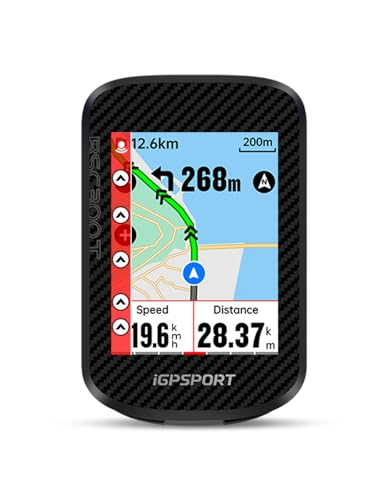
Touchscreen Mapping Choice – iGPSPORT BSC300T
The iGPSPORT BSC300T is a strong contender among durable bike GPS computers for riders who prefer touchscreen controls and offline maps. It adds off-course warnings, real-time tracking, and e-bike support to a compact 2.4-inch navigation computer.
Best For: Road, mountain, group, and e-bike riders who prioritize offline mapping and route awareness.
Pros:
- Downloads worldwide offline maps, stores multiple routes, and provides turn prompts.
- Warns riders when they leave the planned course.
- Supports more than 130 riding data fields and five satellite positioning systems.
- Offers real-time group tracking plus ANT+ and Bluetooth 5.0 connectivity.
Cons:
- Battery life is rated at 20 hours, shorter than some larger-capacity cycling computers.
- A Type-C cable is not included according to the supplied details.
With a two-year warranty, 67-gram weight, and navigation features designed for both exploration and group rides, the BSC300T is a versatile choice. Its touchscreen and button controls also give riders multiple ways to interact with the device.
Long-Battery Simplicity Pick – COOSPO BC107 GPS Computer
For shoppers seeking durable bike GPS computers with straightforward ride tracking, the COOSPO BC107 pairs an auto-backlit 2.4-inch display with IP67 waterproof protection. Its standout feature is an 80-hour battery rating, making it well suited to frequent riders who want fewer charging interruptions.
Best For: Riders who want long battery life, clear data viewing, and ANT+ sensor compatibility.
Pros:
- Rated for up to 80 hours of battery life.
- IP67 protection helps it operate in rainy conditions.
- Auto-backlit display adapts to surrounding conditions and remains sunlight readable.
- Works with ANT+ heart-rate, speed, cadence, and power sensors.
Cons:
- First-time GPS positioning may take three to five minutes outdoors.
- The out-front mount is sold separately.
- Advanced sensor functionality requires compatible sensors, which may need an additional purchase.
The BC107 favors dependable basics over an elaborate navigation interface. Choose it when long runtime, weather resistance, and compatibility with common ANT+ sensors are more important than touchscreen mapping.
Best All-Rounder – iGPSPORT BSC200S
For riders comparing durable bike GPS computers, the iGPSPORT BSC200S combines route navigation, a sunlight-readable color display, wireless sensor support, and IPX7 waterproofing in a lightweight 67-gram design. Its 25-hour battery is well suited to long day rides.
Best For: Everyday riders who want navigation, broad data tracking, and strong weather resistance without a bulky computer.
Pros:
- IPX7 waterproof rating and 25-hour battery life
- Route imports from Strava, Ride with GPS, and Komoot
- Supports Bluetooth and ANT+ sensors, lights, and radar lights
- Offers more than 100 riding metrics and customizable data pages
Cons:
- Type-C charging cable is not included
- Navigation features require setup through the iGPSPORT app
The BSC200S is a balanced choice for riders who want dependable navigation and durable, rain-ready construction. Its button controls, compact size, and sensor compatibility make it practical for regular training and touring.
Best Battery Life – CYCPLUS M1 GPS Bike Computer
The CYCPLUS M1 stands out among durable bike GPS computers with a claimed battery life of more than 60 hours, an IPX6 waterproof design, and a glare-free 2.9-inch display. It records core ride data while connecting to Bluetooth and ANT+ accessories.
Best For: Long-distance riders and cyclists who prioritize extended battery life and a large, easy-to-read display.
Pros:
- More than 60 hours of working time
- 2.9-inch sunlight-visible LCD with automatic backlight
- Supports speed, cadence, heart rate, power, route, and altitude data
- Two-year warranty and stated 24/7 technical support
Cons:
- IPX6 protection is below the IPX7 rating of some alternatives
- Navigation is primarily route tracking and app synchronization rather than built-in turn-by-turn guidance
Choose the M1 if charging frequency matters more than a color navigation screen. Its large display, tempered glass, and high-capacity battery make it a practical option for extended rides and multi-day use.
Best Touchscreen Features – COOSPO CS600 GPS Bike Computer
The COOSPO CS600 is a durable bike GPS computer for riders who want touchscreen control, route guidance, and extensive performance data. Its IPX7 waterproofing, 36-hour battery, and compatibility with radar, lights, trainers, and electronic shifting support more connected rides.
Best For: Training-focused cyclists who want a color touchscreen and a broad connected-device ecosystem.
Pros:
- 2.4-inch color touchscreen with automatic backlight
- Built-in route navigation and breadcrumb trail support
- IPX7 waterproof rating and 36-hour battery life
- Provides more than 150 data insights and supports Bluetooth and ANT+
Cons:
- Cadence, heart-rate, and power sensors are sold separately
- Includes a 12-month warranty
- Touchscreen controls may be less convenient than buttons in wet conditions
The CS600 is the strongest fit for riders who value an interactive display and deeper training connectivity. It offers substantial battery endurance and weather protection, though the full feature set may require additional accessories.
How We Picked the Best Durable Bike GPS Computers
We evaluated these computers by focusing on the features that matter during actual rides rather than relying on screen size or headline specifications alone. Key considerations included GPS positioning, route guidance, rerouting or off-course alerts, display readability, battery capacity, waterproof or water-resistant construction, and compatibility with Bluetooth and ANT+ sensors.
We also considered how each model fits a particular type of rider. A simple speed-and-distance computer may be better for casual cycling, while structured training, turn-by-turn navigation, mountain-bike metrics, or e-bike compatibility can justify a more advanced model.
Quick Comparison
- Best for straightforward tracking: Models with simple interfaces, long battery claims, and essential speed, distance, and ride data.
- Best for navigation: Computers with color maps, route planning, rerouting, voice prompts, or off-course warnings.
- Best for training: Models supporting heart-rate monitors, cadence sensors, power meters, and detailed ride metrics through ANT+ or Bluetooth.
- Best for rough conditions: Units with IPX6, IPX7, or comparable protection, physical controls, and rugged housings.
Key Buying Factors for Durable Bike GPS Computers
Navigation and GPS Performance
Basic GPS tracking is enough for recording a familiar ride, but navigation-focused cyclists should look for route storage, offline maps, rerouting, turn guidance, and off-course notifications. Faster position acquisition is useful when you frequently start rides in unfamiliar areas.
Screen and Controls
Touchscreens are convenient for browsing maps, but physical buttons can be easier to operate with gloves, rain, or rough terrain. A larger color display improves map visibility, while a simpler LCD can reduce distractions and conserve power.
Durability and Battery Life
For Durable Bike GPS Computers, check the stated water-resistance rating and consider how the device will be mounted and protected from impacts. Longer battery life benefits touring and endurance riders, while rechargeable units with shorter runtimes may suit commuting and regular training.
Sensor and Phone Compatibility
Bluetooth and ANT+ support allow a computer to connect with heart-rate straps, cadence sensors, speed sensors, power meters, and some e-bike systems. Confirm that the computer supports the accessories you already own before buying.
Who Should Buy Which Durable Bike GPS Computers?
Casual riders and commuters should prioritize simple controls, clear speed and distance data, dependable weather resistance, and low setup complexity. Road and endurance cyclists will benefit from longer battery life, structured metrics, sensor support, and reliable route guidance. Gravel and touring riders should favor offline maps, rerouting, and displays that remain readable across changing conditions. Mountain bikers should look for rugged construction, physical controls, trail-specific metrics, and strong off-course guidance. E-bike riders should verify compatibility with their bike system and choose a computer that provides the connectivity and navigation features they will actually use.
