
The best folding multi-fuel generators give you more fuel flexibility without forcing you to commit to a single power source. Depending on the model, you may be able to run on gasoline, propane, or natural gas while keeping essential appliances, tools, or RV equipment operating during an outage.
We selected 10 options across high-output home backup generators, RV-ready inverter models, and more versatile dual- and tri-fuel designs. Use the guide below to compare output, fuel compatibility, portability, starting features, and installation requirements before you buy.
Best 10 Folding Multi-Fuel Generators Picks for 2026
Most Powerful
Westinghouse 14500W Tri-Fuel Generator

- 11,500 running and 14,500 peak watts on gasoline
- Runs on gasoline, propane, or natural gas
- Remote start and up to 19 hours at 25% load
Best For: High-capacity residential backup power
Best Value
PowerSmart 4400W Dual-Fuel Inverter Generator

- 4,400 starting and 3,600 running watts on gasoline
- Less than 3% THD inverter power
- Up to 24 hours on a 20-pound propane tank
Best For: Essential appliances and moderate backup needs
Best Tri-Fuel Alternative

- 10,500 running and 13,500 peak watts on gasoline
- Uses gasoline, propane, or natural gas
- Remote start and 19-hour rated runtime
Best For: High-output residential backup with fuel flexibility
Best for RVs
WEN DF360iX Dual-Fuel Inverter Generator

- Lightweight 49-pound portable design
- RV-ready TT-30R outlet and quiet inverter operation
- Runs on gasoline or propane with CO Watchdog
Best For: Camping and RV power on the move
Most Versatile
Generac 12,500-Watt Tri-Fuel Generator

- Gasoline, propane, and natural-gas operation
- 12,500 starting and 9,500 running watts
- Electric start, COsense, AVR, and folding handle
Best For: High-output home backup with flexible fuel choices
Best for Everyday Use
Westinghouse 6,500-Watt Dual-Fuel Generator
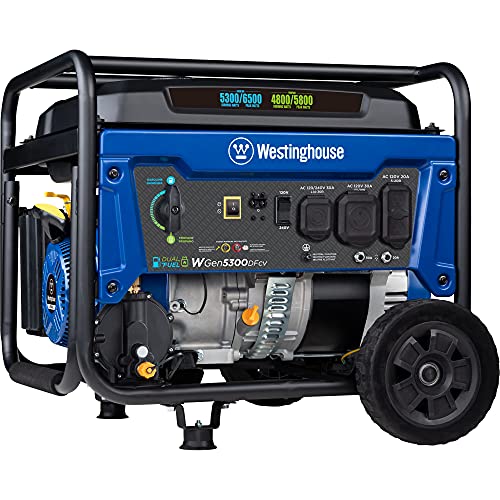
- Gasoline and propane fuel options
- Up to 14.5 hours of runtime
- RV-ready and transfer-switch-ready outlets
Best For: Residential and RV backup on a practical budget
Highest Output
DuroStar DS13000MXT Tri-Fuel Generator

- 10,500 running watts and 13,000-watt peak output
- Gasoline, propane, and natural-gas operation
- Remote electric start and 50-amp outlet
Best For: Demanding whole-home and emergency backup loads
High-Capacity Home Backup

- Up to 9,500 running watts on gasoline
- Gasoline/propane operation with remote start
- 50A RV-ready and 30A transfer-switch-ready outlets
Best For: Large residential backup loads and RV use
Rugged Whole-Home Power

- Up to 10,500 running watts
- Front-panel gasoline/propane fuel selection
- All-metal build with no-flat tires
Best For: High-output home, RV, and jobsite power
Long-Run Automatic Backup

- Up to 19 hours at 25% load
- 10,500 running watts on gasoline
- Compatible with optional WATS200 automatic transfer switch
Best For: Extended residential outages and ATS-ready backup
Most Powerful – Westinghouse 14500W Tri-Fuel Generator
For shoppers comparing folding multi-fuel generators for serious home backup, this Westinghouse model emphasizes high output and fuel flexibility. It produces 11,500 running watts and 14,500 peak watts on gasoline, while also supporting propane and natural gas.
Best For: Whole-home backup applications that need high capacity, 240-volt output, and multiple fuel options.
Pros:
- High 11,500-watt running output on gasoline
- Tri-fuel operation with gasoline, propane, and natural gas
- Up to 19 hours of runtime at 25% load
- Remote electric start, CO sensor, and low-oil shutdown
Cons:
- Heavy 230-pound open-frame design
- Transfer switch and interlock equipment are sold separately
- Less convenient for casual camping or frequent repositioning
This is a substantial home-backup generator rather than a compact travel unit. Its high output, 50A and 30A outlets, and tri-fuel capability make it a strong option when portability means moving the generator occasionally rather than carrying it regularly.
Best Value – PowerSmart 4400W Dual-Fuel Inverter Generator
The PowerSmart 4400-watt model is a practical choice among folding multi-fuel generators for backup essentials and smaller power demands. Its inverter technology supplies less than 3% THD, while dual-fuel operation lets you use gasoline or LPG.
Best For: Homeowners who want a moderately sized dual-fuel generator for refrigerators, televisions, and other essential appliances.
Pros:
- Up to 4,400 starting watts on gasoline
- Clean inverter power for sensitive electronics
- Up to 24 hours at 25% load on a 20-pound propane tank
- Digital display, CO sensor, and parallel-ready design
Cons:
- Limited to 120-volt output
- Lower capacity than large home-backup generators
- Starting-watt detail in the supplied specifications appears inconsistent with the listed 4,400-watt rating
At 68 pounds, this unit is substantially easier to move than the large open-frame Westinghouse generators. It offers useful outlets and long propane runtime, but its 120-volt design is better suited to essential circuits and appliances than full-home backup.
Best Tri-Fuel Alternative – Westinghouse 13500W Generator
This Westinghouse generator is designed for demanding residential backup while offering the flexibility of gasoline, propane, and natural gas. It delivers 10,500 running watts and 13,500 peak watts on gasoline, making it a capable option for shoppers evaluating folding multi-fuel generators.
Best For: Residential backup users who want high output and tri-fuel flexibility with remote starting.
Pros:
- 10,500 running and 13,500 peak watts on gasoline
- Supports gasoline, propane, and natural gas
- Up to 19 hours at 25% load
- Remote electric start, fuel gauge, and CO shutdown sensor
Cons:
- Heavy 230-pound construction
- Transfer switch or interlock equipment is sold separately
- Open-frame format is less suited to quiet recreational use
Its output is slightly below the larger Westinghouse model, but it retains the key features needed for serious home backup, including 240-volt capability and 50A and 30A outlets. Choose it when tri-fuel operation matters more than having the highest available wattage.
Best for RVs – WEN DF360iX Dual-Fuel Inverter Generator
The WEN DF360iX focuses on quiet, compact operation rather than maximum home-backup capacity. For buyers considering folding multi-fuel generators for camping or RV use, it combines gasoline and propane operation with clean inverter power and a built-in TT-30R RV receptacle.
Best For: RV owners and campers who prioritize low noise, portability, and sensitive-electronics protection.
Pros:
- Lightweight 49-pound design
- Dual-fuel operation with gasoline and propane
- Inverter power designed for phones, tablets, and laptops
- Includes TT-30R RV outlet, USB ports, and CO Watchdog shutdown
Cons:
- Lower 2,600-watt rated output on gasoline
- Listed runtime is 5 hours
- Not intended for high-demand whole-home backup
With a compact body, quiet operation comparable to normal conversation, and RV-ready connections, this WEN is the most travel-friendly option in the group. Its smaller output makes it a better fit for campsite and recreational loads than for powering an entire residence.
Most Versatile – Generac 12,500-Watt Tri-Fuel Generator
For shoppers comparing folding multi-fuel generators, the Generac GP9500ETF stands out for its gasoline, propane, and natural-gas flexibility. It delivers 9,500 running watts and 12,500 starting watts, with electric start, COsense shutdown protection, and a folding handle for easier relocation.
Best For: Home backup users who want high output and three fuel options.
Pros:
- Tri-fuel operation supports gasoline, liquid propane, or natural gas.
- High 12,500-watt starting capacity handles substantial surge loads.
- Includes electric start, CO detection, AVR, wheels, and a folding handle.
- Offers transfer-switch compatibility and a 7.5-gallon tank.
Cons:
- At 219 pounds, it is considerably heavier than smaller portable generators.
- Its 9.5-hour gasoline runtime is specified at 50% load, so heavier loads will reduce runtime.
The Generac is a strong choice when maximum flexibility and whole-home-oriented output matter more than portability. Its folding handle helps with movement, but the substantial weight still favors planned placement rather than frequent transport.
Best for Everyday Use – Westinghouse 6,500-Watt Dual-Fuel Generator
The Westinghouse WGen5300DFcv is a practical option among folding multi-fuel generators for residential backup and RV use. It produces 5,300 running watts on gasoline or 4,800 on propane, includes a 120/240V selector, and can run for up to 14.5 hours from its 4.7-gallon tank.
Best For: Residential users and RV owners seeking a simpler dual-fuel generator with useful outlet options.
Pros:
- Runs on gasoline or propane for added fuel flexibility.
- Includes RV-ready TT-30R and transfer-switch-ready L14-30R outlets.
- Up to 14.5 hours of runtime is useful for extended backup periods.
- Comes with oil, funnel, propane hose, wheel kit, and tool kit.
Cons:
- Provides less output than the tri-fuel models in this roundup.
- Uses a magneto ignition rather than electric start.
- At 135.6 pounds, it is portable but still substantial to move.
This Westinghouse balances capacity, runtime, and included accessories without moving into the highest-output class. It is especially appealing if propane and gasoline are sufficient and you need dedicated RV and transfer-switch connections.
Highest Output – DuroStar DS13000MXT Tri-Fuel Generator
The DuroStar DS13000MXT is built for shoppers who need substantial capacity from folding multi-fuel generators. Its 500cc engine supports gasoline, propane, or natural gas, while the generator provides 10,500 running watts and a listed 13,000-watt peak output for whole-home and emergency backup applications.
Best For: Whole-home backup users who prioritize maximum output, tri-fuel flexibility, and remote electric starting.
Pros:
- Tri-fuel technology allows operation on gasoline, propane, or natural gas.
- Provides 10,500 running watts for demanding backup loads.
- Includes remote electric start and a broad power panel with a 50-amp outlet.
- CO Alert automatically shuts the generator down when harmful fumes are detected.
Cons:
- Its 8.3-gallon tank and large steel frame make it less convenient for frequent transport.
- The supplied notes list a 50Hz frequency, which buyers should verify against their intended equipment.
- Transfer-switch installation and whole-home use require appropriate electrical setup.
The DuroStar offers the highest listed running capacity here and combines it with three fuel choices and remote starting. It is a compelling emergency-power platform, provided you have a suitable location and electrical connection plan for its large output.
High-Capacity Home Backup – Westinghouse WGen9500DF
For shoppers comparing folding multi-fuel generators for serious home backup, the Westinghouse WGen9500DF combines gasoline and propane operation with substantial output, remote starting, and transfer-switch-ready connectivity. Its 6.6-gallon tank provides up to 12 hours of runtime, according to the supplied specifications.
Best For: Residential backup power, including larger household loads and RV use.
Pros:
- Produces up to 9,500 running watts and 12,500 peak watts on gasoline.
- Offers gasoline and propane flexibility, plus remote, electric, and recoil starting.
- Includes 30A transfer-switch-ready and 50A RV-ready outlets with rubber covers.
- Provides a fuel gauge, digital hour meter, low-oil shutdown, and real-time VFT display.
Cons:
- Its open-frame design is substantial at 27.2 by 26.1 by 26.5 inches.
- It requires manual setup and connection for transfer-switch use.
This is a practical choice when high output and broad outlet compatibility matter more than compactness. The included accessories and three-year limited warranty also make it a well-equipped home-backup package.
Rugged Whole-Home Power – DuroMax XP13000EH
The DuroMax XP13000EH is a heavy-duty option among folding multi-fuel generators, offering gasoline or propane operation and enough capacity for whole-home backup, RV trips, or jobsite use. Its all-metal construction and no-flat tires emphasize durability and mobility.
Best For: Users who need high-output emergency, residential, RV, or jobsite power.
Pros:
- Delivers up to 10,500 running watts and 13,000 starting watts.
- Switches between gasoline and propane using a front-facing interface.
- Includes push-button electric start and a transfer-switch-ready 50A outlet.
- Features an all-metal frame and power panel, copper windings, and no-flat tires.
Cons:
- At 234 pounds, it is heavy to move despite the wheels and foldable handle.
- The supplied specifications list only a three-hour runtime.
Choose this model when rugged construction and maximum listed output are priorities. It is versatile across home, RV, and worksite settings, though its weight and stated runtime deserve consideration.
Long-Run Automatic Backup – Westinghouse WGen10500DFc
For extended outages, the Westinghouse WGen10500DFc stands out among folding multi-fuel generators with up to 19 hours of runtime at 25% load and compatibility with the separately sold WATS200 automatic transfer switch. It combines gasoline and propane flexibility with remote electric starting and built-in safety monitoring.
Best For: Homeowners seeking long-runtime backup power with optional automatic-transfer capability.
Pros:
- Provides 10,500 running watts and 13,500 peak watts on gasoline.
- Runs on gasoline or propane and supports push-button, remote, and recoil starting.
- Offers up to 19 hours of runtime at 25% load from its 9.5-gallon tank.
- Includes a CO sensor, low-oil shutdown, fuel gauge, and pressure-lubricated 500cc engine.
Cons:
- The WATS200 automatic transfer switch is sold separately.
- At 230 pounds, it is not a lightweight portable generator.
- Its open-frame design may be less compact than an enclosed inverter model.
This model is especially compelling for longer outages and planned home-backup installations. Its extended runtime and ATS compatibility add convenience, while the separate switch and considerable weight should be included in the buying decision.
How We Picked These Folding Multi-Fuel Generators
We focused on generators that support at least two fuel types and cover practical use cases, including emergency home backup, RV camping, job sites, and extended outages. The selection represents a range of capacities, from compact inverter units to high-output whole-home backup models.
We also considered transfer-switch readiness, electric or remote starting, RV outlets, inverter technology, carbon-monoxide monitoring, noise and portability, and whether the generator supports natural gas in addition to gasoline and propane. Always confirm the exact outlet configuration, fuel claims, and local installation requirements for the model you choose.
Quick Comparison
- Highest-output options: The 13,000- to 14,500-watt models are suited to larger homes, multiple appliances, pumps, and demanding starting loads.
- Flexible fuel coverage: Tri-fuel generators can use gasoline, propane, and natural gas; dual-fuel models typically use gasoline and propane.
- RV and quieter-use option: The WEN inverter generator is designed for RV readiness and more portable operation than the large conventional units.
- Midrange backup: A 6,500-watt dual-fuel model can cover essential circuits while remaining less demanding to move and store.
Key Buying Factors for Folding Multi-Fuel Generators
Wattage and Load Management
Calculate running watts for the devices you need simultaneously, then account for the higher starting watts required by refrigerators, sump pumps, air conditioners, well pumps, and power tools. A transfer switch can help you power selected household circuits safely, but it should be installed according to local electrical codes.
Fuel Type and Runtime
Gasoline is widely available and often provides strong output, while propane stores longer and burns cleaner during storage. Natural-gas capability can be convenient for home backup if a suitable line and professionally installed connection are available. Output and runtime may change by fuel, so check the specifications for each mode.
Portability, Noise, and Controls
Large-frame generators usually offer more power but require wheels, handles, and a suitable storage location. Inverter models are often better for sensitive electronics and quieter environments. Electric or remote start is convenient, but keep the battery charged and understand the manual-start procedure.
Safety and Maintenance
Operate any portable generator outdoors, far from doors, windows, and vents, and use carbon-monoxide protection as an additional safeguard. Store fuel properly, exercise the generator periodically, change oil on schedule, and use a properly rated cord or transfer equipment.
Who Should Buy Which Folding Multi-Fuel Generators?
Choose a high-output tri-fuel model if you want maximum fuel flexibility and substantial home backup capacity. Choose a high-output dual-fuel unit if gasoline and propane meet your needs and you want a simpler setup. Choose a midrange model for essential circuits, smaller homes, or easier handling. Choose an inverter generator for RV trips, camping, electronics, and situations where lower noise and portability matter more than whole-home output.
