
The best weather stations do more than display temperature. They can track humidity, wind, rainfall, pressure, and indoor conditions so you can make better decisions about gardening, comfort, outdoor plans, and home maintenance.
These 10 weather stations cover a range of needs, from straightforward atomic-clock thermometers to connected systems with app access, custom alerts, and weather-sharing features. Use the guide below to narrow your choices by accuracy, installation, connectivity, and budget.
Best 10 Weather Stations Picks for 2026
Best Smart-Home Weather Station
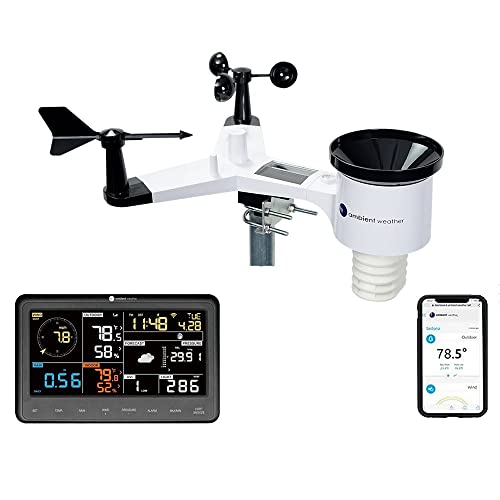
- Wi-Fi monitoring with customizable alerts
- Tracks wind, rain, UV, and solar radiation
- Works with Alexa, Google Home, and IFTTT
Best For: Connected homes and detailed backyard monitoring
Best Easy-Read Forecast Station

- Large color display with adjustable brightness
- Tracks temperature, humidity, dew point, and heat index
- Includes atomic clock and customizable alerts
Best For: Everyday home monitoring and readable indoor displays
Best Comprehensive Color-Screen Station
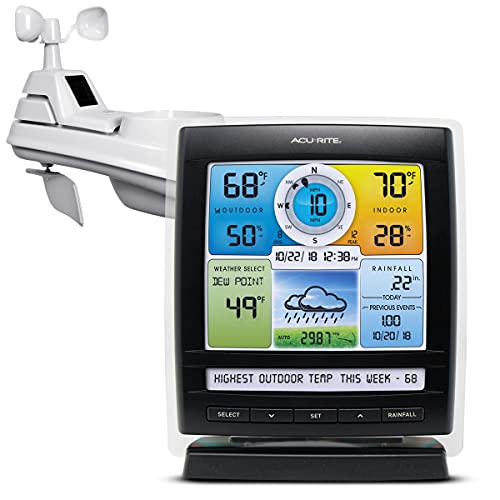
- Provides more than 55 weather data points
- Measures wind, rain, temperature, humidity, and pressure
- Large color display with adjustable dimming
Best For: Detailed at-home weather information without Wi-Fi
Best Low-Maintenance Smart Sensor
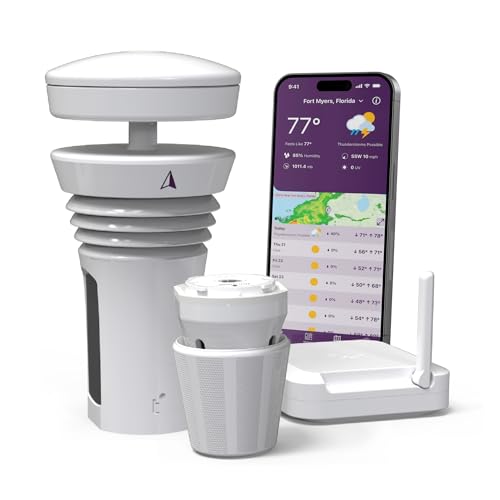
- Tracks weather, lightning, UV, and rainfall
- No moving parts and solar-powered operation
- App, Alexa, Rachio, and IFTTT compatibility
Best For: Smart-home automation and app-based monitoring
Reliable Everyday Monitor
La Crosse Advanced Weather Station

- Color forecast icons with tendency indicators
- Indoor/outdoor temperature and humidity readings
- Atomic time, alerts, and adjustable backlight
Best For: Everyday home monitoring of core weather conditions
Connected Weather Hub
AcuRite Iris 5-in-1 Weather Station
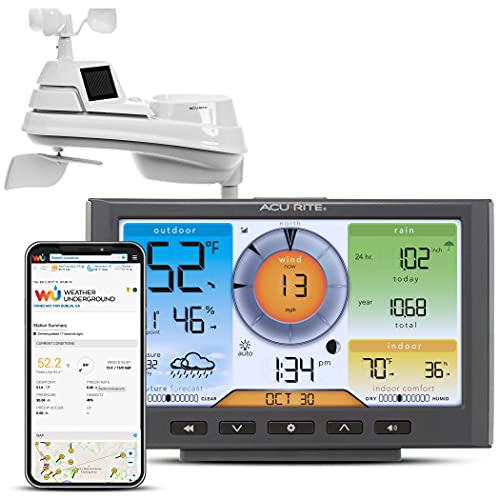
- Measures wind, rain, pressure, temperature, and humidity
- Wi-Fi access through Weather Underground
- Tracks 25-plus data points and historical conditions
Best For: Detailed local weather tracking with remote access
Large Atomic Display
DreamSky Wireless Weather Station

- Large colorful display with adjustable brightness
- Atomic clock with automatic daylight saving adjustment
- Supports up to three outdoor sensors
Best For: Readable home or office monitoring with precise time
Best All-Around Display
Newentor Wireless Weather Station

- Color LCD with temperature, humidity, pressure, and forecast data
- Atomic clock, dual alarms, moon phase, and customizable alerts
- Supports up to three sensors; one sensor included
Best For: Homes wanting a colorful, multifunctional weather display
Best for Simple Home Monitoring
AcuRite Wireless Weather Station
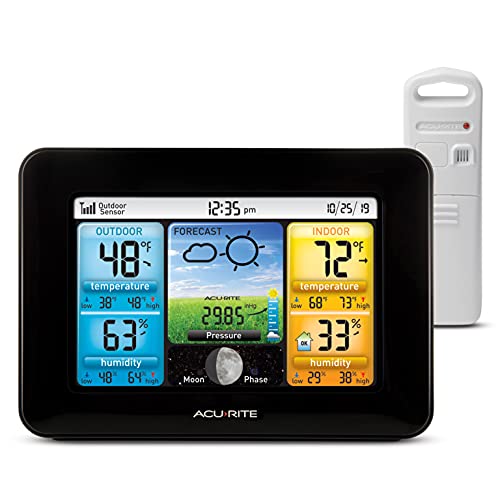
- Color LCD with adjustable dimmer and clear trend indicators
- Tracks indoor/outdoor temperature, humidity, and pressure trends
- Includes a hanging outdoor sensor and 12-hour forecast
Best For: Everyday home, office, or RV weather monitoring
Best Feature-Rich Outdoor Monitoring
Sainlogic 12-in-1 Weather Station

- Measures wind, rainfall, pressure, dew point, and temperature
- Wireless range reaches up to 443 feet in open conditions
- 6.5-inch display with adjustable backlight and rainfall history
Best For: Gardens, farms, and properties needing detailed outdoor data
Best Smart-Home Weather Station – Ambient Weather WS-2902
Ambient Weather WS-2902 Wi-Fi Smart Weather Station | With Wi-Fi Remote Monitoring and Alerts
Check Price On AmazonThe Ambient Weather WS-2902 is a versatile choice for shoppers seeking weather stations with Wi-Fi access and smart-home compatibility. Its outdoor sensor array measures wind, temperature, humidity, rainfall, UV intensity, and solar radiation, while the included color console provides an at-home view.
Best For: Homeowners who want detailed backyard data, remote monitoring, alerts, and smart-home integrations.
Pros:
- Measures a broad range of outdoor conditions, including wind, rain, UV, and solar radiation.
- Supports Wi-Fi remote monitoring, customizable alerts, Alexa, Google Home, and IFTTT.
- Includes a solar-powered sensor array and easy-to-read color LCD display.
Cons:
- Requires three AAA batteries in addition to its solar-powered sensor setup.
- The outdoor sensor is rated down to 14°F, which may limit use in colder climates.
Choose this model if connectivity and detailed hyper-local readings matter as much as the basics. It is more capable than a simple temperature-and-humidity monitor, though its many features may be more than casual users need.
Best Easy-Read Forecast Station – La Crosse C85845-INT
The La Crosse C85845-INT is one of the more approachable weather stations for everyday indoor and outdoor readings. It combines wireless temperature and humidity monitoring with forecast icons, comfort charts, timekeeping, and adjustable display brightness.
Best For: Families and home users who want a readable display, basic forecasts, comfort information, and customizable alerts.
Pros:
- Shows indoor and outdoor temperature and humidity on a large color display.
- Provides dew point, heat index, comfort charts, and daily high/low records.
- Includes an atomic clock, adjustable brightness, and customizable high/low alerts.
Cons:
- Forecast calibration may take 7–10 days.
- The station uses corded power, with backup batteries not included.
- Its listed temperature reading accuracy is ±2°F.
This is a practical pick for straightforward household monitoring rather than advanced weather logging. Its strong display and clock features make it especially convenient for kitchens, offices, or living areas.
Best Comprehensive Color-Screen Station – AcuRite Iris 01512MCB
The AcuRite Iris 01512MCB is a well-rounded option among weather stations, delivering indoor and outdoor readings through a large color LCD screen. It monitors temperature, humidity, wind, pressure trends, and rainfall, while also providing historical data, comfort metrics, and a personalized short-range forecast.
Best For: Home, garden, or office users who want broad weather information without a complicated setup.
Pros:
- Reports more than 55 data points, including historical readings, dew point, and heat index.
- Measures outdoor temperature, humidity, wind speed and direction, pressure, and rainfall.
- Includes a large color display with adjustable dimming and a clock and calendar.
- Outdoor sensor setup uses an included mounting bracket and is described as pre-calibrated.
Cons:
- The outdoor temperature range begins at 32°F.
- Its radio-frequency connection does not provide the Wi-Fi remote access offered by some models.
- The display and sensor system require multiple AA batteries, with corded power for the console.
The Iris makes sense for buyers who prioritize a broad set of readings and a dedicated, information-rich display. It is less suited to shoppers specifically seeking app-based remote access.
Best Low-Maintenance Smart Sensor – Tempest Weather Station
The Tempest Weather Station is designed for shoppers who want advanced weather stations without a traditional console or moving parts. Its solar-powered outdoor sensor tracks temperature, humidity, pressure, wind, precipitation, UV, solar radiation, and lightning, then sends updates wirelessly for app and smart-home use.
Best For: Tech-focused homeowners who prefer app-based monitoring, automation, and low-maintenance outdoor hardware.
Pros:
- Tracks a wide range of conditions, including lightning strikes, UV index, rainfall, and solar radiation.
- Uses a non-mechanical design intended for near-zero maintenance.
- Provides updates every three seconds and transmits wirelessly up to more than 1,000 feet.
- Works with Alexa, Rachio, IFTTT, and other smart-home platforms.
Cons:
- There is no built-in display, so readings depend on the app or connected platform.
- Its advanced feature set may be unnecessary for users seeking only basic temperature readings.
Tempest is a strong fit when automation, frequent updates, and minimal physical maintenance are priorities. Its lack of a console is the main trade-off, especially for buyers who want an always-on display indoors.
Reliable Everyday Monitor – La Crosse Advanced Weather Station
For shoppers comparing weather stations for everyday home use, the La Crosse Advanced Weather Station focuses on clear indoor and outdoor temperature and humidity readings. Its color forecast icons, atomic clock, customizable alerts, and wireless sensor make it a practical choice for a desk, kitchen, or living area.
Best For: Home users who want easy-to-read temperature, humidity, time, and basic forecast information.
Pros:
- Color forecast icons include tendency indicators.
- Displays indoor/outdoor temperature and humidity with MIN/MAX records.
- Atomic time and calendar automatically handle daylight saving time.
- Adjustable backlight and customizable temperature alerts add convenience.
Cons:
- Full-feature display operation requires the included 5V power adapter.
- Battery-only backlight illuminates temporarily on demand.
- It does not provide wind or rainfall measurements.
This is a straightforward weather station for monitoring core household conditions rather than a complete outdoor weather observatory. The 330-foot sensor range, alerts, and readable color display make it a balanced option for routine use.
Connected Weather Hub – AcuRite Iris 5-in-1 Weather Station
Among weather stations for detailed outdoor tracking, the AcuRite Iris 5-in-1 stands out with measurements for temperature, humidity, wind, barometric pressure, and rainfall. Its Wi-Fi connection to Weather Underground also supports remote monitoring and data sharing beyond the home display.
Best For: Home weather enthusiasts who want comprehensive local readings, historical data, and Weather Underground connectivity.
Pros:
- Tracks temperature, humidity, wind speed and direction, pressure, and rainfall.
- Connects to Weather Underground for remote monitoring and sharing.
- Provides more than 25 data points, including heat index, dew point, and wind chill.
- Large color LCD includes time, date, adjustable brightness, alarms, and historical tracking.
Cons:
- The broader feature set may be more than needed for basic temperature checks.
- The listed lower temperature rating is 32°F.
- It relies on a wireless sensor system rather than a simple thermometer-only setup.
The Iris 5-in-1 is the most capable option here for users who want a fuller picture of conditions around their property. Its sensor suite and online connection make it especially useful for tracking trends and sharing localized weather data.
Large Atomic Display – DreamSky Wireless Weather Station
For shoppers seeking weather stations with a large, readable screen, the DreamSky Wireless Weather Station combines colorful indoor/outdoor readings with an atomic clock. It adds high/low temperature alerts, adjustable backlight levels, and support for up to three outdoor sensors for monitoring multiple locations.
Best For: Homes, offices, RVs, garages, and other spaces where readable temperature information and precise atomic time are priorities.
Pros:
- Large colorful display shows forecast information, temperatures, time, and calendar details.
- WWVB atomic time automatically adjusts for daylight saving time.
- Supports up to three outdoor sensors, with one included.
- Offers high/low alerts, MIN/MAX records, adjustable brightness, and a USB port.
Cons:
- Battery backup is not included.
- With battery power alone, the display lights for about 10 seconds before dimming.
- It uses RF sensors and does not offer wind or rainfall measurements.
The DreamSky is a convenient choice when display visibility and accurate timekeeping matter as much as weather readings. Its multi-sensor capability is useful for monitoring separate areas, while the powered display is better suited to a stable indoor location.
Best All-Around Display – Newentor Wireless Weather Station
If you want weather stations that combine everyday home monitoring with clock and forecast features, the Newentor is a practical choice. Its large color LCD shows indoor and outdoor temperature and humidity, daily highs and lows, alerts, barometric pressure, moon phase, and a 12- to 24-hour forecast.
Best For: Bedrooms, living rooms, offices, and households that want a colorful display with atomic time and dual alarms.
Pros:
- Large color screen with adjustable brightness and a broad set of at-a-glance readings.
- Supports up to three wireless sensors for monitoring multiple locations.
- Offers atomic time, dual alarms, weather alerts, and barometric-pressure data.
- Wall power enables an always-on display, while battery backup provides quick-glance viewing.
Cons:
- Only one remote sensor is included.
- Batteries are not included, and battery-only operation dims the display after 15 seconds.
- The forecast is intended for personal, short-term guidance rather than a full outdoor instrument suite.
The Newentor stands out as a versatile indoor weather station for users who prioritize an easy-to-read screen and household convenience features. Its expandable sensor support adds flexibility, although buyers wanting rainfall or wind readings will need a more comprehensive model.
Best for Simple Home Monitoring – AcuRite Wireless Weather Station
For shoppers comparing weather stations for straightforward household use, the AcuRite 02077M offers a clear color display and wireless outdoor sensing. It tracks indoor and outdoor temperature, humidity, barometric-pressure trends, high and low records, signal strength, date, and moon phase.
Best For: Homes, offices, and RVs that need an uncomplicated display for everyday temperature and humidity checks.
Pros:
- Color LCD includes an adjustable dimmer for easier viewing in different rooms.
- Wireless outdoor sensor provides localized temperature, humidity, and pressure-trend information.
- Displays more than 15 data points, including high and low records, trend arrows, and moon phase.
- Outdoor sensor has an integrated hanger for installation on a post or tree branch.
Cons:
- The required two AA batteries are not included.
- The system provides a 12-hour forecast, which is shorter than some extended forecast displays.
- No warranty is listed in the supplied product details.
The AcuRite is a sensible pick when clear presentation and simple setup matter more than advanced outdoor measurements. Its focused feature set covers common home-monitoring needs without adding rainfall or wind instruments.
Best Feature-Rich Outdoor Monitoring – Sainlogic 12-in-1 Weather Station
If you need weather stations that measure more than temperature and humidity, the Sainlogic 12-in-1 provides a broader set of outdoor readings. Its 6.5-inch color display covers rainfall, wind, pressure, dew point, feels-like temperature, moon phase, and other data without Wi-Fi.
Best For: Gardens, farms, orchards, and larger outdoor areas where rainfall and wind measurements are useful.
Pros:
- 12-in-1 monitoring includes temperature, humidity, pressure, wind speed and direction, rainfall, dew point, and more.
- Wireless transmission reaches up to 443 feet in open, unobstructed conditions.
- Large 6.5-inch HD color display has a three-level adjustable backlight.
- Rainfall records cover hourly, daily, weekly, monthly, and cumulative totals.
Cons:
- This model does not include Wi-Fi connectivity.
- The outdoor system is more substantial than a basic thermometer, weighing 2.3 pounds and requiring mounting hardware.
- Rainfall accuracy is listed as ±7%, which may not suit users needing highly precise precipitation measurement.
The Sainlogic is the strongest choice here for detailed outdoor observation, especially when rainfall and wind matter. Its long wireless range and extensive records add utility for larger properties, while the lack of Wi-Fi limits app-based or remote access.
How We Picked These Weather Stations
We focused on the features that matter most in everyday home monitoring: sensor range, measurement coverage, display readability, forecast tools, alert customization, setup requirements, and connectivity. The lineup includes traditional console-based systems, Wi-Fi-enabled models, app-connected stations, and simpler indoor/outdoor thermometers.
We also considered whether each station suits a particular use case. A gardener may value rainfall and humidity data, while a homeowner may prioritize temperature alerts, a large display, or remote access. No single station is ideal for everyone, so the best choice depends on which measurements and controls you will actually use.
Quick Comparison
| Best For | Look For | Recommended Type |
|---|---|---|
| Connected monitoring | Wi-Fi, app access, smart-home support | Ambient Weather or Tempest-style system |
| Detailed outdoor data | Wind, rain, pressure, humidity, and UV or forecast tools | Multi-sensor 5-in-1 or 12-in-1 station |
| Simple home use | Large display, wireless sensor, clear temperature readings | La Crosse, AcuRite, or Newentor-style model |
| Low-cost basics | Indoor/outdoor temperature, humidity, and clock | Compact wireless thermometer station |
Key Buying Factors for Weather Stations
Measurements and Sensor Coverage
Check which readings are included before buying. Temperature and humidity are standard, but wind speed, wind direction, rainfall, barometric pressure, dew point, heat index, and UV data vary by model. If you want meaningful outdoor trends, prioritize a station with the measurements relevant to your property and climate.
Wireless Range and Installation
Verify the stated sensor range and account for walls, trees, metal siding, and other obstructions. Outdoor sensors need a suitable location: place temperature and humidity sensors in shade with airflow, and install wind and rain components according to the manufacturer’s guidance. More advanced systems may require careful leveling and mounting.
Display, Alerts, and Connectivity
A bright, readable console is useful when you want information at a glance. Custom alerts can notify you about freezing temperatures, high heat, humidity, or storms. Wi-Fi and app support are worth paying for if you want remote monitoring, data history, weather-network sharing, or smart-home integration; otherwise, a local console may be simpler and more reliable.
Power and Maintenance
Review whether the outdoor sensor uses batteries, solar assistance, or both, and check expected battery life. Rain gauges may need periodic cleaning, while exposed sensors require occasional inspection for debris, insects, and weather damage. A model with accessible replacement parts can be easier to keep running long term.
Who Should Buy Which Weather Stations?
Choose a Wi-Fi or app-connected station if you want remote access, historical graphs, smart alerts, or integration with a broader home-monitoring setup. These models are best for weather enthusiasts, gardeners, and homeowners who want data when they are away.
Choose a multi-function station with wind and rain measurements if you care about local conditions rather than general forecasts. It is especially useful for gardens, patios, hobby farms, and planning outdoor work. For bedrooms, kitchens, offices, or basic comfort monitoring, a simpler wireless thermometer with a large display is usually the better value.
Finally, prioritize atomic time and customizable alerts if convenience matters most. Before ordering, confirm the sensor count, display size, mounting hardware, app requirements, and compatibility with your preferred network or smart-home platform.
