
The best home weather stations do more than display the temperature. They can track conditions around your property, monitor indoor comfort, and provide timely data for gardening, storm awareness, and everyday planning.
We compared 10 leading models across sensor coverage, display quality, connectivity, alerts, setup, and overall value to help you choose the right station for your home.
Best 10 Home Weather Stations Picks for 2026
Best Color-Display Pick
AcuRite 02077M Wireless Weather Station
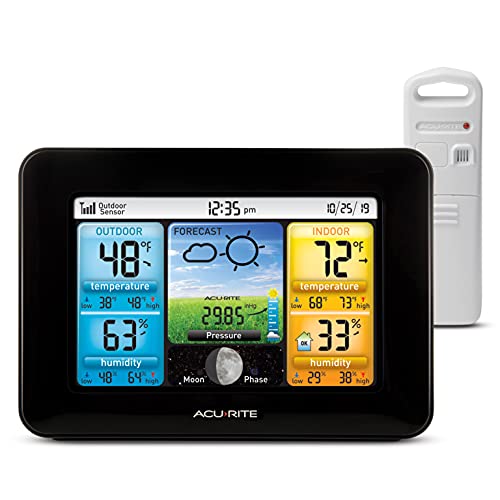
- Color LCD with adjustable dimmer
- Tracks temperature, humidity, and pressure trends
- Includes forecast icons and moon phase
Best For: Everyday home weather monitoring with a clear display
Best Smart-Home Option
Ambient Weather WS-2902 Wi-Fi Station
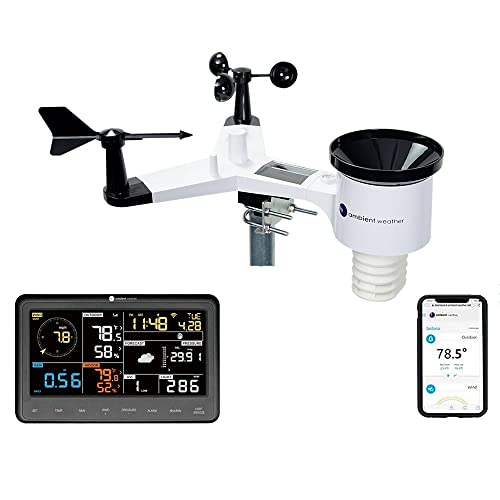
- Measures wind, rain, UV, and solar radiation
- Offers Wi-Fi access, alerts, and remote monitoring
- Integrates with Alexa, Google Home, and IFTTT
Best For: Connected homes and detailed backyard weather tracking
Best Clock-and-Weather Combo
Newentor Q3 Wireless Weather Station

- Large color display with weather and clock data
- Supports up to three remote sensors
- Includes atomic time, alarms, and adjustable backlight
Best For: Bedrooms and living spaces needing weather and clock functions
Best Advanced Console
Ambient Weather WS-2000 Smart Station
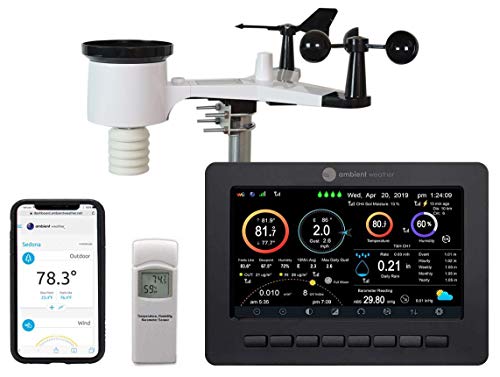
- High-definition TFT color display
- Tracks wind, rain, UV, and solar radiation
- Supports Wi-Fi, calibration, and metric units
Best For: Detailed backyard and garden weather monitoring
Best Wi-Fi Weather Station
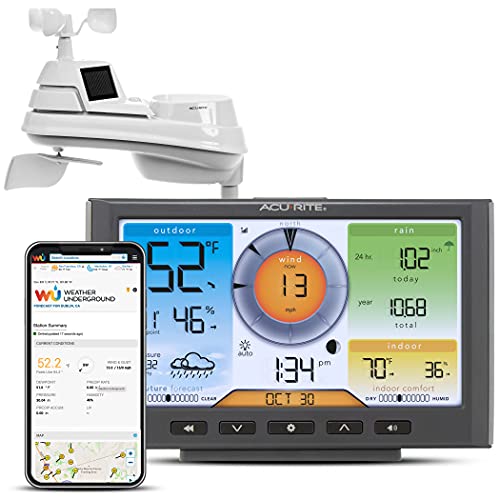
- Tracks temperature, humidity, wind, pressure, and rainfall
- Connects to Weather Underground for remote monitoring
- Displays more than 25 weather data points
Best For: Detailed local weather tracking and Wi-Fi access
Best Atomic Clock Weather Station

- Large color display with adjustable five-level backlight
- WWVB atomic time with automatic daylight-saving adjustment
- Supports up to three sensors and temperature alerts
Best For: Readable everyday monitoring with precise timekeeping
Best Comfort-Focused Weather Station

- Shows indoor/outdoor temperature, humidity, dew point, and heat index
- Includes comfort charts and customizable high/low alerts
- Adds forecast icons and an atomic self-setting clock
Best For: Indoor comfort monitoring and clear daily weather information
Best All-Around Choice
AcuRite Iris Color Screen Weather Station
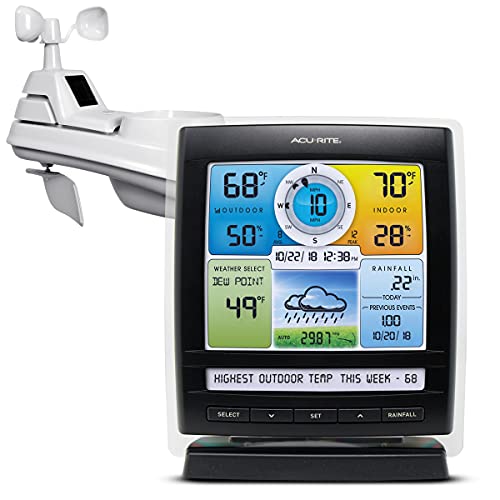
- Tracks more than 55 weather data points
- Includes wind, rain, pressure, temperature, and humidity readings
- Large color display with adjustable brightness
Best For: Comprehensive home and garden monitoring
Best No-WiFi Value
Sainlogic 12-in-1 Wireless Weather Station

- Covers 12 weather and household functions
- Records rainfall across multiple time periods
- Large 6.5-inch display with adjustable backlight
Best For: Standalone monitoring at home, gardens, or farms
Best Smart Data Tracking
Sainlogic WiFi Smart Weather Station

- Works with dual-band 5GHz and 2.4GHz Wi-Fi
- Offers app access, alerts, and Bluetooth pairing
- Stores two years of data with Excel export
Best For: Connected monitoring and long-term weather analysis
Best Color-Display Pick – AcuRite 02077M Wireless Weather Station
For shoppers comparing home weather stations, the AcuRite 02077M is a straightforward choice for tracking indoor and outdoor conditions. Its wireless sensor reports temperature, humidity, and barometric pressure trends to a colorful LCD display, along with a localized 12-hour forecast.
Best For: Homes, offices, and RVs that want an easy-to-read display with essential weather data.
Pros:
- Color LCD display includes adjustable dimming for flexible placement.
- Tracks indoor and outdoor temperature, humidity, pressure trends, and records.
- Provides forecast icons, trend arrows, and moon-phase information.
- Wireless outdoor sensor hangs on a post or tree branch.
Cons:
- Outdoor sensor requires two AA batteries, which are not included.
- Forecasting is limited to a 12-hour personalized outlook.
- No warranty is listed in the supplied specifications.
The 02077M focuses on clear, colorful presentation rather than advanced connectivity. It is a practical fit for everyday household monitoring when you want more information than a basic thermometer.
Best Smart-Home Option – Ambient Weather WS-2902 Wi-Fi Station
The Ambient Weather WS-2902 is one of the more connected home weather stations in this lineup. Its sensor array measures wind, temperature, humidity, rainfall, UV intensity, and solar radiation, while Wi-Fi enables remote access, alerts, and smart-home integrations.
Best For: Gardeners and connected households that want detailed backyard data and remote monitoring.
Pros:
- Measures wind speed and direction, temperature, humidity, rain, UV, and solar radiation.
- Supports remote access and alerts through Wi-Fi connectivity.
- Works with IFTTT, Google Home, Alexa, and other smart-home tools.
- Includes a color LCD console and solar-powered sensor array.
Cons:
- The sensor operates in a stated temperature range beginning at 14°F.
- Three AAA batteries are required, but not included.
- Its broader feature set may be more than needed for basic indoor/outdoor readings.
With comprehensive outdoor measurements and smart-home support, the WS-2902 is suited to users who want their weather data available beyond the console. The Ambient Weather Network also adds optional sharing and dashboard features.
Best Clock-and-Weather Combo – Newentor Q3 Wireless Weather Station
The Newentor Q3 combines a home weather station with an atomic clock and alarm functions. Its large color screen shows indoor and outdoor temperature and humidity, daily highs and lows, forecast information, moon phase, pressure, and time-related features.
Best For: Bedrooms, living rooms, and offices that need a readable weather display with clock functions.
Pros:
- Large color LCD presents essential weather and time information at a glance.
- Supports up to three wireless remote sensors for multiple locations.
- Includes customizable alerts, atomic time, dual alarms, and snooze.
- Wall power enables an always-on display, while battery mode conserves energy.
Cons:
- Batteries are not included for battery operation.
- Battery-only mode dims after a 15-second quick-glance period.
- Its temperature accuracy is listed as ±1.8°F.
The Q3 is a versatile choice when a weather monitor and bedside or household clock are both useful. Its multi-sensor support also makes it adaptable for monitoring more than one indoor or outdoor area.
Best Advanced Console – Ambient Weather WS-2000 Smart Station
The Ambient Weather WS-2000 is designed for users who want a more advanced console and broad outdoor measurements. Its integrated sensor array tracks wind, temperature, humidity, rainfall, UV, and solar radiation, while Wi-Fi provides an option for remote monitoring and network sharing.
Best For: Garden and backyard users who want detailed readings on a high-definition color console.
Pros:
- High-definition TFT color display makes the data easy to review.
- Measures wind, temperature, humidity, precipitation, UV, and solar radiation.
- Supports imperial and metric units with calibration capability.
- Offers Wi-Fi connectivity for remote monitoring and personal weather network transmission.
Cons:
- Sensor-array batteries are not included.
- Temperature accuracy is listed as ±2°F.
- The supplied specifications identify the sensor as outdoor-focused rather than an indoor/outdoor console system.
The WS-2000 stands out for its feature-rich console and extensive outdoor data coverage. It is a strong match for weather-aware gardeners and homeowners who value measurement variety and optional Wi-Fi access.
Best Wi-Fi Weather Station – AcuRite Iris 5-in-1
If you want one of the more comprehensive home weather stations for hyperlocal monitoring, the AcuRite Iris 5-in-1 combines indoor and outdoor readings with Wi-Fi access. Its color display tracks temperature, humidity, wind, barometric pressure, and rainfall, while Weather Underground connectivity enables remote viewing.
Best For: Homeowners who want detailed local weather data, rainfall tracking, and remote monitoring through Weather Underground.
Pros:
- Measures more than 25 weather data points, including wind, rainfall, heat index, dew point, and wind chill.
- Connects to Weather Underground for remote monitoring and data sharing.
- Includes a large color LCD with adjustable brightness, historical data, and threshold alarms.
Cons:
- The outdoor temperature range listed in the specifications begins at 32°F.
- Its broader feature set may be more than needed for basic temperature monitoring.
The AcuRite Iris is a strong choice when detailed weather information matters more than simplicity. The integrated sensor suite and Wi-Fi connection make it particularly useful for tracking changing conditions around your property.
Best Atomic Clock Weather Station – DreamSky Wireless Thermometer
For shoppers who prioritize readability and accurate timekeeping, this DreamSky model is a practical option among home weather stations. Its large color display shows indoor and outdoor conditions, forecasts, calendar information, and atomic time, with adjustable backlighting for day or night use.
Best For: Homes, offices, RVs, and other spaces where an easy-to-read display, atomic time, and temperature alerts are useful.
Pros:
- Large colorful display shows weather information, temperature, humidity, date, and calendar details.
- WWVB atomic clock automatically adjusts for daylight saving time.
- Supports up to three outdoor sensors and includes high/low temperature alerts.
- Offers five brightness levels plus USB charging and battery backup.
Cons:
- Only one outdoor sensor is included.
- When running on battery power alone, the display dims after 10 seconds.
- The forecast is based on local pressure and requires a seven-day calibration period.
The DreamSky focuses on everyday convenience rather than extensive weather instrumentation. Its large display, automatic timekeeping, and configurable alerts make it a good fit for rooms where quick-glance information is the priority.
Best Comfort-Focused Weather Station – La Crosse C85845-INT
The La Crosse C85845-INT is one of the more straightforward home weather stations for monitoring indoor comfort and outdoor conditions. It combines wireless temperature and humidity readings with forecast icons, customizable alerts, dew point, heat index, and an atomic clock in a large display.
Best For: Households that want clear temperature and humidity information, comfort indicators, and customizable alerts.
Pros:
- Displays indoor and outdoor temperature and humidity with dew point and heat index views.
- Provides forecast icons, trend arrows, and daily high/low records after barometric calibration.
- Includes customizable high/low alerts and color-coded comfort charts.
- Features an atomic clock, adjustable brightness, and automatic daylight-saving adjustment.
Cons:
- The forecast requires 7–10 days for barometric calibration.
- AC power is required for constant backlighting.
- Backup batteries and the outdoor sensor batteries are not included.
This La Crosse station emphasizes clear presentation and comfort-related measurements. It is well suited to users who want actionable humidity and temperature information without the expanded rainfall and wind instrumentation of a 5-in-1 system.
Best All-Around Choice – AcuRite Iris Color Screen Weather Station
The AcuRite Iris is a practical choice for shoppers comparing home weather stations that provide broad at-home coverage without a complicated setup. Its wireless sensor tracks core outdoor conditions, while the color display adds historical data and forecast information.
Best For: Homeowners who want a comprehensive indoor/outdoor weather display with a large color screen.
Pros:
- Reports more than 55 data points, including heat index, dew point, feels-like temperature, and pressure trends.
- Measures indoor and outdoor temperature and humidity, wind speed and direction, barometric pressure, and rainfall.
- Large color LCD includes time, date, adjustable brightness, and indoor/outdoor readings.
- Wireless sensor setup uses included batteries and a mounting bracket.
Cons:
- Outdoor temperature range is listed as 32°F to 120°F.
- Requires 10 AA batteries, and the display is powered by corded electricity.
Choose this model if you value a detailed local dashboard and a personalized 12-hour forecast based on elevation and barometric-pressure data. It is especially useful for monitoring a wide mix of household and garden conditions from one display.
Best No-WiFi Value – Sainlogic 12-in-1 Wireless Weather Station
The Sainlogic 12-in-1 is a straightforward option among home weather stations for buyers who prefer a standalone display instead of app connectivity. It combines a large color screen with rainfall records, broad weather coverage, and a claimed wireless range of up to 443 feet in open conditions.
Best For: Homes, gardens, farms, and other spaces needing detailed local readings without Wi-Fi.
Pros:
- Monitors temperature, humidity, pressure, wind, rainfall, dew point, feels-like temperature, moon phase, calendar, and alarm functions.
- Rain gauge records hourly, daily, weekly, monthly, and cumulative totals from 0–9999 mm.
- 6.5-inch HD color display has three adjustable backlight levels.
- Wireless transmission reaches up to 443 feet in open, unobstructed conditions.
Cons:
- Does not include Wi-Fi connectivity.
- Rainfall accuracy is listed as ±7%, which may matter for users needing highly precise precipitation measurements.
This is a sensible pick for users who want a readable console and extensive weather information without configuring an app or network. Its rainfall history and long stated transmission range also suit larger outdoor areas.
Best Smart Data Tracking – Sainlogic WiFi Smart Weather Station
The Sainlogic WiFi Smart Weather Station is designed for shoppers who want connected home weather stations with remote app access and historical data tools. Dual-band Wi-Fi, Bluetooth pairing, real-time alerts, and exportable records make it a strong fit for users who want to review weather trends beyond the console.
Best For: Connected homes, gardens, greenhouses, and users who want app access and weather-data exports.
Pros:
- Supports both 5GHz and 2.4GHz Wi-Fi, with Bluetooth fast pairing for setup.
- App provides real-time indoor and outdoor data, while the system supports real-time alerts.
- Stores up to two years of local data and exports records to Excel in 30-day segments.
- Tracks rainfall totals and offers a wireless range of up to 443 feet in open areas.
Cons:
- More setup and connectivity requirements than a standalone, no-Wi-Fi station.
- Excel exports cover up to 30 days per file, despite the device’s two-year storage capacity.
This model is the most suitable of the three for users who want to analyze weather patterns over time. Its Swiss SHT40 sensor specifications, Wi-Fi flexibility, app access, and export features make it particularly useful for data-focused monitoring.
How We Picked the Best Home Weather Stations
We evaluated these Home Weather Stations by looking at the features that matter most after installation: measurement range, sensor configuration, display readability, wireless reliability, data updates, and ease of use. We also considered whether each model is better suited to basic temperature monitoring, detailed backyard observation, or connected weather tracking through Wi-Fi and mobile apps.
Because needs vary widely, the list includes straightforward indoor/outdoor thermometers as well as more advanced systems with wind, rain, humidity, forecast, and weather-network support. A higher sensor count does not automatically mean a better fit; placement, maintenance, and the quality of the display or app can matter just as much.
Quick Comparison
| Best For | Look For | Typical Features |
|---|---|---|
| Simple temperature checks | Easy setup and clear display | Indoor/outdoor temperature, clock, basic forecast |
| Detailed backyard data | Multi-function outdoor sensor | Wind, rain, humidity, barometric pressure |
| Remote monitoring | Wi-Fi and app support | Online dashboards, alerts, weather-network sharing |
| Indoor comfort | Humidity and customizable alerts | Heat index, dew point, high/low records |
Key Buying Factors for Home Weather Stations
Sensor Coverage and Accuracy
Decide which measurements you actually need. Temperature and humidity are enough for many households, while gardeners, hobbyists, and storm watchers may benefit from wind speed, wind direction, rainfall, UV, and barometric pressure. Check whether the outdoor sensor is an integrated unit or uses separate components.
Display and Visibility
A color screen can make trends easier to read, but screen size, contrast, viewing angle, and backlighting are equally important. If you want information at a glance from across a room, prioritize a large, uncluttered display. For remote access, confirm whether the system also provides a dependable app or web dashboard.
Connectivity and Alerts
Wi-Fi models can send readings beyond the home and notify you about conditions such as temperature changes, rainfall, or wind. They typically require a stable network and account setup. Non-connected stations are often simpler and continue working without internet access, making them a good choice for basic monitoring.
Installation and Maintenance
Before buying, identify a suitable outdoor mounting location with good exposure and minimal interference from walls, roofs, trees, and heat sources. Consider battery life, solar assistance, rain-gauge cleaning, sensor replacement costs, and whether the included hardware matches your installation plan.
Who Should Buy Which Home Weather Stations?
Choose a basic wireless thermometer if you mainly want indoor and outdoor temperature, humidity, time, and simple forecast information with minimal setup.
Choose a multi-sensor station if you garden, maintain a yard, enjoy weather observations, or want wind and rainfall data from your own property.
Choose a Wi-Fi model if remote access, historical records, app alerts, or sharing data with an online weather service are priorities. These systems offer more flexibility but may involve more setup and ongoing connectivity requirements.
Choose a large-screen model if the station will sit in a kitchen, office, or living area where quick readability matters more than advanced online features. The best choice is the one that provides the measurements you need without adding unnecessary complexity.
