
The best lightweight forestry helmets combine head protection, face shielding, and hearing protection without creating unnecessary bulk during long days of cutting, limbing, or climbing.
We compared 10 forestry helmet systems across safety features, adjustability, visibility, comfort, and everyday practicality to help you choose the right setup for your work.
Best 10 Lightweight Forestry Helmets Picks for 2026
Most Versatile

- Six configurable protection setups
- Mesh and clear visors included
- ANSI-rated head, face, and hearing protection
Best For: Versatile forestry and arborist work
Best Adjustable Fit

- Six-point textile suspension
- Three depth settings and slip ratchet
- 24 dB NRR adjustable ear muffs
Best For: Users prioritizing fit customization
Best Ventilation

- Built-in visor plus metal mesh shield
- Ventilated six-point suspension
- Includes sweat-wicking liner and storage bag
Best For: Warm-weather logging and outdoor work
Best Breathability

- Six ventilation holes
- Adjustable six-point harness
- Flip-up stainless steel mesh visor
Best For: Straightforward logging and arboriculture protection
Best Balanced Protection

- 3-in-1 helmet, face shield, and earmuffs
- 6-point ratchet fit for 20.5–24.8-inch heads
- Ventilated design with moisture-wicking sweatband
Best For: DIY projects and general forestry work
Best Complete Kit
UM ULTRAMAXX 6-in-1 Chainsaw Helmet

- Includes goggles, cooling liner, and storage bag
- 31 dB SNR earmuffs with adjustable mesh shield
- Ventilation and 6-point adjustable suspension
Best For: Users wanting a full protective kit for chainsawing and landscaping
Best Visibility Features

- Hi-vis design for improved low-light visibility
- 25 dB NRR earmuffs with flip-up mesh visor
- Glove-friendly adjustment and sliding vents
Best For: Forestry, construction, and outdoor jobsite use
Best Value
TOOLIOM 3-in-1 Forestry Helmet

- ANSI Type I, Class C certification
- Includes visor, goggles, and 25 dB earmuffs
- Adjustable 53–64 cm fit with ventilation
Best For: Versatile forestry and landscaping protection
Best Connected Protection
GREEN DEVIL Bluetooth Forestry Helmet
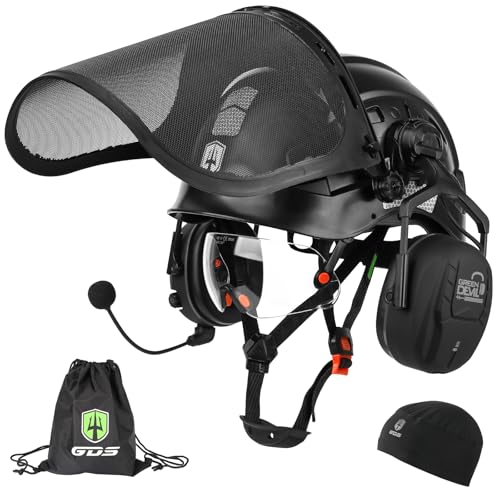
- Bluetooth 5.3 with 27 dB noise reduction
- Dual mesh shield and built-in visor
- ANSI/OSHA-compliant helmet system
Best For: Forestry work with wireless hearing protection
Best Full-Brim Coverage
GREEN DEVIL Full-Brim Forestry Helmet
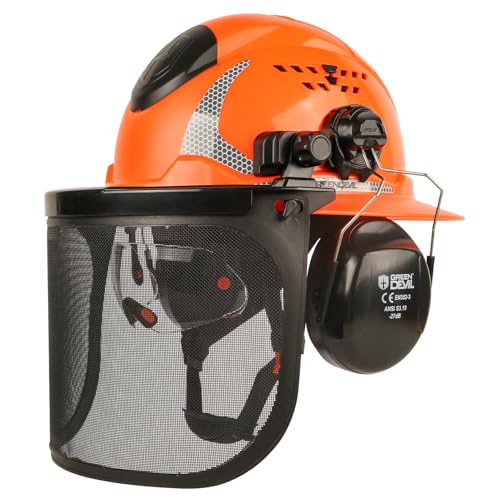
- Lightweight HDPE full-brim shell
- Four-in-one head, face, eye, and ear protection
- Ventilation and adjustable ratcheting fit
Best For: Outdoor forestry work in sun and changing weather
Most Versatile – NoCry 6-in-1 Forestry Helmet
For shoppers comparing lightweight forestry helmets, the NoCry 6-in-1 stands out for its configurable face and hearing protection. It combines an ANSI Z89.1 hard hat with interchangeable mesh and clear visors, adjustable ear muffs, and headgear designed to fit over glasses or a mask.
Best For: Forestry, arborist work, brush clearing, firewood cutting, landscaping, and DIY users who want flexible all-in-one protection.
Pros:
- Six configuration options with mesh and clear visors.
- Includes adjustable 25.9 dB SNR ear muffs.
- Headband adjusts for 21.2- to 24.4-inch head sizes.
- Components carry ANSI hard-hat, hearing, and face-visor ratings.
Cons:
- Its multiple components may feel less streamlined than a basic helmet.
- The stated fit range may not suit every user.
This is a practical choice when versatility matters as much as head protection. The ability to rotate the ear muffs and switch visor types makes it adaptable across changing outdoor tasks.
Best Adjustable Fit – Husqvarna Forestry Helmet
The Husqvarna Helmet is a solid option among lightweight forestry helmets for users who prioritize adjustability and visibility. Its six-point textile suspension, slip ratchet, etched visor, and adjustable ear muffs are designed to help tune the fit without excessive pressure.
Best For: Chainsaw users and forestry workers seeking an adjustable helmet with integrated eye and hearing protection.
Pros:
- Six-point textile suspension supports a customized fit.
- Three depth settings help position the helmet comfortably.
- Vertical and sideways ear-muff adjustment with 24 dB NRR.
- Meets ANSI Z89.1 Type I, Class E requirements.
Cons:
- The neck guard is sold separately.
- Listed weight is 2 pounds, so it may not feel ultralight to every wearer.
- Warranty coverage is limited to 90 days.
Its fit system and adjustable hearing protection make this a sensible pick for longer work sessions. Buyers should account for the separately sold neck guard if that coverage is needed.
Best Ventilation – Green Devil 4-in-1 Helmet
The Green Devil 4-in-1 combines a built-in visor, metal mesh face shield, ear muffs, and an ABS helmet. For shoppers seeking lightweight forestry helmets with comfort features, its ventilation holes, six-point suspension, sweat-wicking liner, and included storage bag are notable additions.
Best For: Arborist, logging, brush-cutting, and outdoor DIY work where face, eye, ear, and head coverage are needed.
Pros:
- Dual-layer eye and face protection can slide up or down.
- Vent holes promote airflow during outdoor work.
- Includes a sweat-wicking liner and drawstring storage bag.
- Fits 20.86- to 24.80-inch head sizes and carries stated ANSI/OSHA compliance.
Cons:
- One-size fit may not provide an ideal fit for every wearer.
- The ABS construction and multiple protective components may feel bulkier than a basic hard hat.
This model is geared toward users who want broad coverage and comfort-oriented features in one kit. Its ventilation and liner are particularly useful considerations for warm outdoor work.
Best Breathability – Oregon Safety Helmet Combo
The Oregon Chainsaw Safety Protective Helmet is a straightforward combo for buyers comparing lightweight forestry helmets. It pairs an impact-resistant helmet with six ventilation holes, a six-point adjustable harness, a stainless steel mesh visor, and articulated ear cups.
Best For: Logging and arboriculture tasks requiring a simple helmet, mesh visor, and ear-muff setup.
Pros:
- Six ventilation holes support breathability.
- Six-point harness allows a snug, adjustable fit.
- Stainless steel mesh visor flips up and down.
- Detachable sun peak and adjustable cap-mounted ear cups add flexibility.
Cons:
- Listed weight is 2 pounds.
- The supplied notes specify Class C rather than higher electrical-insulation classes.
- It includes a mesh visor, but no clear visor is listed.
This is a focused choice for users who prefer a ventilated, uncomplicated protective setup. The flip-up mesh visor and adjustable harness keep the design practical for routine chainsaw and forestry work.
Best Balanced Protection – LANON Forestry Safety Helmet
For shoppers comparing lightweight forestry helmets, the LANON combines an ANSI-approved ABS hard hat with a mesh face shield and removable hearing protection. Its adjustable suspension, ventilation, and moisture-wicking sweatband make it a practical choice for chainsawing, trimming, and outdoor projects.
Best For: DIY users and forestry workers who want an adjustable 3-in-1 helmet system.
Pros:
- Includes a mesh face shield and adjustable/removable NRR 24 dB earmuffs.
- 6-point ratchet suspension fits head circumferences from 20.5 to 24.8 inches.
- Ventilation, a replaceable brow pad, and moisture-wicking sweatband support comfort.
- Meets listed ANSI, OSHA, and CE-related protection standards.
Cons:
- It is supplied assembled except for the mask, which still requires assembly.
- The listed warranty is limited to six months.
The LANON is a well-rounded option when you want core head, face, and hearing coverage without buying separate components. Its broad adjustability also makes it suitable for shared household or work use.
Best Complete Kit – UM ULTRAMAXX 6-in-1 Chainsaw Helmet
Among lightweight forestry helmets, the UM ULTRAMAXX stands out for including more accessories in one package. Along with the ABS helmet, mesh shield, and earmuffs, it adds safety goggles, a cooling liner, and a drawstring storage bag for a more complete setup.
Best For: Chainsaw users and landscapers who want integrated eye, face, hearing, and head protection.
Pros:
- 6-in-1 kit includes goggles, cooling liner, and portable storage bag.
- 31 dB SNR earmuffs, mesh shield, and goggles provide layered coverage.
- 6-point suspension and rear tension knob fit 20.47–24.80-inch head circumferences.
- Ventilation and a sweat-wicking liner help manage heat during extended work.
Cons:
- The complete package weighs 1.24 kg according to the supplied specifications.
- It is listed as a medium-size helmet, despite its adjustable range.
This is the most feature-packed choice of the three. The modular components can be removed for lighter tasks, while the included bag makes transport and storage more convenient.
Best Visibility Features – GREEN DEVIL Forestry Helmet
Forestry Safety Helmet Chainsaw Helmet with Mesh Face Shield and Ear Muffs 3 in 1 Forestry Hard Hat
Check Price On AmazonThis GREEN DEVIL 3-in-1 model is a practical pick among lightweight forestry helmets, pairing an HDPE hard hat with a flip-up mesh visor and 25 dB NRR earmuffs. Hi-visibility coloring, sliding vents, and glove-friendly adjustment add useful details for outdoor and jobsite work.
Best For: Forestry and construction users who prioritize visibility and easy on-the-job adjustments.
Pros:
- Includes adjustable/removable earmuffs and a flip-up mesh face shield.
- Hi-vis orange styling improves visibility in low-light conditions.
- One-handed adjustment can be used while wearing gloves.
- 6-point suspension, chinstrap, sweatband, and sliding vents support practical use.
Cons:
- The product is described as one adjustable size rather than offering multiple sizes.
- It provides a mesh visor, not a sealed or transparent face shield.
- Assembly is required, although installation instructions are included.
The GREEN DEVIL is especially appealing for users working around machinery, brush, or changing weather. Its visibility-oriented design and glove-friendly adjustment make it a strong field-focused alternative.
Best Value – TOOLIOM 3-in-1 Forestry Helmet
For shoppers comparing lightweight forestry helmets, the TOOLIOM M-5016 is a practical all-in-one option with a hard hat, metal mesh visor, anti-fog goggles, and earmuffs. Its adjustable suspension, ventilation, and high-visibility orange design suit a range of outdoor and trade tasks.
Best For: Arborists, landscapers, tree trimmers, and general forestry or construction work requiring integrated head, eye, face, and hearing protection.
Pros:
- ANSI Z89.1 Type I, Class C certified and CE approved.
- Includes 25 dB SNR earmuffs, a flip-up metal mesh visor, and anti-fog goggles.
- Six-point suspension, sliding vents, and an adjustable 53–64 cm fit.
- High-visibility design with reflective details for lower-light visibility.
Cons:
- At 2.4 pounds, it may feel less lightweight than simpler hard hats.
- Class C certification does not provide electrical protection.
The TOOLIOM stands out when you want broad coverage and useful accessories in one ready-to-use kit. It is a solid value for buyers who prioritize versatility and visibility over the absolute lowest weight.
Best Connected Protection – GREEN DEVIL Bluetooth Forestry Helmet
Among lightweight forestry helmets, this GREEN DEVIL model adds Bluetooth hearing protection to a full face-and-eye protection system. It combines a mesh shield, built-in visor, six-point suspension, and a sweat-absorbing liner for extended chainsaw, brush-cutting, and forestry work.
Best For: Forestry and industrial workers who want integrated face, eye, head, and hearing protection with wireless audio and call functionality.
Pros:
- Bluetooth 5.3 earmuffs offer up to an 80-foot wireless range and a 27 dB noise reduction rating.
- Combines a metal mesh face shield with a built-in adjustable visor.
- Six-point suspension, replaceable sweatband, and molded chin-cup support a secure fit.
- Helmet, hearing protection, visor, and face shield meet the listed ANSI or CE standards.
Cons:
- At 3.5 pounds, it is the heaviest option in this roundup.
- Bluetooth features add complexity and may be unnecessary for users seeking a basic helmet.
- Its one-size fit covers 53–63 cm, a narrower range than some adjustable models.
This helmet is designed for buyers who value communication and entertainment alongside jobsite protection. The feature-rich system is less focused on minimum weight, but it offers strong convenience for longer work sessions.
Best Full-Brim Coverage – GREEN DEVIL Full-Brim Forestry Helmet
This GREEN DEVIL full-brim model is a strong choice for shoppers seeking lightweight forestry helmets with broader environmental coverage. Its HDPE shell, wide brim, ventilation, and integrated four-in-one protection system help address falling branches, glare, rain, wind, and flying debris.
Best For: Arborists, logging professionals, and outdoor workers who want full-brim coverage with removable hearing protection and integrated face and eye protection.
Pros:
- Strong, lightweight HDPE shell with a full brim for added sun, rain, wind, and debris coverage.
- Four-in-one setup includes a hard hat, ear protectors, face shield, and anti-fog built-in visor.
- Adjustable six-point suspension, ratcheting headgear, sweatband, and chin-cup support comfort and stability.
- Sliding vents help promote airflow and allow adjustment for changing conditions.
Cons:
- Full-brim construction may feel bulkier than a standard-profile helmet.
- Class C certification does not provide electrical protection.
- The supplied notes do not specify the helmet’s total weight or head-size range.
The full brim makes this model especially appealing for exposed outdoor work where weather and glare matter as much as impact and debris protection. Choose it when coverage is more important than a minimalist profile.
How We Picked the Best Lightweight Forestry Helmets
We focused on complete helmet systems designed for chainsaw use, forestry work, arborist tasks, and demanding property maintenance. The selected models were compared for stated safety certifications, integrated or included face shields, hearing protection, adjustment systems, ventilation, visor visibility, and overall versatility.
Because product specifications can vary by size, production run, and seller, verify the current listing and applicable requirements before purchase. A helmet should complement—not replace—safe cutting practices, training, protective clothing, and equipment inspections.
Quick Comparison
| Feature | What to look for |
|---|---|
| Head protection | Recognized hard-hat certification and a secure, adjustable suspension |
| Face protection | Mesh for airflow or clear plastic for splash and debris coverage |
| Hearing protection | Comfortable earmuffs that seal well without excessive pressure |
| Versatility | Removable or configurable visor and ear-muff components |
| Comfort | Low weight, ventilation, balanced fit, and easy adjustment |
Key Buying Factors for Lightweight Forestry Helmets
Fit and Adjustment
A lightweight helmet only feels light when it fits correctly. Look for a smooth rear adjustment, a stable suspension, and enough range to accommodate your head size. The helmet should remain secure when you bend, turn, or look upward without creating pressure points.
Visor Type and Visibility
Mesh visors generally provide better airflow and resist fogging, making them useful in warm conditions. Clear shields offer more complete coverage against fine debris and some splash hazards but may fog or scratch more easily. Check that the visor stays in position and does not obstruct your sightline.
Hearing Protection and Communication
Integrated earmuffs are convenient for chainsaw and equipment noise. Prioritize a comfortable seal, adjustable positioning, and a design that does not interfere with eyewear or other PPE. Bluetooth-equipped versions can be useful for communication, but they add components that require charging and maintenance.
Certification and Maintenance
Check the exact certification claims for the model and region where you will use it. Inspect the shell, suspension, visor, and earmuffs regularly; replace damaged or worn parts according to the manufacturer’s guidance. Do not modify the helmet or use incompatible accessories.
Who Should Buy Which Lightweight Forestry Helmets?
Choose a basic 3-in-1 or 4-in-1 system if you want straightforward protection for occasional firewood cutting or property work. A six-in-one kit is better for buyers who want mesh and clear visor options or expect to use one helmet across changing conditions. Arborists and frequent users should prioritize the best fit, ventilation, replaceable components, and long-term comfort over the largest accessory count. If communication is important, a Bluetooth model may be worthwhile, provided its hearing protection and battery requirements suit your workflow.
