
When an outage lasts for hours or days, a dependable generator can keep essential appliances, communications, tools, and climate-control equipment running. The right choice depends on more than peak wattage: fuel options, startup method, outlet configuration, noise, runtime, and safe installation all matter.
This roundup compares 10 heavy-duty portable backup generators and portable power stations across several use cases, from whole-home emergency power to quieter RV and electronics backup. Use the guide below to narrow the options by capacity, fuel flexibility, portability, and operating priorities.
Best 10 Heavy-Duty Portable Backup Generators Picks for 2026
Best Whole-Home Fuel Flexibility
Westinghouse 14500W Tri-Fuel Generator

- 11,500 running and 14,500 peak watts
- Runs on gas, propane, or natural gas
- Up to 19 hours at 25% load
Best For: Extended residential outages and high-demand home backup
Best Lightweight Battery Option

- 1,500W output with 3,000W surge
- 23.8-pound LFP power station
- Fast, quiet, app-controlled charging
Best For: Portable electronics, camping, and smaller emergency loads
Best Budget RV-Ready Inverter

- 3,400 running and 4,400 peak watts
- 14-hour runtime at 25% load
- 30A RV outlet and inverter technology
Best For: RV trips, camping, and moderate emergency power
Best Dual-Fuel RV Inverter

- Up to 6,800 surge watts on gasoline
- Runs on gasoline or propane
- RV-ready outlets and bonded-neutral 240V
Best For: RV backup, dual-fuel flexibility, and compatible EV charging
Lightweight RV Backup Pick
Compact 4,400-Watt Inverter Generator

- 4,400 peak and 3,400 running watts
- Up to 14 hours at 25% load with ECO mode
- 56-pound frame with RV-ready outlet
Best For: RV trips, camping, and moderate emergency backup
Balanced Home Backup Pick
6,500-Watt Dual-Fuel Generator
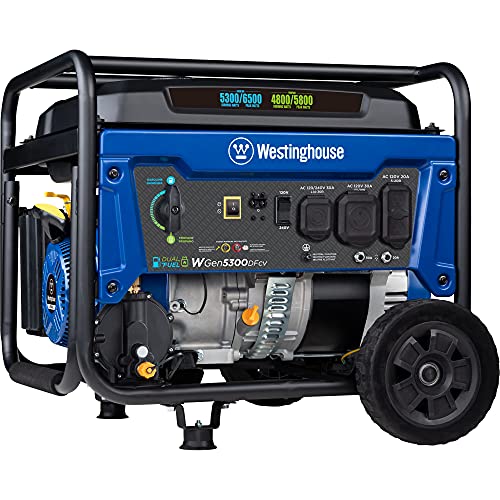
- Up to 6,500 peak and 5,300 running watts
- Gasoline or propane operation
- 30A RV and transfer-switch-ready outlets
Best For: Residential backup with fuel flexibility
Maximum Output Pick
13,000-Watt Dual-Fuel Generator

- 13,000 starting and 10,500 running watts
- 50A transfer-switch-ready outlet
- Remote electric start and CO shutdown
Best For: Whole-home backup and demanding equipment loads
Maximum Home Backup Capacity
Westinghouse 13500 Peak Watt Dual Fuel Generator

- 10,500 running and 13,500 peak watts on gasoline
- Up to 19 hours at 25% load
- Remote electric start and transfer-switch ready
Best For: High-output residential backup with extended runtime
Versatile Household and RV Power
Westinghouse 12500 Watt Dual Fuel Generator

- 9,500 running and 12,500 peak watts on gasoline
- 50A RV-ready and 30A transfer-switch-ready outlets
- Remote, electric, and recoil start options
Best For: Home backup with RV and multi-outlet versatility
Safety-Focused Dual-Fuel Backup
Westinghouse 12500 Peak Watt CO-Sensor Generator

- 9,500 running and 12,500 peak watts on gasoline
- Automatic CO and low-oil shutdown
- 50A RV-ready and 30A transfer-switch-ready outlets
Best For: High-output home backup with CO safety monitoring
Best Whole-Home Fuel Flexibility – Westinghouse 14500W Tri-Fuel Generator
For shoppers comparing heavy-duty portable backup generators, this Westinghouse model stands out for its 11,500 running and 14,500 peak watts on gasoline, plus gasoline, propane, and natural-gas compatibility. Its 50A and 30A outlets, transfer-switch readiness, remote electric start, and up to 19-hour runtime at 25% load make it a strong option for extended residential outages.
Best For: Homeowners who want high output, long runtime, and three-fuel flexibility in a portable generator.
Pros:
- High 11,500W running output on gasoline supports substantial home-backup loads.
- Tri-fuel operation offers gasoline, propane, or natural gas choices.
- Remote and push-button electric start, CO shutdown, and automatic low-oil protection add convenience and safety.
- Less than 5% THD helps provide cleaner power for phones, computers, and TVs.
Cons:
- At 230 pounds, it is considerably less convenient to move than smaller portable units.
- The transfer switch and automatic transfer switch are sold separately.
- Its open-frame design may be less suitable where low operating noise is a priority.
This is a substantial home-backup machine rather than a lightweight camping generator. Choose it when fuel flexibility, 240-volt-capable home connections, and long gasoline runtime matter more than portability.
Best Lightweight Battery Option – Jackery Explorer 1000 v2
The Jackery Explorer 1000 v2 is a compact alternative to fuel-powered heavy-duty portable backup generators. It supplies 1,500 watts with a 3,000-watt surge, weighs 23.8 pounds, and uses a quiet, rechargeable LFP battery system for camping, road trips, and smaller emergency loads.
Best For: Buyers who prioritize quiet, lightweight backup power for electronics, appliances, camping, and short-duration emergencies.
Pros:
- Portable 23.8-pound design with a foldable handle is easy to carry.
- Pure sine wave AC output, USB ports, a DC car port, and LED lights support varied devices.
- LFP battery is rated for over 4,000 cycles while retaining more than 70% capacity.
- App-controlled charging includes a one-hour emergency-charge mode and a 30 dB quiet mode.
Cons:
- Its 1,070Wh capacity and 1,500W output are not intended for sustained whole-home loads.
- Solar charging is compatible only with Jackery solar panels.
- The supplied runtime detail is listed as 42 minutes, so high-wattage appliances can drain it quickly.
This power station avoids fuel, exhaust, and engine maintenance, making it convenient indoors when used appropriately for its intended electrical loads. It is best viewed as a portable electronics and light-appliance backup rather than a replacement for a high-output home generator.
Best Budget RV-Ready Inverter – Oxseryn 4400W Generator
Among heavy-duty portable backup generators, the Oxseryn 4400W model offers a practical middle ground for RV use, camping, and basic home emergencies. It delivers 3,400 running watts, includes a 30A RV outlet, and can run for up to 14 hours at 25% load from its two-gallon gasoline tank.
Best For: RV owners and budget-conscious buyers needing moderate portable power with inverter technology.
Pros:
- Provides 4,400 peak watts and 3,400 running watts for common portable power needs.
- 30A RV outlet, two 120V AC ports, and a 12V DC port improve connection flexibility.
- At about 57 pounds, it is easier to move than larger home-backup generators.
- ECO mode, low-oil shutdown, overload protection, and cold-start technology support practical operation.
Cons:
- Gasoline-only operation offers less fuel flexibility than dual- or tri-fuel models.
- The one-year manufacturer warranty is shorter than the coverage offered by some competing units.
- The manufacturer notes that a slight gasoline smell may be present on arrival after factory testing.
This Oxseryn is a sensible choice when you need RV compatibility and extended light-load runtime without the weight of a large residential generator. Its 3,400 running watts are better suited to selected circuits and appliances than full-home backup.
Best Dual-Fuel RV Inverter – WEN DF680iX 6800W Generator
The WEN DF680iX combines inverter output, dual-fuel capability, and RV-ready connections in a 99.2-pound package. It produces up to 5,100 rated watts on gasoline or 4,500 rated watts on propane, while its bonded-neutral 240V configuration can provide low-power Level 2 charging for battery and hybrid electric vehicles.
Best For: RV users and emergency-preparedness buyers who want dual-fuel flexibility, electric start, and specialized 240V capability.
Pros:
- Runs on gasoline or propane, with up to 6,800 surge watts on gasoline.
- Includes an RV TT-30R receptacle, 120V/240V L14-30R outlet, USB ports, and a 12V DC receptacle.
- CO Watchdog, fuel shutoff, electric start, wheels, and a telescoping handle add practical usability.
- Bonded-neutral 240V configuration supports low-power Level 2 charging for compatible battery and hybrid EVs.
Cons:
- At 99.2 pounds, it is heavy for one-person transport.
- Listed runtime is six hours, so fuel planning may be needed during extended outages.
- Its rated output is lower on propane than on gasoline.
This WEN offers more flexibility than a basic RV generator, particularly for users who may need propane operation or the specified EV-charging capability. Its weight and shorter listed runtime make it better for prepared, occasional deployment than frequent lightweight transport.
Lightweight RV Backup Pick – Compact 4,400-Watt Inverter Generator
For shoppers comparing heavy-duty portable backup generators, the Oxseryn offers a relatively easy-to-move option for RV trips, camping, and limited home backup. It delivers 4,400 peak watts and 3,400 running watts, while ECO mode can extend runtime to up to 14 hours at 25% load.
Best For: RV owners, campers, and households needing a lighter emergency-power option.
Pros:
- 56-pound design is easier to reposition than larger open-frame generators.
- Includes two 120V AC outlets, a 12V DC port, and an RV-ready outlet.
- ECO mode, a fuel gauge, low-oil shutdown, and overload protection support practical operation.
Cons:
- Its 3,400 running watts are lower than the other generators in this roundup.
- Gasoline-only operation provides less fuel flexibility than dual-fuel models.
- Noise is rated under 72 dBA from 23 feet, so it is not silent.
The Oxseryn is a sensible choice when portability matters as much as output. Its 2-gallon tank and compact frame suit moderate loads, but buyers needing whole-home or high-demand equipment support should consider a larger model.
Balanced Home Backup Pick – 6,500-Watt Dual-Fuel Generator
The Westinghouse is a practical middle-ground choice among heavy-duty portable backup generators, combining gasoline or propane operation with outlets for household, RV, and transfer-switch connections. It produces up to 6,500 peak watts on gasoline and runs for up to 14.5 hours.
Best For: Homeowners who want flexible fuel options and transfer-switch-ready backup power.
Pros:
- Dual-fuel operation provides gasoline and propane flexibility.
- Offers 5,300 running watts on gasoline and 4,800 on propane.
- Includes an RV-ready TT-30R outlet and a transfer-switch-ready L14-30R outlet.
- CO shutdown, low-oil protection, rubber outlet covers, and a fuel gauge add useful safeguards.
Cons:
- At 135.6 pounds, it is substantially heavier than the Oxseryn.
- Its 14-hour runtime is specified with the larger 4.7-gallon tank, but actual runtime varies with load and fuel.
- It requires minimal assembly before use.
With its 120/240V selector, 30A connections, and dual-fuel design, the Westinghouse fits planned residential backup particularly well. It offers more capacity than a compact RV generator without reaching the size and weight of a whole-home-class model.
Maximum Output Pick – 13,000-Watt Dual-Fuel Generator
The DuroStar DS13000MX is the highest-output option here for shoppers seeking heavy-duty portable backup generators for demanding residential, commercial, or RV applications. Its 500cc engine provides 13,000 starting watts and 10,500 running watts, with gasoline and propane support.
Best For: Whole-home backup, high-demand equipment, job sites, and large RV power needs.
Pros:
- High 13,000-watt starting output and 10,500-watt running output support substantial loads.
- Dual-fuel operation lets users choose gasoline or propane.
- 50A transfer-switch-ready outlet supports whole-home connection setups.
- Remote electric start, CO detection, and a rugged all-metal frame improve usability and durability.
Cons:
- At 220 pounds, it is the least portable option in this group.
- Its large 29.75-by-27.5-by-25.75-inch footprint requires substantial storage space.
- Higher output and capacity may be excessive for basic camping or small backup loads.
The DS13000MX is the clear capacity leader, pairing a 50A connection with electric and remote starting. Choose it when substantial load support is the priority, and plan for assistance moving and positioning this 220-pound generator.
Maximum Home Backup Capacity – Westinghouse 13500 Peak Watt Dual Fuel Generator
For shoppers comparing heavy-duty portable backup generators, this Westinghouse model stands out with 10,500 running watts on gasoline, 13,500 peak watts, dual-fuel capability, and a 500cc engine. Its remote electric start, long gasoline runtime, and transfer-switch readiness make it suited to substantial residential backup needs.
Best For: Homeowners who need high-output emergency power with gasoline or propane flexibility.
Pros:
- Provides 10,500 running and 13,500 peak watts on gasoline.
- Runs up to 19 hours at 25% load on its 9.5-gallon gasoline tank.
- Includes remote key-fob start, electric start, and backup recoil starting.
- Supports transfer-switch and interlock-kit setups, with a CO sensor and low-oil shutdown.
Cons:
- At 230 pounds, it is heavy for one person to move.
- The automatic transfer switch is sold separately.
- Its open-frame design may be less convenient where low noise is a priority.
Choose this model when maximum output and extended gasoline runtime matter more than portability. It offers a particularly strong combination of capacity, fuel flexibility, starting options, and home-backup compatibility.
Versatile Household and RV Power – Westinghouse 12500 Watt Dual Fuel Generator
This Westinghouse is a practical choice among heavy-duty portable backup generators, delivering 9,500 running watts and 12,500 peak watts on gasoline. It combines dual-fuel operation, remote starting, a 50A RV-ready outlet, and a real-time VFT display for monitoring voltage, frequency, and lifetime hours.
Best For: Households and RV owners who want strong backup output and multiple connection options.
Pros:
- Produces 9,500 running and 12,500 peak watts on gasoline, or 8,500 running watts on propane.
- Offers remote, electric, and recoil starting.
- Includes two GFCI household outlets, a 30A transfer-switch-ready outlet, and a 50A RV-ready outlet.
- Features a cast-iron-sleeve engine, automatic low-oil shutdown, and digital monitoring.
Cons:
- Its 6.6-gallon tank provides up to 12 hours of runtime, less than the larger 13500-watt model.
- It weighs approximately 212 pounds.
- It does not list a CO sensor in the supplied specifications.
This model balances high residential output with especially useful outlet variety. It is a sensible fit if you want one generator for home backup, transfer-switch connections, and RV use.
Safety-Focused Dual-Fuel Backup – Westinghouse 12500 Peak Watt CO-Sensor Generator
For buyers prioritizing safety features in heavy-duty portable backup generators, this Westinghouse delivers 9,500 running watts and 12,500 peak watts on gasoline while adding automatic carbon monoxide shutdown. Dual-fuel operation, remote start, and transfer-switch-ready connections support flexible emergency use.
Best For: Residential users seeking high-output backup power with an integrated CO safety feature.
Pros:
- Supplies 9,500 running and 12,500 peak watts on gasoline, with 8,500 running watts on propane.
- Includes automatic low-oil and carbon monoxide shutdown.
- Provides remote, electric, and recoil starting.
- Offers household, 30A transfer-switch-ready, and 50A RV-ready outlets.
Cons:
- Runtime is up to 12 hours on the 6.6-gallon gasoline tank.
- At 212.1 pounds, it is difficult to handle without assistance.
- The transfer switch itself is not included.
This version is a strong option when CO monitoring is a deciding factor. It retains the substantial output and flexible connections of the platform while adding an important automatic shutdown feature.
How We Picked the Best Heavy-Duty Portable Backup Generators
We focused on generators and power stations that can provide meaningful emergency backup rather than small, occasional-use power. The selection includes high-output dual-fuel and tri-fuel models for major household loads, as well as inverter generators and a battery power station for quieter, cleaner power. We compared advertised wattage, fuel compatibility, electric or remote starting, transfer-switch readiness, RV outlets, inverter technology, emissions and carbon-monoxide safety features, portability, and practical use cases.
Specifications can vary by configuration and fuel type. Before buying, confirm the manufacturer’s running-watt rating, outlet limits, included accessories, and local requirements for outdoor operation and transfer-switch installation.
Quick Comparison
- Largest household-load capacity: The 13,000- to 14,500-peak-watt models are the strongest candidates for broad emergency coverage, provided the running-watt rating supports your actual loads.
- Balanced home backup: 12,500- and 13,500-peak-watt dual-fuel generators offer substantial capacity with gasoline and propane flexibility.
- Midrange backup and RV use: 6,500- to 6,800-watt models can support essential circuits, appliances, and many RV loads without the size of a whole-home-class unit.
- Quieter electronics and lighter-duty needs: The inverter generators and Jackery power station are better suited to sensitive electronics, camping, small appliances, and situations where reduced noise matters.
Key Buying Factors for Heavy-Duty Portable Backup Generators
Running Watts Versus Peak Watts
Starting watts cover brief surges from refrigerators, pumps, compressors, and other motor-driven equipment. Running watts determine what the generator can sustain. Add the continuous wattage of the appliances you expect to use, then leave headroom for startup surges. A high peak number alone does not guarantee whole-home capability.
Fuel Flexibility and Runtime
Dual-fuel models can run on gasoline or propane, while tri-fuel units add natural gas when supported. Gasoline typically offers strong output, propane stores well, and natural gas can simplify extended utility outages. Compare runtime at a stated load, not only tank size, and keep fuel storage and local regulations in mind.
Connection, Safety, and Installation
Transfer-switch readiness is important if you want to power selected household circuits safely. Never connect a portable generator directly to a wall outlet. Use it outdoors, far from doors and windows, with adequate ventilation, and treat CO sensors as an added safeguard—not a replacement for proper placement. A qualified electrician should handle permanent connections.
Noise, Portability, and Power Quality
Open-frame generators generally prioritize output and value, while inverter designs usually provide cleaner power and lower noise. Check weight, wheel and handle design, outlet layout, and whether electric or remote start is worth the added complexity for your conditions.
Who Should Buy Which Heavy-Duty Portable Backup Generators?
- Choose a high-output tri-fuel model if you want broad home-backup capability and access to gasoline, propane, and potentially natural gas.
- Choose a 12,500- to 13,500-peak-watt dual-fuel model for substantial emergency capacity with the convenience of propane backup.
- Choose a 13,000-watt dual-fuel generator when large appliances, pumps, or workshop equipment require especially strong starting capacity.
- Choose a 6,500- to 6,800-watt unit for essential circuits, RV use, and a more manageable balance of output, size, and cost.
- Choose an inverter generator when lower noise, ECO operation, or cleaner power is more important than maximum whole-home output.
- Choose the portable power station for silent, fuel-free backup of electronics, networking equipment, lights, and smaller devices. Its battery capacity and recharge needs make it less suitable for sustained high-wattage appliances.
Whichever model you choose, test-start it before an emergency, follow the maintenance schedule, and calculate your essential loads in advance. That preparation matters as much as the generator’s headline wattage.
