
A hammock can feel wonderfully light and flexible on the trail, but cold air beneath the fabric can quickly undermine a comfortable night outdoors. The right underquilt adds targeted insulation without requiring a bulky sleeping system.
We’ve gathered 10 compact hammock underquilts suited to different weather conditions, hammock sizes, and budgets. Use the comparison and buying advice below to narrow your choices by warmth, weight, coverage, setup, and versatility.
Best 10 Compact Hammock Underquilts Picks for 2026
Best All-Season Value

- 23°F cold-weather rating
- 950 g with compact 8-inch-diameter pack size
- Includes carabiners and elastic cords
Best For: Fall and winter hammock camping on a practical budget
Best Adjustable Budget Pick
Underquilt Blanket for Camping

- Water- and wind-resistant ripstop shell
- Adjustable shock cords and cord locks
- Packs to 6 by 15 inches
Best For: Budget campers needing a versatile, adjustable fit
Best Ultralight Down Option

- Only 13 ounces
- 850-fill-power goose down insulation
- 20°F rating with equal-warmth top insulation
Best For: Ultralight hammock backpackers with a matched top quilt
Best Eco-Conscious Double Hammock Quilt
onewind Double Hammock Underquilt
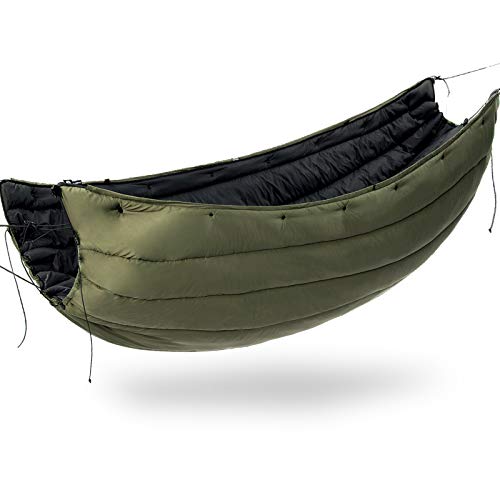
- Bio-based Sorona insulation
- 83-by-52-inch coverage for double hammocks
- Adjustable cords and compression storage bag
Best For: Double-hammock campers wanting roomy, adjustable insulation
Most Versatile
Kijaro Kubie Multi-Use Hammock Underquilt

- Eight configurations, including an underquilt and sleeping bag
- Water-resistant nylon ripstop with integrated straps
- Packs into a handled pouch; hammock supports up to 250 pounds
Best For: Multi-purpose camping, travel, and sports sidelines
Best Dedicated Option
CROSSHIP Full-Length Lightweight Underquilt

- 1.7-pound full-length design for easier packing
- 20D ripstop shell with DWR coating and 700-gram fill
- Sized for most standard hammocks with adjustable attachment points
Best For: Lightweight hammock camping in moderate temperatures
Best for Cold Conditions
Camouflage Warm Hammock Underquilt

- Designed to surround the hammock’s sides and bottom
- Hollow cotton fill targets a stated 0°F–15°F chill range
- Water-repellent shell, soft liner, and compression sack
Best For: Winter-oriented hammock camping with full-length coverage
Wind-Ready Compact Hammock Underquilt

- Under 2 pounds and packable
- Draft collar helps block wind
- Adjustable, broadly compatible fit
Best For: Lightweight three-season hammock camping
Spacious Warm Compact Hammock Underquilt

- Roomy 102-by-63-inch coverage
- 200g/m² hollow-cotton insulation
- Includes a convenient storage bag
Best For: Campers wanting warmth and generous coverage
Soft Cotton Compact Hammock Underquilt

- 200g hollow-cotton insulation
- Loose fit supports varied sleeping positions
- Includes a compression storage bag
Best For: Cool-weather hammock camping in milder conditions
Best All-Season Value – DD Hammocks Underblanket
For shoppers comparing compact hammock underquilts, the DD Hammocks Underblanket offers a practical balance of cold-weather coverage, manageable weight, and simple setup. It weighs 950 g, packs to about 8 inches in diameter, and is rated for temperatures down to 23°F.
Best For: Fall and winter hammock camping when you want substantial insulation without an oversized packed bundle.
Pros:
- Rated for temperatures down to 23°F.
- Weighs under a kilogram and packs compactly.
- Included carabiners and elastic cords make attachment straightforward.
Cons:
- At 950 g, it is heavier than the ultralight options in this roundup.
- The nylon underblanket is designed to fit beneath a hammock rather than serve as a standalone sleeping quilt.
The DD Underblanket is a sensible choice for campers prioritizing reliable cold-weather insulation and easy installation over minimum trail weight.
Best Adjustable Budget Pick – Underquilt Blanket for Camping
This compact hammock underquilt is a flexible option for campers who want water- and wind-resistant fabric, adjustable fit, and a small stuff-sack package. Its 300 g microfiber fill is intended for a broad temperature range of 17–64°F.
Best For: Budget-conscious hammock campers who need adjustable coverage for different hammock sizes and changing conditions.
Pros:
- 210T ripstop polyester shell has a urethane coating for water and wind resistance.
- Attached shock cords and cord locks adjust the ends and sides.
- Includes a stuff sack and packs to 6 by 15 inches.
- Reversible green-and-gray design offers two color options.
Cons:
- At 1.8 pounds, it is not the lightest choice for backpacking.
- Its stated temperature range is broad, so real comfort will depend on conditions and sleep-system layering.
With useful adjustability and weather-resistant construction, this underquilt suits casual trips and backpacking setups where packability matters but ultralight weight is not the only priority.
Best Ultralight Down Option – SlingLite Hammock Underquilt
Western Mountaineering Slinglite Hammock Underquilt One Size | SlingLite Hammock Underquilt
Check Price On AmazonFor backpackers seeking compact hammock underquilts with minimal carry weight, the SlingLite stands out at only 13 ounces. It uses 850-fill-power goose down, 15-denier water-resistant nylon, and continuous baffles for loft, with a 20°F rating when paired with equally warm top insulation.
Best For: Weight-conscious hammock backpackers who already use a comparably warm top-insulation system.
Pros:
- Very light at 13 ounces.
- 850-fill-power goose down provides a high warmth-to-weight focus.
- Continuous baffles are designed to preserve loft and warmth.
- Multiple attachment options support fit adjustments and varied setups.
Cons:
- The 20°F rating applies when paired with top insulation of equal warmth.
- Its approximate packed size is 5 by 10 inches or larger, so the final bundle may vary.
- Down insulation and water-resistant nylon still require care in wet conditions.
The SlingLite is the clear ultralight specialist here, particularly for experienced hammock backpackers who understand that the stated rating depends on a complete, well-matched sleep system.
Best Eco-Conscious Double Hammock Quilt – onewind Double Hammock Underquilt
The onewind Double Hammock Underquilt combines a roomy 83-by-52-inch design with 20D recycled nylon and bio-based Sorona insulation. For a compact hammock underquilt suited to three- or four-season use, its adjustable ends, center tightening, and compression bag make fit and packing straightforward.
Best For: Double-hammock users who want broad underbody coverage, adjustable airflow, and bio-based insulation.
Pros:
- Sorona insulation offers loft and recovery after compression.
- Recycled 20D nylon is described as windproof and waterproof for light rain.
- Adjustable cords let you tighten for warmth or loosen for airflow.
- Carabiners and a double-sided compression bag simplify setup and storage.
Cons:
- At 2.3 pounds, it is relatively heavy for ultralight backpacking.
- Its compact folded dimensions are listed as 7.1 by 15.2 cm, but the 83-by-52-inch coverage favors a larger hammock setup.
- The notes do not provide a specific temperature rating.
This is a practical, feature-rich choice for campers who value generous coverage, easy adjustment, and recycled or bio-based materials more than the lowest possible packed weight.
Most Versatile – Kijaro Kubie Multi-Use Hammock Underquilt
If you want compact hammock underquilts with more than one use, the Kijaro Kubie stands out as a multi-purpose camping layer. It converts into eight configurations, including an underquilt, hammock, sleeping bag, poncho, and shade canopy, then packs into a handled pouch.
Best For: Campers and travelers who value versatile gear for outdoor activities, sports sidelines, and general emergency use.
Pros:
- Eight configurations include an insulated poncho, ground cover, sleeping bag, hammock liner, underquilt, and canopy.
- Nylon ripstop fabric has a water-resistant coating.
- Includes integrated hammock straps and a fleece-lined hood.
- Hammock configuration supports up to 250 pounds and packs to 16.9 x 9.1 x 5.5 inches.
Cons:
- At 3.6 pounds, it is heavier than a dedicated lightweight underquilt.
- Its multi-use design may be less specialized than a purpose-built underquilt.
The Kubie is a practical choice when pack space matters but versatility matters more than minimum weight. Choose it for an all-in-one outdoor kit rather than a dedicated cold-weather sleep system.
Best Dedicated Option – CROSSHIP Full-Length Lightweight Underquilt
For shoppers comparing compact hammock underquilts, the CROSSHIP offers a dedicated full-length design with a stuff sack and a 1.7-pound weight. Its 700-gram polyester fill is intended for temperatures from 41°F to 68°F, making it suited to three- to four-season use in milder conditions.
Best For: Backpackers and hammock campers seeking a lightweight, full-length underquilt for spring, summer, fall, and warmer winter days.
Pros:
- Uses a 20D ripstop nylon shell with DWR coating and a soft 300T polyester pongee lining.
- Large 95 x 55-inch size fits most standard hammocks.
- Split ends, elastic straps, and bungee loops help with positioning and setup.
- Weighs 1.7 pounds and includes a compression stuff sack.
Cons:
- The stated temperature range is 41°F to 68°F, so it is not presented as a deep-winter quilt.
- It is an underquilt only and does not function as a hammock or carry a load.
The CROSSHIP is the most focused option here for reducing pack weight while retaining full-length coverage. Its published temperature range makes it a better match for moderate conditions than severe cold.
Best for Cold Conditions – Camouflage Warm Hammock Underquilt
Backbayia Hammock Underquilt Warm Under Blanket Sleeping Bag for Camping Backpacking (Camouflage)
Check Price On AmazonThis camouflage hammock underquilt is designed to surround the sides and bottom of a hammock, helping reduce exposure to winter chill. It combines water-repellent ripstop polyester, a soft pongee liner, hollow cotton fill, adjustable shock cords, and a compression stuff sack.
Best For: Campers who want full-length hammock coverage and a camouflage finish for winter-oriented outdoor use.
Pros:
- Hollow cotton fill is designed to protect against a stated 0°F–15°F winter chill range.
- Water-repellent 201T ripstop polyester taffeta exterior.
- Soft 240T polyester pongee liner adds a more comfortable interior surface.
- Adjustable shock cords simplify setup, and a compression sack supports storage.
Cons:
- The supplied notes do not provide dimensions or a hammock weight capacity.
- At 200 grams as listed, the stated weight may warrant verification before relying on it for a winter kit.
This model emphasizes warmth and full-length coverage over detailed fit specifications. It is worth considering for cold-weather hammock use, but shoppers should confirm the listed weight and compatibility with their hammock before buying.
Wind-Ready Compact Hammock Underquilt – Insulated Camping Quilt
This compact hammock underquilt is a practical choice for campers who want full-length insulation without carrying a bulky blanket. It weighs under 2 pounds, packs small, and uses adjustable suspension and draft-control features to help reduce heat loss on breezy three-season nights.
Best For: Backpackers and hammock campers seeking lightweight, packable warmth with broad hammock compatibility.
Pros:
- Under-2-pound design packs easily for backpacking.
- Draft collar, edge sealing, and wind-blocking insulation help limit convective heat loss.
- Color-coded clips and adjustable shock cords simplify setup and fit adjustment.
- Water-resistant outer fabric helps protect against dew and light moisture.
Cons:
- Hammock is not included.
- Listed maximum weight recommendation is 20 kg; this product is an underquilt, not a load-bearing hammock.
- Designed for three-season use rather than severe winter conditions.
With its low weight, universal-style adjustment, and wind-focused construction, this is a strong compact option for regular three-season hammock trips.
Spacious Warm Compact Hammock Underquilt – Ripstop Nylon Under Blanket
This compact hammock underquilt combines hollow-cotton insulation with a generous 102-by-63-inch profile. Its adjustable elastic cords help create a snug fit, while the included storage bag makes it easier to carry for camping, hiking, and travel.
Best For: Campers who prioritize a roomy underquilt with warm insulation and convenient storage.
Pros:
- 200g/m² hollow-cotton filler and a soft polyester lining provide warmth.
- Large 102-by-63-inch design accommodates various hammocks.
- Adjustable elastic cords help seal out cold wind.
- Storage bag supports portable packing and transport.
Cons:
- At 2.2 pounds, it is heavier than the lightest underquilt options.
- The supplied notes do not specify a temperature rating.
- Its spacious dimensions may be less appealing when minimum pack size is the priority.
This model is a sensible middle ground for buyers who want portable hammock insulation but prefer extra coverage over ultralight weight.
Soft Cotton Compact Hammock Underquilt – Winter Warm Sleeping Quilt
Winter Warm Sleeping Hammock Ultralight Hammock Underquilt Camping Warm Quilt Blanket Cotton Hammock
Check Price On AmazonThis compact hammock underquilt wraps around the bottom and sides of a hammock to add warmth while remaining light and easy to store. The 200g hollow-cotton fill, adjustable buckles, and compression bag make it suited to extending hammock trips into cooler seasons.
Best For: Hammock campers seeking soft cotton insulation and flexible coverage for cool-weather outdoor use.
Pros:
- 200g hollow-cotton filling provides a warm insulating layer.
- Loose design accommodates lying flat or curled-up sleeping positions.
- Light, thin construction and a compression bag support portability.
- Adjustable tightening buckles help fit different hammock setups.
Cons:
- Despite the winter-oriented description, the notes say it is not for cold winter conditions.
- Cotton construction may not suit buyers specifically seeking synthetic insulation.
- The supplied details do not provide a weight or temperature rating.
This underquilt is best viewed as a soft, flexible layer for spring, summer, autumn, and warmer winter nights rather than a severe-cold solution.
How We Picked These Compact Hammock Underquilts
We focused on underquilts and multi-use hammock insulation designed for camping, backpacking, hiking, and travel. Our comparison considers stated temperature suitability, insulation type, coverage, packed portability, suspension or setup convenience, and likely compatibility with common gathered-end hammocks. Because published specifications vary, treat temperature ratings as guidance rather than a guarantee; sleep system, wind, humidity, clothing, and personal comfort all affect real-world warmth.
Quick Comparison
| What to Compare | Best For | Why It Matters |
|---|---|---|
| Full-length coverage | Cold-weather camping | Protects more of your body from convective heat loss. |
| Shorter or lighter design | Ultralight trips | Reduces pack weight and bulk, but may require warmer clothing. |
| Multi-use construction | Minimalist campers | One item may serve as a blanket, poncho, sleeping bag, or underquilt. |
| Adjustable suspension | Frequent hammock users | Helps seal gaps and improves fit across hammock styles. |
| Durable ripstop shell | Regular outdoor use | Offers better resistance to abrasion and handling damage. |
Key Buying Factors for Compact Hammock Underquilts
Warmth and Insulation
Check the stated temperature range, fill material, and insulation thickness. A winter-rated quilt is useful in freezing conditions, while a lighter three-season model may pack smaller and avoid excess weight in mild weather. Remember that an underquilt insulates your underside; you still need an appropriate top quilt or sleeping bag.
Fit and Coverage
Choose a full-length model if you want consistent insulation from shoulders to feet. A shorter quilt can be more compact, but your legs and feet may need separate insulation. Look for shock cords or adjustable ends that let the quilt sit close to the hammock without compressing the fill.
Weight, Packed Size, and Materials
For backpacking, compare total weight and packed dimensions rather than relying on labels such as “ultralight.” Ripstop nylon can improve durability, while cotton-based or heavier fills may offer comfort at the expense of packability. Confirm whether a stuff sack, suspension system, and storage bag are included.
Setup and Compatibility
A practical quilt should attach quickly and remain positioned when you move. Verify the hammock’s length and width, attachment points, and whether the underquilt uses universal cords, carabiners, or dedicated hardware. Avoid overtightening, which can flatten insulation and create cold spots.
Who Should Buy Which Compact Hammock Underquilts?
Choose a full-length, warmer-rated quilt for late-fall, winter, or exposed campsites. Backpackers covering long distances should prioritize low weight and a small packed size, accepting that a shorter quilt may need extra foot insulation. If you camp across changing seasons, a versatile three- or four-season design offers a useful balance. Multi-use options suit minimalist travelers who value one piece of gear that can function beyond hammock insulation. For occasional backyard or beach use, a simpler, easy-to-pack model may provide better value than a technical winter quilt.
