
The best portable power stations for commuters keep phones, tablets, laptops, lights, and other essentials running when outlets are unavailable. The right model balances capacity, portability, charging speed, and the connections you actually use.
We’ve compared 10 compact power stations across battery size, output, recharge options, durability, and everyday convenience to help you choose a dependable fit for commuting, business travel, campus life, or emergency use.
Best 10 Portable Power Stations for Commuters Picks for 2026
Best Compact Commuter Pick
Daran 89.6Wh LiFePO4 Power Station

- Smartphone-sized, 2.54-pound design
- Seven ports with 100W AC output
- Fanless operation and 3,500+ cycle battery
Best For: Backpack commuters carrying phones, laptops, and small electronics
Best Capacity Upgrade
Jackery Explorer 300 Portable Power Station

- 292Wh capacity in a 7.5-pound design
- 300W rated output with 600W peak
- Multiple AC, USB, and car-port outputs
Best For: Longer commutes, travel, camping, and multi-device charging
Best Rugged Travel Option
BLAVOR 236.8Wh Waterproof Power Station

- 236.8Wh capacity and 4.5-pound weight
- IP67 waterproof and shockproof casing
- Wireless charging pad and 360-degree lantern
Best For: Outdoor commuting, travel, rainy conditions, and emergency use
Best Fast-Charging Mini Station
R101 Lite 89.6Wh Power Station

- 2.5-pound, carry-on-friendly design
- 100W USB-C output and 65W input
- Four charging methods with fanless operation
Best For: Travelers and commuters needing fast, quiet USB-C power
Compact Commuter Backup
HOWEASY 120W Portable Power Station

- Lightweight 2.3-pound, backpack-friendly design
- Eight ports for charging multiple small devices
- AC, car, and solar-compatible recharging
Best For: Lightweight personal electronics backup
Air-Travel Ready Choice
BLUETTI Elite 10 Mini Power Station

- 200W AC output with 100W USB-C charging
- 10ms UPS supports continuity for essential electronics
- Compact 3.97-pound design with app control
Best For: Mobile work and approved air travel
High-Capacity Commuter Basecamp
DaranEner Cubus600L 600W Power Station
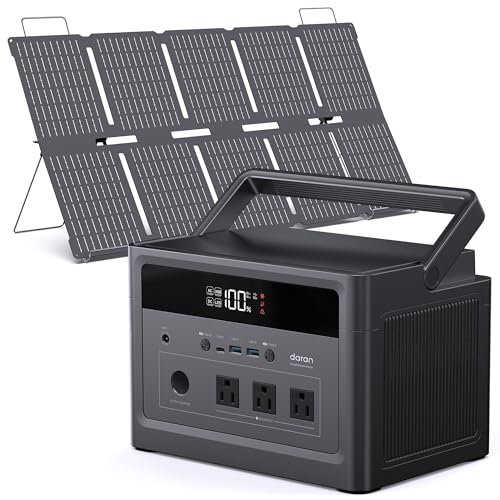
- 576Wh capacity with 600W continuous output
- Includes a foldable 100W solar panel
- Three AC outlets plus USB-C, USB-A, and 12V ports
Best For: Car-based travel and extended emergency backup
Best Overall Commuter Backup

- 288Wh capacity with 600W continuous output
- Fast 0-80% wall charging in about 45 minutes
- 10ms UPS backup for critical electronics
Best For: Commuters needing robust backup power for laptops, routers, or CPAP machines
Best Lightweight Option

- Only 5 pounds for easy daily carrying
- Nine outlets, including three USB-C ports
- Quiet 200W running output for small electronics
Best For: Commuters prioritizing portability for phones, laptops, and accessories
Best Compact Commuter Pick – Daran 89.6Wh LiFePO4 Power Station
For commuters who want portable power stations for commuters that fit easily into a backpack, the Daran stands out for its smartphone-sized design, quiet operation, and useful mix of AC, USB, and DC outputs. Its 89.6Wh LiFePO4 battery is best suited to personal electronics and smaller devices rather than high-wattage appliances.
Best For: Backpack commuting, laptops, phones, cameras, and quiet backup power at work or while traveling.
Pros:
- Compact 2.54-pound design with a soft ergonomic handle.
- Seven output ports, including two AC outlets and USB-C PD charging.
- Fanless operation, an LED display, flashlight, and LiFePO4 battery rated for 3,500+ cycles.
Cons:
- Its 100W output is limited to smaller electronics and low-power devices.
- Solar panel and charging cable are not included.
The Daran is a practical choice when portability and silent operation matter more than capacity. It can keep a commuter’s core devices running, but users needing longer runtimes or heavier loads should consider a larger station.
Best Capacity Upgrade – Jackery Explorer 300 Portable Power Station
The Jackery Explorer 300 is a strong option for shoppers comparing portable power stations for commuters who need more reserve capacity than a compact power bank can provide. Its 292Wh battery, 300W rated output, and six-device charging support make it useful for longer workdays, travel, and outdoor backup.
Best For: Commuters who carry several devices, need extended laptop and camera power, or want a more capable travel and camping backup.
Pros:
- 292Wh capacity with a relatively lightweight 7.5-pound body and integrated handle.
- 300W rated output with 600W peak surge capability.
- Two AC outlets, USB-C PD, USB-A ports, and a car port support multiple devices.
- LiFePO4 chemistry is rated for more than 4,000 cycles before reaching 70% capacity.
Cons:
- Heavier and bulkier than the sub-3-pound compact options.
- Solar panel is optional rather than included.
- Its AC outlet count is limited to two.
Choose the Explorer 300 when battery capacity and output flexibility are higher priorities than minimal carry weight. It is more station than pocket charger, but that added size brings meaningfully longer runtime for a commuter’s devices.
Best Rugged Travel Option – BLAVOR 236.8Wh Waterproof Power Station
For commuters who regularly move between work, travel, and outdoor settings, the BLAVOR combines a 236.8Wh battery with rugged protection and convenient charging features. Among portable power stations for commuters, it is especially notable for its IP67 waterproof rating, wireless charging pad, and built-in lantern.
Best For: Outdoor commuters, travelers, and anyone who wants weather-resistant backup power with integrated lighting.
Pros:
- 236.8Wh capacity with a relatively portable 4.5-pound weight.
- Two bidirectional USB-C ports, two USB-A ports, and 15W wireless charging.
- IP67 waterproof construction with shockproof protection when the silicone cover is closed.
- Built-in 360-degree lantern offers up to 59 hours on low mode.
Cons:
- The listed 165W output is less suitable for higher-demand appliances.
- Solar panel is sold separately.
- Wireless charging requires a compatible Qi device.
The BLAVOR is a well-rounded pick for commuting that includes rain, camping, or emergency preparation. Its combination of weather resistance, lighting, and wireless charging adds convenience, though users focused mainly on AC-powered devices may prefer a model with more clearly specified AC output.
Best Fast-Charging Mini Station – R101 Lite 89.6Wh Power Station
The R101 Lite is designed for commuters who want portable power stations for commuters with fast recharging and a carry-on-friendly footprint. Its 89.6Wh LiFePO4 battery, two-way USB-C charging, and fanless design make it convenient for topping up electronics during travel or a workday.
Best For: Airline travelers, students, and professionals who need rapid USB-C charging in a small, quiet package.
Pros:
- Compact 2.5-pound, venti-cup-sized design suitable for carry-on travel.
- USB-C1 supports 65W input and 100W output, with multiple additional ports.
- Supports AC, USB-C PD, car, and solar recharging methods.
- Fanless operation, LiFePO4 cells, and 12-layer safety monitoring.
Cons:
- The 89.6Wh capacity provides less reserve than larger stations.
- Solar panel is not included.
- AC output automatically shuts off below 9% battery level.
The R101 Lite is a particularly practical commuter choice when fast USB-C performance and easy portability are the priorities. Its limited capacity and 100W AC output keep it focused on personal electronics rather than demanding equipment.
Compact Commuter Backup – HOWEASY 120W Portable Power Station
For commuters looking for portable power stations for commuters, the HOWEASY H120 emphasizes a small, lightweight design and broad device compatibility. Its 88Wh battery, 120W AC output, and 2.3-pound carry weight make it suitable for charging personal electronics, lights, and other low-wattage gear at work, school, or during travel.
Best For: Commuters who need lightweight backup power for phones, tablets, cameras, lights, and other small devices.
Pros:
- Compact 6.6 x 4 x 3-inch design weighs just 2.3 pounds.
- Eight output ports support charging several devices simultaneously.
- Offers AC, car, and compatible solar-panel recharging options.
- Built-in LED flashlight includes steady, flashing, and SOS modes.
Cons:
- Its 120W output is intended for smaller electronics rather than high-power appliances.
- The solar panel is not included.
- The 88Wh capacity is lower than that of larger backup stations.
The HOWEASY is a practical choice when portability matters most. It fits easily into a backpack and provides useful charging flexibility, but shoppers should stay within its 120W output limit.
Air-Travel Ready Choice – BLUETTI Elite 10 Mini Power Station
The BLUETTI Elite 10 is one of the more travel-focused portable power stations for commuters, combining a 128Wh capacity with a 200W AC outlet and 100W USB-C fast charging. Its 3.97-pound body is designed for easy carrying, while airline approval with prior permission may make it useful for certain flights.
Best For: Commuters and travelers who want compact power, fast USB-C charging, and brief UPS protection for essential electronics.
Pros:
- 200W AC output and 100W USB-C charging support laptops and other small devices.
- Built-in 10ms UPS can help keep laptops, routers, and security equipment running during interruptions.
- Supports AC, solar, and car charging, including up to 150W AC input.
- Bluetooth app control and integrated lighting add convenience.
Cons:
- Airline carry-on use requires prior approval and is subject to airline limits.
- Its single listed AC outlet may be less convenient for several AC-powered devices.
- The 128Wh capacity is intended for compact electronics rather than extended high-wattage use.
With fast recharging, UPS functionality, and a compact form factor, the Elite 10 is especially appealing for mobile work and travel. Confirm airline policies before bringing it on a flight.
High-Capacity Commuter Basecamp – DaranEner Cubus600L 600W Power Station
The DaranEner Cubus600L is a larger option among portable power stations for commuters, offering 576Wh of capacity and 600W continuous output. It is better suited to extended trips, vehicle-based commuting, or emergency backup than daily backpack carry, especially because the included 100W solar panel expands its off-grid usefulness.
Best For: Commuters who travel by car or RV and need extended power for laptops, CPAP devices, small appliances, or emergency equipment.
Pros:
- 576Wh LiFePO4 battery and 600W output provide substantially more capacity than mini stations.
- Three AC outlets, 100W USB-C PD, USB-A ports, and a 12V car port support multiple devices.
- Includes a foldable 100W solar panel and supports AC, car, and solar charging.
- LiFePO4 battery is rated for 3,500+ cycles and includes BMS protection.
Cons:
- At 13.7 pounds, it is considerably less convenient for backpack commuting.
- Its larger 11.1 x 7.52 x 7.83-inch body takes more storage space.
- The 600W output is not intended for appliances requiring more continuous power.
The Cubus600L makes sense when runtime and device range outweigh maximum portability. Its solar panel, durable battery chemistry, and three-year warranty add value for car-based travel and emergency preparedness.
Best Overall Commuter Backup – BLUETTI Elite 30 V2
For commuters who want substantial capacity without carrying a full-size generator, the BLUETTI Elite 30 V2 is a strong option among portable power stations for commuters. Its 288Wh battery, 600W continuous output, compact design, and fast wall charging make it practical for laptops, routers, CPAP machines, and other essential electronics during travel or outages.
Best For: Commuters who need higher output, fast recharging, and dependable backup power for work or emergency electronics.
Pros:
- 288Wh capacity in a lightweight 9.5-pound body.
- 600W continuous output with a 1500W Power Lifting mode.
- Charges from 0% to 80% in about 45 minutes with wall power.
- 10ms UPS switching helps keep laptops, routers, and CPAP machines running during interruptions.
Cons:
- Its 9.5-pound weight is higher than the smallest commuter-focused options.
- The solar panel is compatible but sold separately.
The Elite 30 V2 is the most capable choice here for commuters who prioritize capacity and output over minimum carry weight. Its fast charging and UPS function add useful flexibility for home-office and emergency use.
Best Balanced Value – DYNESS PPS300-4
The DYNESS PPS300-4 offers a straightforward balance of portability, battery capacity, and connectivity for people comparing portable power stations for commuters. Its 256Wh LiFePO4 battery and 300W output cover common travel and work devices, while AC, USB, DC, car, and optional solar charging support flexible use.
Best For: Commuters who want a compact, versatile power station for laptops, routers, cameras, and small appliances.
Pros:
- 256Wh LiFePO4 battery is designed for stable energy storage and long cycle life.
- 300W continuous output suits laptops, routers, cameras, and mini fridges.
- Six output ports include AC, USB-C, USB-A, DC, and car connections.
- Supports wall, car, solar, and dual-input charging.
Cons:
- 300W output is less suitable for higher-demand appliances than the BLUETTI option.
- The solar panel is optional rather than included.
- It has a two-year manufacturer warranty.
For everyday commuting and occasional backup, the DYNESS is a practical middle ground. It provides more capacity than ultra-compact units while keeping its output focused on typical electronics and smaller appliances.
Best Lightweight Option – Westinghouse iGen400s
At just 5 pounds, the Westinghouse iGen400s is an easy-carry choice among portable power stations for commuters. Its 183Wh capacity and 200W running output are suited to phones, laptops, and other small electronics, while the compact shell, display, flashlight, and multiple USB ports make it convenient for daily travel and indoor backup.
Best For: Commuters who value low weight, multiple charging ports, and quiet power for smaller electronics.
Pros:
- Lightweight 5-pound design with a built-in top handle.
- Nine outlets include AC, USB-C, USB-A, and a 12V DC port.
- Charges to 80% in about two hours from a 120V outlet with the included USB-C cable.
- Includes a tri-mode flashlight and protective safety features.
Cons:
- 183Wh capacity and 200W running output are lower than the other listed models.
- The fastest charging setup requires a 100W AC power adapter, which is not included.
- The solar panel is not included.
The iGen400s is the most convenient model to carry regularly, especially for commuters powering phones, laptops, and accessories. Choose it when portability and outlet variety matter more than extended runtime or high-wattage appliance support.
How We Picked the Best Portable Power Stations for Commuters
We focused on practical features that matter outside the home: manageable weight, usable battery capacity, reliable output, charging flexibility, and convenient ports. The lineup includes small models for phones and accessories, mid-size units for laptops and several devices, and larger options for extended outages or vehicle-based travel.
We also considered battery chemistry, pure sine wave AC output where specified, USB-C performance, solar and car charging support, displays, lighting, wireless charging, weather resistance, and outlet count. Capacity claims are measured in watt-hours, while real-world runtime is lower after conversion losses.
Quick Comparison
| Best For | Recommended Capacity | What to Prioritize |
|---|---|---|
| Phone and small accessories | 80–130Wh | USB-C PD, low weight, fast recharging |
| Laptop commuting | 120–300Wh | AC or high-wattage USB-C output, compact design |
| Several devices or long trips | 230–400Wh | Multiple ports, higher inverter output, display |
| Emergency or vehicle backup | 400Wh or more | LiFePO4 cells, solar input, outlets, durability |
Key Buying Factors for Portable Power Stations for Commuters
Capacity and Runtime
Estimate your daily load before buying. A phone may use only a few watt-hours, while a laptop can require substantially more. Choose enough capacity for your devices plus a reserve, but remember that larger batteries add weight and bulk.
Output and Ports
Check both total wattage and port types. USB-C Power Delivery is often the most efficient option for modern phones, tablets, and laptops. For AC-powered chargers or accessories, verify the continuous wattage rather than relying only on the peak figure.
Portability and Charging
Commuters should compare dimensions, handle design, and weight—not just capacity. Fast AC charging reduces preparation time, while car and solar inputs are useful for road trips, remote work, and backup situations.
Battery Safety and Durability
LiFePO4 batteries generally offer long cycle life and strong thermal stability. A clear screen, built-in light, wireless charging pad, or water resistance can also improve daily usability, but these extras should not replace adequate capacity and output.
Who Should Buy Which Portable Power Stations for Commuters?
Choose a compact 90–130Wh station if you mainly need phone, tablet, camera, or low-power accessory charging during a commute. These models are easier to carry and typically recharge quickly.
A 180–300Wh unit is a better fit for laptop users, travelers, students, and remote workers who need several charges or multiple ports. Look for USB-C PD and an AC outlet if your laptop charger requires one.
For extended travel, camping, RV use, or home backup, select a 400Wh-plus LiFePO4 model with stronger inverter output and solar support. It will be less convenient on public transit but more capable when runtime and appliance compatibility matter. Always check airline, workplace, and transit rules before carrying a power station, and recharge it before each trip.
