
The best budget weather stations make it easier to track conditions around your home than relying on a distant forecast alone. These affordable systems can monitor temperature, humidity, rainfall, wind, and barometric pressure from a display or smartphone.
We compared 10 popular options across sensor coverage, connectivity, display quality, setup, and everyday value to help you choose a weather station that fits your space and monitoring needs.
Best 10 Budget Weather Stations Picks for 2026
Best Value Color Display
Newentor Wireless Weather Station

- Large color LCD with indoor/outdoor readings
- Supports up to three wireless sensors
- Atomic clock, alerts, and forecast included
Best For: Everyday home monitoring on a budget
Best for Wind Tracking
AcuRite Notos Pro Weather Station
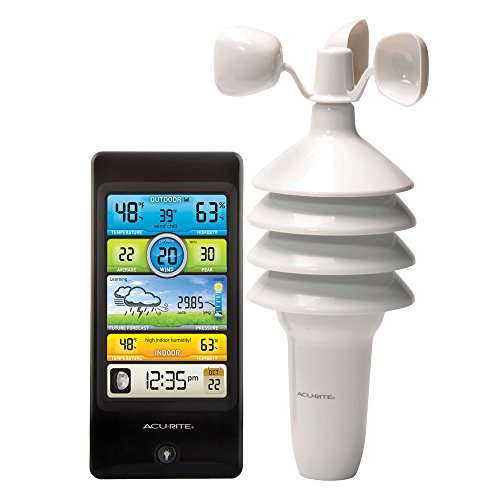
- Measures temperature, humidity, and wind speed
- Records current, average, and peak wind
- Color display includes adjustable dimmer
Best For: Simple home wind and weather monitoring
Best Large-Display Station
Sainlogic SA68 12-in-1 Weather Station

- Readable 8-inch display with adjustable backlight
- Tracks wind, rain, pressure, temperature, and humidity
- Solar-powered sensor with battery backup
Best For: Gardens, farms, and easy-to-read monitoring
Best Smart Features
Ambient Weather WS-2902 Wi-Fi Station
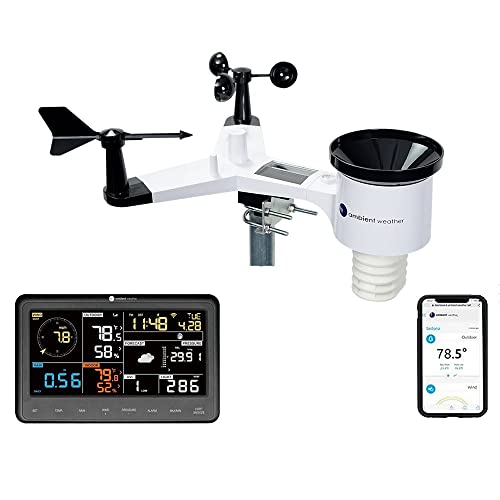
- Wi-Fi remote monitoring and customizable alerts
- Measures wind, rain, UV, and solar radiation
- Works with Alexa, Google Home, and IFTTT
Best For: Connected homes and remote weather access
Best Everyday Pick
La Crosse Custom Alert Weather Station

- Large color display with adjustable brightness
- Custom temperature and humidity alerts
- Tracks dew point, heat index, and daily records
Best For: Home comfort monitoring and easy-to-read alerts
Best Feature-Packed Value
VEVOR 7-in-1 Wi-Fi Weather Station

- Measures wind, rain, temperature, humidity, and light
- Remote monitoring via Wi-Fi services
- Solar-assisted sensor with 150-meter transmission range
Best For: Gardens, farms, and detailed outdoor weather tracking
Best for Weather Underground
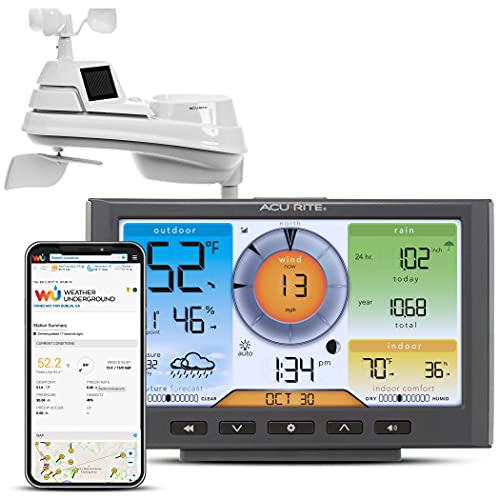
- Tracks temperature, humidity, wind, pressure, and rainfall
- Connects to Weather Underground for remote monitoring
- Offers 25-plus data points and historical tracking
Best For: Connected home weather monitoring and local data history
Best Precision Pick
Sainlogic WiFi Weather Station

- High stated temperature and humidity accuracy
- Tracks comprehensive weather conditions and trends
- Two-year storage, export, and 443-foot wireless range
Best For: Precision-focused home, garden, and greenhouse monitoring
Best Solar-Powered Value
VEVOR 7-in-1 Wi-Fi Weather Station

- Solar-assisted outdoor sensor with battery backup
- Large 7.5-inch display with adjustable brightness
- App monitoring for seven core weather measurements
Best For: Homes and gardens wanting a large display and solar assistance
Best No-WiFi Option
Sainlogic Wireless Weather Station

- Large readable 6.5-inch color display
- 12-in-1 data with detailed rainfall memory
- Simple setup without WiFi or tools
Best For: Accessible local weather monitoring for homes and gardens
Best Value Color Display – Newentor Wireless Weather Station
For shoppers seeking budget weather stations with an easy-to-read home display, the Newentor combines indoor and outdoor temperature and humidity readings with clock, forecast, pressure, and moon-phase information. Its included sensor and adjustable backlight make it a practical everyday option.
Best For: Bedrooms, living rooms, and households wanting a feature-rich display at a budget-friendly level.
Pros:
- Large color LCD shows temperature, humidity, highs and lows, time, date, and forecast information.
- Supports up to three wireless sensors for monitoring multiple locations.
- Wall power enables an always-on display, while battery mode provides a quick-glance eco setting.
- Includes atomic time, dual alarms, customizable alerts, and adjustable brightness.
Cons:
- Only one remote sensor is included.
- Batteries are not included.
- Battery-only operation dims the screen after a 15-second glance.
The Newentor is a strong value when a clear indoor display and broad household features matter more than advanced outdoor measurements such as wind or rainfall.
Best for Wind Tracking – AcuRite Notos Pro Weather Station
Among budget weather stations, the AcuRite Notos stands out for focusing on core outdoor conditions. Its wireless sensor measures temperature, humidity, and wind speed, while the color console records current, average, and peak wind readings.
Best For: Home users who want straightforward wind, temperature, and humidity monitoring with a color console.
Pros:
- 3-in-1 wireless sensor measures temperature, humidity, and wind speed.
- Tracks current, average, and peak wind readings and updates them every 18 seconds.
- Color display has an adjustable dimmer and optional battery backup.
- Includes mounting hardware and a tabletop stand.
Cons:
- Does not include rainfall measurement.
- Temperature accuracy is listed as plus or minus 2 degrees Fahrenheit.
- Requires three AAA batteries for backup operation.
This is a sensible pick for buyers who prioritize wind data and simple setup over a larger set of precipitation and solar measurements.
Best Large-Display Station – Sainlogic SA68 12-in-1 Weather Station
The Sainlogic SA68 is one of the more comprehensive budget weather stations for users who want broad outdoor coverage without Wi-Fi. Its large 8-inch display presents temperature, humidity, wind, rainfall, pressure, dew point, and perceived temperature data.
Best For: Seniors, gardeners, farms, ranches, and anyone who wants a large, information-rich screen.
Pros:
- Large 8-inch display uses bold, high-contrast fonts and three backlight levels.
- Monitors wind speed and direction, rainfall, temperature, humidity, barometric pressure, dew point, and perceived temperature.
- Rain gauge supports manual calibration and provides specified accuracy ranges.
- Solar-powered outdoor operation includes battery backup.
Cons:
- No Wi-Fi connectivity.
- Batteries are not included.
- The extensive data display may feel more complex than basic home thermometers.
Choose the SA68 when readability and a wide range of measurements are more important than remote app access or a compact footprint.
Best Smart Features – Ambient Weather WS-2902 Wi-Fi Station
Ambient Weather WS-2902 Wi-Fi Smart Weather Station | With Wi-Fi Remote Monitoring and Alerts
Check Price On AmazonFor buyers who want budget weather stations with connected features, the Ambient Weather WS-2902 adds Wi-Fi remote monitoring to a full sensor array. It measures wind, temperature, humidity, rainfall, UV intensity, and solar radiation, with support for alerts and compatible smart-home services.
Best For: Smart-home users and weather enthusiasts who want remote access, alerts, and detailed backyard data.
Pros:
- Measures wind speed and direction, temperature, humidity, rainfall, UV intensity, and solar radiation.
- Wi-Fi enables remote monitoring and customizable alerts.
- Works with IFTTT, Google Home, Alexa, and other compatible smart-home tools.
- Solar-powered sensor array includes a color LCD console.
Cons:
- Requires a 2.4 GHz Wi-Fi connection for connected features.
- Requires three AAA batteries.
- Its smart-home and network features may be unnecessary for shoppers seeking only basic readings.
The WS-2902 is the strongest choice here for connected monitoring, especially if remote alerts and smart-home integration justify choosing a more capable system.
Best Everyday Pick – La Crosse Custom Alert Weather Station
For shoppers comparing budget weather stations, the La Crosse C85845-INT focuses on easy-to-read home monitoring rather than advanced outdoor instruments. Its large color display tracks indoor and wireless outdoor temperature, humidity, dew point, heat index, and daily high/low records.
Best For: Homeowners who want straightforward indoor and outdoor comfort monitoring with customizable alerts.
Pros:
- Large display with adjustable brightness and color comfort charts.
- Custom high/low alerts for temperature and humidity.
- Includes dew point, heat index, daily records, atomic time, and calendar functions.
- Corded operation provides a constant backlight, with optional battery backup.
Cons:
- Forecast icons require 7–10 days for barometric calibration.
- Outdoor sensor batteries are not included.
- It monitors temperature and humidity but does not provide wind or rainfall readings.
This is a practical budget weather station for rooms, gardens, and general household comfort checks. Choose it if readable alerts and everyday temperature data matter more than a full instrument suite.
Best Feature-Packed Value – VEVOR 7-in-1 Wi-Fi Weather Station
The VEVOR YT60234 is a strong option for budget weather stations when you want broad outdoor coverage. Its 7-in-1 sensor measures wind, temperature, humidity, rainfall, and light, while the display also provides pressure, moon phase, dew point, and wind chill information.
Best For: Gardeners, farm users, and households that want remote weather data and multiple outdoor measurements.
Pros:
- 7-in-1 sensor covers wind speed, wind direction, temperature, humidity, rainfall, and light.
- Wi-Fi supports remote viewing through Weather Underground and WeatherCloud.
- 150-meter transmission distance allows flexible sensor placement.
- Solar-assisted sensor power, rechargeable Ni-MH batteries, and a large dimmable display.
Cons:
- The adapter must remain plugged in for Wi-Fi connection and date synchronization.
- Wireless interference can affect placement near televisions, signal towers, or high-voltage lines.
- Its feature set and outdoor installation may be more involved than basic home stations.
With its broad sensor coverage and app-style remote access, this model offers more measurement capability than a basic budget weather station. It is best suited to buyers willing to handle a more involved setup for richer local data.
Best for Weather Underground – AcuRite Iris 5-in-1 Station
The AcuRite Iris 01540M stands out among budget weather stations for buyers who want a connected home display and Weather Underground access. Its 5-in-1 outdoor sensor reports temperature, humidity, wind speed and direction, barometric pressure, and rainfall.
Best For: Home users who want comprehensive local readings, historical data, and remote monitoring through Weather Underground.
Pros:
- 5-in-1 sensor combines temperature, humidity, wind, pressure, and rainfall data.
- Wi-Fi connection enables remote monitoring through Weather Underground.
- Large color LCD includes adjustable brightness, time, and date.
- Provides more than 25 data points, threshold alarms, and historical weather information.
Cons:
- Temperature accuracy is listed as plus or minus 2 degrees Fahrenheit.
- The display is battery powered, while the included components list identifies a power cord.
- Its connected features may require more setup than a simple wireless thermometer.
This is a well-rounded choice for buyers who want more than basic temperature readings without moving to a highly specialized system. Its Weather Underground integration and historical tracking are the main reasons to consider it.
Best Precision Pick – Sainlogic WiFi Weather Station
For shoppers comparing budget weather stations, the Sainlogic WiFi Weather Station stands out for its sensor accuracy, broad data coverage, and remote monitoring. It measures indoor and outdoor conditions plus wind, rainfall, pressure, moon phase, and trends, while WiFi access lets you check readings from your phone.
Best For: Nurseries, greenhouses, wine cellars, gardens, farms, and homeowners who want detailed data with remote access.
Pros:
- High stated accuracy of ±0.2°C for temperature and ±1.8%RH for humidity.
- Tracks temperature, humidity, pressure, wind, rainfall, moon phase, forecasts, and trends.
- Stores up to two years of data locally and supports Excel export without subscription fees.
- Wireless sensor range reaches up to 443 feet in open areas.
Cons:
- WiFi and smartphone features add setup complexity compared with a basic wireless station.
- Requires three AA batteries.
This is a feature-rich choice among budget weather stations, especially if measurement precision and historical data matter more than having the simplest possible setup.
Best Solar-Powered Value – VEVOR 7-in-1 Wi-Fi Weather Station
This VEVOR model is a practical option for budget weather stations when you want a large display, solar-assisted outdoor sensing, and app access. Its 7-in-1 sensor covers core weather measurements, while the indoor console shows forecasts and readings in an easy-to-view format.
Best For: Homes, gardens, farms, and shoppers who want solar-assisted operation with a large indoor display.
Pros:
- Measures temperature, humidity, rainfall, wind speed and direction, sunlight, and dew point.
- Solar panel helps power the outdoor sensor, with batteries supporting nighttime or cloudy conditions.
- 7.5-inch display offers four brightness levels for daytime and nighttime viewing.
- Smart Life app supports viewing, storing, analyzing, and sharing weather data.
Cons:
- WiFi supports 2.4GHz only, not 5GHz.
- The adapter must remain plugged in for WiFi connection and date synchronization.
- Stated temperature accuracy is ±1°C, less precise than some specialized stations.
Choose this VEVOR station if a readable screen and reduced outdoor-sensor battery dependence are priorities. Its app and solar design add convenience, but the 2.4GHz requirement is worth checking before buying.
Best No-WiFi Option – Sainlogic Wireless Weather Station
For straightforward budget weather stations, this Sainlogic wireless model avoids WiFi and app requirements while still providing a broad set of readings. Its 6.5-inch color display shows temperature, humidity, pressure, wind, rainfall, dew point, moon phase, and forecasts at a glance.
Best For: Seniors, gardeners, homeowners, and anyone who wants detailed local weather information without internet setup.
Pros:
- Large 6.5-inch color screen with oversized fonts and three-level brightness adjustment.
- Provides 12-in-1 weather information, including wind, rainfall, pressure, dew point, and forecasts.
- Rain collector records hourly, daily, weekly, monthly, and total accumulation.
- Wireless setup requires no WiFi, tools, or complicated wiring.
Cons:
- No WiFi or remote smartphone monitoring.
- Stated temperature accuracy is ±1°C.
- Requires three AA batteries for the sensor or system components.
This is a strong fit for buyers who value simple local monitoring over connected features. The readable display and rainfall memory make it particularly useful for everyday home and garden observation.
How We Picked the Best Budget Weather Stations
We focused on the features that matter most in a home weather station: useful sensor coverage, dependable wireless range, readable displays, straightforward installation, and practical access to current data. Models with rain gauges, wind sensors, barometers, Wi-Fi, app support, or weather-service integration were considered alongside simpler indoor-outdoor thermometers.
We also weighed value rather than simply choosing the systems with the longest feature lists. A basic station may be a better choice for checking temperature and humidity, while a connected 7-in-1 system can make more sense for gardening, weather logging, or monitoring conditions across a larger property.
Quick Comparison
| Best for | Look for | Typical strengths |
|---|---|---|
| Simple home monitoring | Indoor/outdoor temperature and humidity | Easy setup, lower cost, compact design |
| Rain and wind tracking | Multi-sensor outdoor array | More complete local weather data |
| Remote monitoring | Wi-Fi and mobile app support | Weather data available away from home |
| Weather enthusiasts | Barometer, forecasting, logging, and service integration | More detailed records and customization |
Key Buying Factors for Budget Weather Stations
Sensor Coverage
Decide whether you only need temperature and humidity or want rainfall, wind speed, wind direction, pressure, and dew point. Full weather arrays provide more information but usually require more outdoor space and careful mounting.
Wireless Range and Placement
Check the stated transmission distance, then account for walls, trees, metal siding, and other obstructions. Place the outdoor sensor where it has good exposure without putting it too close to heat sources, roofs, or sheltered corners that can distort readings.
Display, Wi-Fi, and Apps
A large console is convenient for quick at-a-glance checks. Wi-Fi models are more useful if you want alerts, historical data, remote access, or integration with a weather reporting service. Confirm whether the app and online features require an account or ongoing subscription.
Power and Maintenance
Solar-assisted outdoor sensors can reduce battery changes, but they still typically use backup batteries. Rain collectors may need occasional cleaning, and wind sensors should be mounted securely and high enough to avoid nearby obstructions.
Who Should Buy Which Budget Weather Stations?
Choose a straightforward indoor-outdoor model if you mainly want dependable temperature and humidity readings for a home, office, greenhouse, or nursery. Select a station with rain and wind sensors if you garden, manage outdoor projects, or want a fuller picture of conditions on your property.
Wi-Fi-enabled Budget Weather Stations are the better fit for users who want smartphone access, alerts, data history, or Weather Underground connectivity. Before buying, prioritize the measurements you will actually use, verify the available mounting space, and compare total setup requirements—not just the number of advertised sensors.
