
Stair climber machines can deliver challenging, low-impact cardio while targeting the glutes, quads, hamstrings, and calves. The right model depends on your available space, preferred intensity, stability needs, and budget.
We selected 10 stair climber machines spanning compact folding steppers and larger commercial-style stair machines, so you can compare resistance levels, step speed, weight capacity, displays, and useful home-gym features.
Best 10 Stair Climber Machines Picks for 2026
Best Adjustable-Stride Pick
Sunny Health & Fitness Foldable Stair Climber

- Adjustable step height and extended stride
- Targets legs, glutes, and core
- SunnyFit app with AI plans and metrics
Best For: Customizable home cardio and strength workouts
Best Commercial-Style Option

- 15 speeds from 24 to 164 steps per minute
- 660-pound weight capacity
- LED monitor and preset workout programs
Best For: High-capacity, intensive home stair training
Best Foldable Resistance Model
MERACH Adjustable-Resistance Stair Stepper

- Adjustable resistance and three angles
- Foldable, compact home-gym design
- LCD tracks time, steps, and calories
Best For: Small spaces needing customizable workouts
Best Stability-Focused Value

- Four metal guide rails for stability
- Five adjustable intensity levels
- Foldable design for small spaces
Best For: Beginners and apartment-friendly workouts
Best Space-Saving Pick
Folding Adjustable-Handlebar Stair Climber

- Three resistance levels plus three height settings
- Folding design with phone holder and storage compartment
- Extra-wide pedals and stated 350-pound capacity
Best For: Compact, quiet home workouts
Best Commercial-Grade Option

- Fifteen speed levels from 24 to 164 steps per minute
- Eight preset programs and multi-metric LED display
- Heavy-duty frame with stated 550-pound capacity
Best For: Structured, high-capacity home-gym training
Best Quiet Resistance Pick

- Sixteen magnetic resistance levels for progressive workouts
- Two incline modes for cardio or strength emphasis
- Foldable frame with wheels, handle, LCD, and heart-rate sensors
Best For: Quiet, flexible training in smaller spaces
Best Overall
ERGOLIFE Commercial-Grade Stair Climber

- 25 resistance levels for varied training
- Floating pedals designed for comfort
- Quiet drive system with touchscreen
Best For: Versatile home cardio and multi-user training
Best for Program Variety
GMWD Commercial-Grade Stair Stepper
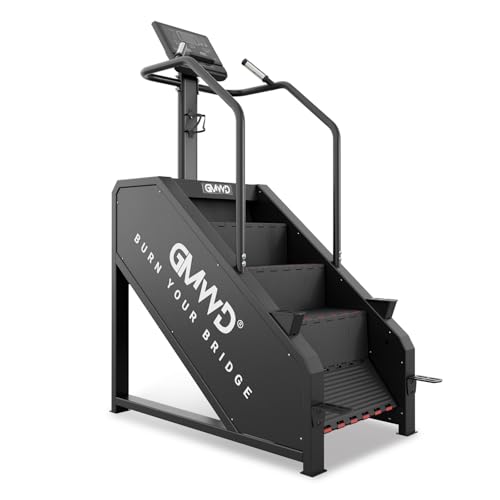
- 12 preset and targeted workout options
- Large 17.3-inch LED display
- Commercial-size step area
Best For: Structured workouts and spacious climbing platforms
Best for Heavy-Duty Stability
T1 Commercial-Grade Stair Climber

- Spacious 22-by-9-inch step platform
- Automatic pedal lock and braking
- 15 resistance levels with eight programs
Best For: Stable, commercial-style home climbing workouts
Best Adjustable-Stride Pick – Sunny Health & Fitness Foldable Stair Climber
If you want stair climber machines with a customizable range of motion, this Sunny Health & Fitness model stands out. Its step height adjusts from 8.9 to 23.5 inches, while the extended 21.5-inch stride lets you vary workout intensity and impact. The foldable design, adjustable handlebars, and 330-pound capacity make it practical for home cardio and strength training.
Best For: Users who want adjustable stride and step height with app-supported workouts.
Pros:
- Adjustable 8.9- to 23.5-inch step height and 21.5-inch stride
- Targets legs, glutes, and core with low-impact movement
- Four-level handlebars and 330-pound weight capacity
- SunnyFit app includes metrics, programs, scenic routes, and AI plans
Cons:
- No resistance settings; the core provides stability control
- The 29.3-pound frame may feel lighter than larger commercial-style climbers
- Warranty coverage is one year for the frame and 180 days for other parts
This is a flexible choice for shoppers who want to fine-tune their climbing motion rather than commit to a fixed step pattern. Its app integration adds useful guidance for progressing at home.
Best Commercial-Style Option – FEIERDUN SC3 Stair Climber
Among stair climber machines, the FEIERDUN SC3 is designed for shoppers seeking a more substantial, gym-style workout. Its revolving staircase motion, 15 speed levels, preset and targeted programs, and 660-pound capacity support a broad range of training intensities. The machine arrives 90% pre-assembled, but its 54-by-54-inch footprint and 77-inch height require careful space planning.
Best For: Users wanting high-capacity, program-rich stair training at home.
Pros:
- 15 speed levels from 24 to 164 steps per minute
- Revolving staircase design simulates continuous stair climbing
- 660-pound weight capacity and electromagnetic braking system
- LED monitor tracks time, steps, calories, pulse, level, and SPM
Cons:
- Large 54-by-54-inch footprint needs substantial floor space
- At 77 inches tall, it requires a suitable ceiling height
- Its commercial-style design may be more machine than casual users need
The SC3 is the strongest fit here for intensive, continuously paced stair workouts. Confirm the available floor area and ceiling clearance before buying, especially for a home gym with limited space.
Best Foldable Resistance Model – MERACH Adjustable-Resistance Stair Stepper
The MERACH is one of the more compact stair climber machines for home use, combining adjustable resistance with a foldable frame. Its three adjustable angles and customizable foot pedals help tailor the workout, while the LCD monitor tracks time, steps, and calories. At 33.9 by 22.1 by 47.2 inches, it is suited to spaces where storage is a priority.
Best For: Small-space users who want adjustable resistance and easy storage.
Pros:
- Adjustable resistance and three workout angles
- Foldable design for home gyms and compact storage areas
- Non-slip pedals, secure handlebars, and stable triangle design
- LCD monitor displays time, steps, and calories
Cons:
- 300-pound weight capacity is lower than some larger models
- The compact frame may provide a less substantial feel than commercial climbers
- The display tracks basic metrics rather than a wider range of workout data
This MERACH model makes sense when storage and workout adjustability matter more than maximum capacity or commercial-scale construction. Its one-year manufacturer warranty adds basic ownership support.
Best Stability-Focused Value – Relife Vertical Climber
For shoppers comparing compact stair climber machines, the Relife vertical climber emphasizes stability, quiet operation, and simple intensity adjustment. Four metal guide rails support the motion, while five adjustable levels range from jogging-style effort to a rock-climbing simulation. Its folding frame is particularly useful for apartments, offices, and other space-limited settings.
Best For: Beginners and apartment users seeking a stable, foldable vertical climber.
Pros:
- Four metal guide rails support a stable workout
- Five adjustable levels for different training intensities
- Inclined pedals help keep the center of gravity near the frame
- Folds for storage under a bed, in a corner, or on a balcony
Cons:
- It offers five levels rather than a larger range of speed settings
- The 330-pound capacity is below the FEIERDUN SC3’s listed capacity
- Supplied details do not mention a display or app-based workout tracking
The Relife is a practical option when a stable, space-saving frame is the priority. Its straightforward five-level setup should appeal to both beginners and users who prefer uncomplicated home equipment.
Best Space-Saving Pick – Folding Adjustable-Handlebar Stair Climber
This compact folding option is a practical choice for shoppers comparing stair climber machines for home use. It offers three resistance levels, three height settings, extra-wide anti-slip pedals, and a built-in display for tracking time, steps, and calories.
Best For: Home users who want a foldable, quiet stair stepper with straightforward resistance adjustments and a high stated weight capacity.
Pros:
- Three resistance levels and three height settings support varied workouts.
- Extra-wide, anti-slip pedals provide a more secure footing.
- Folds to save storage space and includes a phone holder.
- Near-silent operation, foam handles, and a stated 350-pound capacity suit home use.
Cons:
- It uses a basic workout display rather than preset programs or extensive training metrics.
- The supplied dimensions still require over four feet of vertical clearance during use.
Choose this model if storage efficiency and simple controls matter more than advanced programming. Its compact design and quiet resistance system make it especially practical for apartments or shared spaces.
Best Commercial-Grade Option – JELENS 15-Level Stair Climber
For shoppers seeking more structured stair climber machines, the JELENS combines 15 speed levels with a large, heavy-duty frame. Its LED screen tracks key workout metrics, while preset programs, motion sensors, and non-slip pedals add convenience and safety features.
Best For: Users who want a full-size stair climber with extensive intensity adjustment, preset programs, and a high stated weight capacity.
Pros:
- Fifteen levels range from 24 to 164 steps per minute for progressive training.
- Eight preset programs add workout variety.
- LED display tracks time, speed, distance, heart rate, and calories.
- Heavy-duty alloy-steel construction supports a stated 550-pound maximum.
Cons:
- Its large 76.8-inch height and full-size footprint make it less suitable for tight rooms.
- It is a substantial machine to place and move compared with folding steppers.
This is the strongest fit for buyers prioritizing a commercial-style feel and detailed workout control. Measure your ceiling and available floor space carefully before choosing it for a home gym.
Best Quiet Resistance Pick – YOLEO Magnetic Stair Stepper
The YOLEO stands out among stair climber machines for its quiet magnetic resistance and broad adjustment range. It offers 16 resistance levels, two incline modes, a 28-inch extended stride, heart-rate sensors, and a foldable frame with built-in mobility features.
Best For: Apartment or home-gym users who want quiet, adjustable cardio and strength training with fold-away storage.
Pros:
- Sixteen magnetic resistance levels support gradual progression.
- Two incline modes target cardio or steeper leg and glute training.
- Quiet operation is well suited to apartments and shared spaces.
- Folding construction, wheels, and a handle simplify storage and repositioning.
Cons:
- The supplied notes do not specify the machine’s folded dimensions.
- Its many resistance and incline options may require more setup than a basic stepper.
Consider this model when low noise, training flexibility, and storage convenience are your main priorities. The LCD monitor and heart-rate sensors also make it easier to keep workouts focused on measurable progress.
Best Overall – ERGOLIFE Commercial-Grade Stair Climber
The ERGOLIFE is a versatile choice among stair climber machines, combining 25 resistance levels with a floating-pedal design intended to make climbing more comfortable. Its quiet drive system, large display, and high stated capacity make it suitable for structured home cardio sessions.
Best For: Home users who want broad resistance adjustment, quieter operation, and comfort-focused pedals.
Pros:
- 25 resistance levels and a 20–164 steps-per-minute range accommodate varied workout intensities.
- Floating full pedals, a 35° angle, and 7-inch pedal height are designed to support a more natural climbing motion.
- Quiet EMS resistance and a Gates drive belt are designed for smoother, lower-noise workouts.
- 15.6-inch touchscreen, wireless charging, and dual storage trays add convenience.
Cons:
- At 311 pounds, it is a substantial machine to position.
- The listed dimensions may require dedicated floor space.
- The product notes contain differing weight-capacity figures, so buyers should verify the current specification.
With its wide resistance range and comfort-oriented pedal design, the ERGOLIFE stands out as a flexible stair climber for households with multiple users. Confirm the capacity and space requirements before ordering.
Best for Program Variety – GMWD Commercial-Grade Stair Stepper
The GMWD is a program-focused option for shoppers comparing stair climber machines for home or commercial-style workouts. It offers 12 workout options, a large LED display, automatic pedal locking, and a commercial-size step area, though its tall, heavy frame calls for careful placement planning.
Best For: Users who want preset and target-based workouts with a large climbing platform.
Pros:
- Eight preset and four targeted programs provide structured workout variety.
- The 17.3-inch LED screen tracks heart rate, calories, and other workout information.
- Automatic pedal locking, anti-skid technology, and pulse sensors support guided training.
- Arrives 90% assembled and includes a two-year manufacturer warranty.
Cons:
- The 54-by-30-by-77-inch footprint and recommended ceiling height of 8’8"–9’8" limit placement options.
- Its gross weight of 441 pounds makes moving and installation more demanding.
- The product notes describe the frame material as polypropylene rather than alloy steel.
The GMWD makes the strongest case for buyers who value workout programming and a spacious step area. Measure both the floor and ceiling clearance, and plan for delivery and positioning of this heavy machine.
Best for Heavy-Duty Stability – T1 Commercial-Grade Stair Climber
The T1 is a heavy-duty entry in the stair climber machines category, pairing a reinforced alloy-steel build with a spacious 22-by-9-inch step area. Its 15 resistance levels, safety braking system, and preset programs make it a practical option for users seeking a commercial-style climbing experience at home.
Best For: Users prioritizing a stable platform, safety features, and commercial-style dimensions.
Pros:
- Reinforced construction and anti-slip foot pads are designed for stability during intense workouts.
- Fifteen resistance levels cover a 24–164 steps-per-minute range.
- Infrared sensors and automatic braking stop or lock the pedals when needed.
- Eight preset programs, integrated pulse sensors, and media and bottle holders support convenient sessions.
Cons:
- At about 77 inches tall, it requires substantial ceiling clearance.
- The product notes list conflicting weight-capacity figures, so the current rating should be confirmed.
- Its 49.41-by-31.3-inch footprint may be large for smaller home gyms.
The T1 is a compelling choice when stability and a generous step platform matter more than compact storage. Verify the weight rating and available ceiling clearance, particularly because the machine is designed for a commercial-style setup.
How We Picked the Best Stair Climber Machines
We focused on the features that matter most during regular home use: resistance or speed adjustability, step range, frame stability, user weight capacity, footprint, folding or storage features, and display functionality. We also considered whether each machine suits beginners, experienced exercisers, or users seeking a more demanding stair-climbing workout.
Because product specifications can vary by configuration and seller, confirm the current dimensions, maximum user weight, warranty, and assembly requirements before ordering.
Quick Comparison
Compact folding stair steppers are generally the easiest to store and can work well in apartments, bedrooms, or smaller home gyms. Commercial-grade models typically provide a larger frame, higher weight capacity, more resistance or speed settings, and a steadier feel, but they require more floor space and usually cost more.
- Best for limited space: Choose a foldable model with a manageable footprint and convenient storage.
- Best for progressive training: Look for multiple resistance or speed levels and a broad step range.
- Best for heavier users: Prioritize a clearly stated, suitably high weight capacity and a rigid frame.
- Best for tracking workouts: Select a machine with an easy-to-read LED or LCD display showing useful metrics.
Key Buying Factors for Stair Climber Machines
Resistance, Speed, and Step Range
More adjustment levels make it easier to begin comfortably and increase workout difficulty over time. A longer or more natural step range can feel closer to climbing stairs, while compact steppers may emphasize shorter, controlled movements.
Stability and Weight Capacity
Check the maximum user weight, frame construction, handlebar design, and base dimensions. A heavier, wider machine often feels more secure during fast or intense sessions. Handles can improve balance, especially for beginners, but they also increase the machine’s footprint.
Size, Folding, and Setup
Measure both the exercise area and storage location, allowing extra clearance around the machine. Folding designs are useful when the equipment must share space with other activities. Also check whether assembly requires two people or specialized tools.
Display and Comfort
A basic display may track time, steps, speed, or calories. These figures are useful for consistency, but they are estimates rather than medical measurements. Confirm that pedals, handles, and moving parts feel comfortable for your height and stride.
Who Should Buy Which Stair Climber Machines?
Beginners and occasional users should look for simple controls, stable handlebars, moderate resistance settings, and a compact design. Apartment dwellers may prefer folding equipment with a smaller footprint and easier storage. Progress-focused exercisers should prioritize a wide adjustment range, durable construction, and a step action that remains smooth at higher intensities. Frequent or heavier users will usually benefit from commercial-grade Stair Climber Machines with a robust frame, higher capacity, and stronger stability.
Before buying, compare the machine’s fully assembled dimensions, return policy, warranty, noise expectations, and maintenance requirements. The best option is the one you can store safely, use consistently, and adjust as your fitness improves.
