
Professional stair climber machines bring the steady, demanding rhythm of a stair workout into a home gym or commercial training space. The models in this roundup vary widely in resistance control, step rate, user capacity, display features, and storage design.
Use the guide below to compare the specifications that matter most before choosing a machine for conditioning, weight management, or lower-body endurance training.
Best 10 Professional Stair Climber Machines Picks for 2026
Heavy-Duty Pick
Goimu T1 Commercial Stair Climber

- 15 resistance levels and 24–164 steps per minute
- Commercial-grade frame with large steps
- Safety sensors, preset programs, and pulse tracking
Best For: Demanding home workouts and users prioritizing stability
Adjustable Stride Pick

- 21.5-inch extended stride with adjustable step height
- Foldable design with four-level handlebars
- SunnyFit app with AI-personalized plans
Best For: Flexible home training and easier storage
Maximum Capacity Pick

- 660-pound listed capacity and revolving-stair design
- 15 speed levels plus 12 programmed workouts
- LED metrics, anti-skid pedals, and electromagnetic braking
Best For: High-capacity home cardio and progressive training
Compact Home Pick

- Foldable frame for smaller workout areas
- Adjustable resistance with LCD workout tracking
- Non-slip pedals, handlebars, and 300-pound capacity
Best For: Space-conscious home users and basic full-body workouts
Best Overall

- 25 resistance levels with a 20–164 SPM range
- Floating pedals and reinforced D-frame for stable climbing
- 15.6-inch touchscreen with programs and heart-rate monitoring
Best For: Dedicated home gyms seeking extensive adjustment and commercial-style features
Best High-Capacity Pick
JELENS Commercial Stair Stepper

- 550-pound maximum user capacity
- 15 levels spanning 24–164 steps per minute
- Wide anti-slip pedals with eight preset programs
Best For: Users wanting a high-capacity climber with wide steps and workout conveniences
Best Space-Saving Option

- Foldable design for compact storage
- Four metal guide rails support stability and smooth motion
- Five adjustable levels for varied training intensity
Best For: Small apartments, beginners, and users needing easy post-workout storage
Quiet Adjustable Pick

- 16 magnetic resistance levels up to 130 lb
- Two incline modes for cardio or strength
- Foldable, quiet design with 660-lb capacity
Best For: Quiet, adjustable home workouts in compact spaces
Commercial-Style Choice
GMWD Commercial Grade Stair Climber
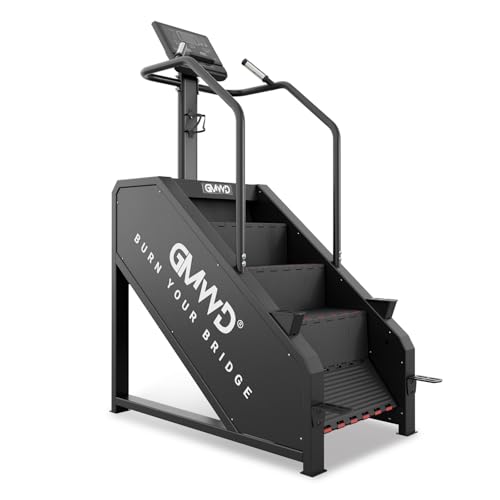
- 15 resistance levels and 24–164 steps per minute
- 12 workout programs on a large LED display
- 660-lb capacity with commercial-size step height
Best For: Dedicated home gyms seeking structured, intensive workouts
Compact Quiet Trainer
RELIFE Adjustable Stair Stepper

- Three spring-based resistance levels
- Two inclines and adjustable pedals and handlebars
- Below-25-dB operation with 350-lb capacity
Best For: Quiet, compact home cardio and lower-body training
Heavy-Duty Pick – Goimu T1 Commercial Stair Climber
For shoppers comparing professional stair climber machines, the Goimu T1 stands out with a commercial-grade alloy-steel frame, 15 resistance levels, and a broad speed range of 24 to 164 steps per minute. Its large steps, preset programs, safety sensors, and real-time workout tracking make it a substantial home-gym option.
Best For: Users who want a sturdy, feature-rich stair climber for demanding home workouts.
Pros:
- Supports up to 550 pounds according to the product description, with a reinforced base and anti-slip foot pads.
- Offers 15 resistance levels, eight preset programs, and integrated hand-pulse heart-rate sensors.
- Includes automatic pedal locking, intelligent braking, a media rack, and a water-bottle holder.
- Arrives 90% pre-assembled and uses spacious 22-inch-wide steps.
Cons:
- Its 49.41-by-31.3-by-76.57-inch footprint requires substantial floor and ceiling clearance.
- The supplied details list both a 550-pound capacity claim and a 440-pound specification, so buyers should verify the current rating.
The T1 is a strong choice when stability, programming, and safety features matter more than compact storage. Measure your workout area carefully before buying.
Adjustable Stride Pick – Sunny Foldable Stair Climber
Among professional stair climber machines, this Sunny Health & Fitness model offers a different approach: adjustable step height, an extended 21.5-inch stride, and foldable storage. It uses bodyweight movement rather than resistance settings, with app-based training support and adjustable handlebars for a more customized home workout.
Best For: Home users who want adjustable climbing mechanics, app-guided workouts, and a relatively light machine.
Pros:
- Adjusts from 8.9 to 23.5 inches in step height to vary intensity and joint impact.
- The 21.5-inch extended stride provides a more expansive climbing motion.
- Includes four-level adjustable handlebars and a free SunnyFit app with AI-personalized plans.
- Foldable design and a 29.3-pound listed weight support easier storage than larger commercial-style units.
Cons:
- There are no resistance settings; intensity comes from bodyweight movement and stride adjustment.
- The 330-pound capacity is lower than the heavy-duty machines in this roundup.
- Warranty coverage is listed as one year for the frame and 180 days for other parts and components.
This is a practical pick for users who value adjustability and guided training over electronic resistance controls. Its foldable format may also suit home gyms where storage space is limited.
Maximum Capacity Pick – FEIERDUN SC3 Stair Climber
The FEIERDUN SC3 is one of the more substantial professional stair climber machines for home use, combining a revolving-stair design with a claimed 660-pound capacity. Fifteen speed levels, multiple workout programs, electromagnetic braking, and a metric-rich LED monitor give it a strong focus on progressive cardio and lower-body training.
Best For: Users seeking high weight capacity, broad speed control, and a club-style climbing experience at home.
Pros:
- Offers 15 speed levels from 24 to 164 steps per minute, plus eight preset and four targeted programs.
- Lists a 660-pound maximum weight capacity and four thickened pedals for added support.
- Tracks time, steps, height, calories, level, pulse, and steps per minute on the LED monitor.
- Uses automatic pedal locking, anti-skid technology, and a gravity-induction electromagnetic braking system.
Cons:
- Its 54-by-30-by-77-inch listed dimensions require considerable space.
- The product is large and intended for a dedicated workout area rather than easy portability.
- Users should check ceiling clearance carefully because the machine is approximately 77 inches tall.
The SC3 is compelling for buyers who want maximum capacity and extensive workout controls. Its size and commercial-style construction make careful placement planning essential.
Compact Home Pick – MERACH Foldable Stair Stepper
For shoppers who want the feel of professional stair climber machines without a full-size commercial footprint, the MERACH Stair Stepper emphasizes compact storage and adjustable resistance. Its handlebars, non-slip pedals, LCD monitor, and foldable frame support straightforward full-body and lower-body workouts in smaller home gyms.
Best For: Space-conscious users who want a foldable stair climber with basic tracking and adjustable resistance.
Pros:
- Foldable 33.9-by-22.1-by-47.2-inch design is suited to smaller spaces.
- Adjustable resistance and foot-pedal settings allow users to personalize workout intensity.
- Stable triangle design, secure handlebars, and non-slip pedals support controlled exercise.
- LCD monitor tracks time, steps, and calories, while the product includes a one-year manufacturer warranty.
Cons:
- The 300-pound capacity is lower than the larger commercial-grade options listed here.
- Its LCD monitor tracks fewer metrics than the advanced LED systems on the heavier machines.
- The compact frame may provide a less substantial climbing platform than full-size stair climbers.
The MERACH is best viewed as a convenient, space-saving home stepper rather than a maximum-capacity commercial-style machine. Choose it when foldability and a smaller footprint are your primary priorities.
Best Overall – Niceday Stair Climber Master
For shoppers comparing professional stair climber machines, the Niceday Stair Climber Master stands out with 25 resistance levels, a broad 20–164 steps-per-minute range, and a 397-pound capacity. Its floating pedals, safety sensors, and large touchscreen make it a feature-rich option for dedicated home workouts.
Best For: Home users who want a commercial-style stair climber with extensive resistance adjustment and built-in safety features.
Pros:
- Offers 25 precision resistance levels from recovery-paced workouts to high-intensity climbs.
- Floating pedals provide full-foot support with a 9.8-inch tread and a 6.9-inch step height.
- Includes infrared safety sensors, emergency-stop controls, assist pedals, and full-coverage handrails.
- Features a 15.6-inch tiltable touchscreen, six preset programs, wireless charging, and hand-grip heart-rate monitoring.
Cons:
- At 324 pounds, it is substantially heavier than compact home stair steppers.
- The listed footprint is about 57.9 by 28.2 by 75.4 inches, so it requires a dedicated workout area.
- Only a one-year frame warranty is listed in the product details, despite the supplied notes also mentioning a two-year parts warranty.
The Niceday is a strong choice when adjustability, stability, and safety matter more than portability. Its size and weight make it better suited to a permanent home gym setup than occasional or space-conscious use.
Best High-Capacity Pick – JELENS Commercial Stair Stepper
The JELENS Commercial Stair Stepper is a practical contender among professional stair climber machines, combining a 550-pound maximum capacity with 15 speed levels and a 24–163 steps-per-minute range. Its wide pedals, preset programs, and built-in media shelf support varied home workouts.
Best For: Users who prioritize a high weight capacity, wider stepping surfaces, and straightforward workout tracking.
Pros:
- Supports users up to 550 pounds with a heavy-duty alloy steel frame.
- Provides 15 adjustable levels from 24 to 164 steps per minute.
- Wide 22-by-9.1-inch steps include anti-slip bars and an auto-lock mechanism.
- Offers eight preset programs, an LED display, handle heart-rate and BMI detection, a media bracket, and a water-bottle holder.
Cons:
- Its approximately 76.8-inch length and 76.8-inch height call for substantial clearance.
- It has fewer resistance levels than the Niceday model.
- The product details list a one-year warranty.
JELENS makes the most sense for buyers who want a sturdy, high-capacity machine with broad steps and useful session conveniences. Measure the room carefully before purchasing, particularly for ceiling and front-to-back clearance.
Best Space-Saving Option – Relife Folding Stair Stepper
For shoppers seeking professional stair climber machines in a smaller format, the Relife Stair Stepper focuses on stability and storage convenience. Four metal guide rails, five adjustable levels, and a foldable design make it a simpler choice for home cardio workouts where space is limited.
Best For: Apartment dwellers, beginners, and users who need a foldable climber for compact living spaces.
Pros:
- Folds for storage under a bed, in a corner, on a balcony, or in a small office.
- Four metal guide rails and included lubricating grease are designed for stability and smoother, quieter operation.
- Five adjustable levels accommodate workouts ranging from jogging-style movement to rock-climbing intensity.
- Radian pedal design helps keep the center of gravity closer to the frame.
Cons:
- Its 330-pound capacity is lower than the larger JELENS and Niceday machines.
- It offers five levels rather than the broader adjustment ranges found on commercial-style models.
- The compact 23.8-by-8.3-inch listed dimensions indicate a more limited platform than full-size stair climbers.
The Relife is best viewed as a compact, approachable stepper rather than a full commercial stair-climber replacement. Its folding frame and beginner-friendly adjustment make it particularly appealing when storage space is a primary concern.
Quiet Adjustable Pick – YOLEO Magnetic Stair Stepper
For shoppers comparing professional stair climber machines for home use, the YOLEO stands out with magnetic resistance, two incline settings, and a foldable frame. Its quiet operation and heart-rate tracking make it a practical option for structured cardio or lower-body strength sessions in smaller spaces.
Best For: Apartment dwellers and home users who want adjustable resistance, folding storage, and quieter workouts.
Pros:
- Offers 16 magnetic resistance levels, up to 130 pounds.
- Provides 61° and 77° incline modes for cardio or steeper strength-focused climbing.
- Supports up to 660 pounds and includes wheels and a handle for easier storage.
- LCD display and heart-rate sensors help monitor workouts.
Cons:
- Its compact home-focused design may not match the scale of a commercial stair machine.
- The product details do not specify the display’s full set of metrics.
The YOLEO is a versatile home stair climber for buyers prioritizing quiet magnetic resistance and space-efficient storage. Its dual inclines add training variety, while the heavy-duty frame provides substantial stated capacity.
Commercial-Style Choice – GMWD Commercial Grade Stair Climber
The GMWD is one of the more substantial professional stair climber machines in this lineup, with a commercial-size step height, broad speed range, and electromagnetic braking. Its large frame and preset programs are suited to buyers who want a more structured stair-climbing workout at home.
Best For: Users with dedicated workout space who want commercial-style dimensions, programmed training, and high weight capacity.
Pros:
- Provides 15 resistance levels and a range of 24–164 steps per minute.
- Includes eight preset programs and four targeted programs.
- Features a 17.3-inch LED display with heart rate and calorie information.
- Uses anti-skid technology, automatic pedal locking, pulse sensors, and ergonomic handrails.
Cons:
- Its 54-by-30-by-77-inch footprint and 441-pound gross weight require significant space.
- The recommended ceiling height is approximately 8 feet 8 inches to 9 feet 8 inches.
- It arrives 90% assembled, so some setup is still required.
Choose the GMWD when workout programming, climbing speed, and commercial-style construction matter more than portability. Confirm ceiling clearance and available floor space before purchase.
Compact Quiet Trainer – RELIFE Adjustable Stair Stepper
The RELIFE is a compact option among professional stair climber machines, combining adjustable gravity-spring resistance, two incline settings, and height-adjustable handlebars. Its wide non-slip pedals and low-noise operation make it suitable for everyday indoor training without requiring a large dedicated gym area.
Best For: Beginners and experienced home users who want quiet, space-saving cardio with adjustable fit and climbing intensity.
Pros:
- Uses three heavy-duty gravity springs with three resistance levels.
- Offers two incline settings and three pedal-angle adjustments.
- Wide, textured pedals and three-level handlebar adjustment support stability and fit.
- Operates below 25 dB, has a 350-pound capacity, and arrives 80% pre-assembled.
Cons:
- Its three resistance levels provide less adjustment than machines with many resistance settings.
- The 350-pound capacity is lower than the capacity of the other listed models.
- It is designed for home use rather than commercial-scale training.
The RELIFE offers useful adjustability in a smaller, quieter package. It is a sensible fit for home users who value stable footing, easy setup, and adaptable positioning over maximum resistance range.
How We Picked These Professional Stair Climber Machines
We focused on machines marketed for frequent use and compared the features that most affect workout quality and ownership. The main criteria included resistance or speed adjustment, stated weight capacity, step-rate range, frame stability, display information, footprint, folding or storage options, and the type of user each machine is likely to suit.
“Commercial grade” can describe a product’s construction or marketing position, so it should not be treated as a guarantee of gym-level durability. Check the manufacturer’s specifications, warranty, assembly requirements, and maintenance guidance before buying.
Quick Comparison
| Feature | Why It Matters | What to Look For |
|---|---|---|
| Resistance and speed | Controls workout intensity and progression | Multiple levels or a broad steps-per-minute range |
| Weight capacity | Indicates the supported user limit | A capacity comfortably above the user’s weight |
| Step range | Helps match the machine to fitness goals | Low settings for controlled work and higher settings for intervals |
| Footprint and storage | Determines whether the unit fits your space | Folding parts, transport wheels, and measured dimensions |
| Console information | Makes pacing and progress easier to monitor | Time, speed, steps, calories, and resistance feedback |
Key Buying Factors for Professional Stair Climber Machines
Intensity Control
Look for enough resistance or speed levels to support both easy sessions and challenging intervals. A wide range is more useful than a high maximum alone, particularly if multiple people will use the machine.
Stability, Capacity, and Stride Feel
A solid frame, secure handholds, and a suitable weight rating are essential during fast or extended sessions. Pay attention to step dimensions and motion style as well as headline capacity; a comfortable, predictable stride encourages consistent use.
Space and Setup
Measure the available floor area, ceiling clearance, and route through doorways before ordering. Folding models may save room, but confirm their folded dimensions and whether folding affects transport or setup.
Maintenance and Warranty
Stair machines experience repeated loading, so inspect the warranty coverage, replacement-part availability, lubrication requirements, and recommended service intervals. A clear manual and responsive support can matter as much as extra console features.
Who Should Buy Which Professional Stair Climber Machines?
For performance-focused training: Choose a higher-capacity machine with a broad speed or resistance range, stable construction, and clear workout feedback.
For compact home gyms: Prioritize folding designs, transport wheels, and a footprint that leaves room for safe mounting and dismounting.
For beginners: Select simple controls, lower intensity settings, dependable hand support, and a display that makes pacing easy to understand.
For shared households: Look for a generous adjustment range, durable contact points, and a capacity that accommodates the heaviest intended user with room to spare.
Whichever model you choose, place it on a level surface, keep clearance around the frame, and start with short sessions while learning the stepping motion. Increase duration or intensity gradually rather than relying only on the machine’s top setting.
