
An indoor trainer makes it easier to ride consistently, but noise can turn a workout into a problem for housemates or neighbors. The quietest choice depends on more than the trainer itself: tires, vibration, and floor setup matter too.
These 10 picks span affordable wheel-on stands and app-ready direct-drive trainers, so you can narrow your options by budget, bike compatibility, and how you plan to ride.
Best 10 Quiet Bike Trainers Picks for 2026
Best for Natural Resistance

- Progressive fluid resistance
- Fits most 26–29-inch and 700c wheels
- Includes riser block and carrying bag
Best For: Riders seeking speed-responsive resistance without manual adjustments
Best for Virtual Rides
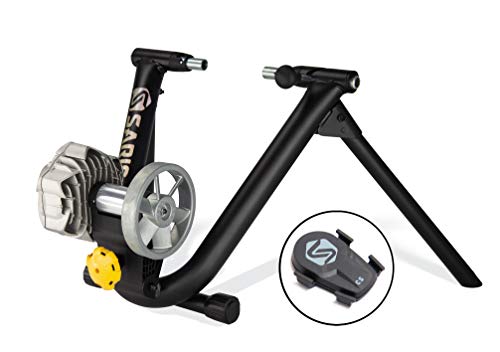
- Speed sensor for cycling apps
- 69 dB stated at 20 mph
- Thru-axle adapter sold separately
Best For: App-focused riders who want a wheel-on fluid trainer
Best for Manual Control
Six-Level Magnetic Bike Trainer
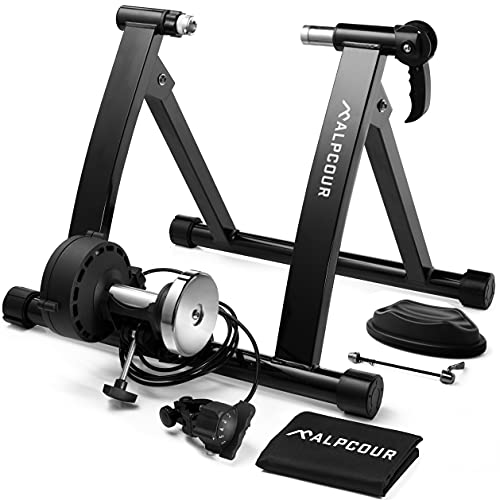
- Six handlebar-controlled settings
- Includes riser block and bag
- Stated fit: most 26–28-inch and 700c wheels
Best For: Riders who prefer preset resistance for intervals
Best for Easy Storage

- Noise-reducing fluid wheel
- Fits 26–29-inch and 700c wheels
- Folding frame; stated weight 24.3 lb
Best For: Riders who store their fluid trainer between workouts
Best Cassette-Ready Option

- Includes 11-speed cassette
- Smooth, road-like resistance
- Wi-Fi pairing and updates
Best For: 11-speed riders planning structured indoor workouts
Best Foldable Pick
Garmin Tacx NEO 2T Smart Trainer

- Foldable design
- ANT+ and Bluetooth
- Includes axle adapters
Best For: Riders who value foldability and wireless connectivity
Best Zwift Cog Bundle
Wahoo KICKR CORE 2 Zwift Cog and Click

- Zwift Cog and Click included
- Smooth, road-like resistance
- Wi-Fi pairing and updates
Best For: Riders seeking a CORE 2 bundle with Zwift accessories
Simple Magnetic Pick
FDW Magnetic Bike Trainer Stand
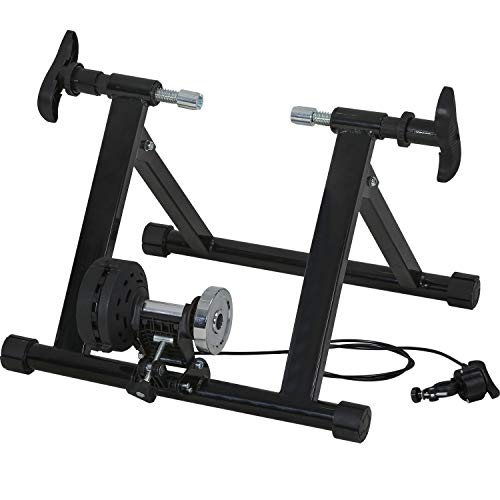
- Five manual resistance levels
- Foldable for storage
- First-setting noise claimed at 60 dB or less
Best For: Basic indoor workouts with manual resistance
Connected Performance Pick
Wahoo KICKR V6 Smart Indoor Trainer
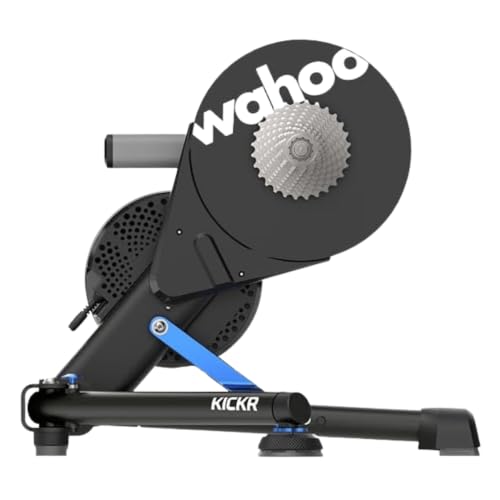
- 2.4 GHz Wi-Fi connectivity
- Stated ±1% power accuracy
- No supplied decibel rating
Best For: Connected workouts and precise power tracking
Quiet Smart Pick
ThinkRider X2Max Smart Bike Trainer

- About 58 dB at 30 km/h, per manufacturer
- Simulates grades up to 18%
- Cassette not included
Best For: Interactive riding with a stated noise figure
Best for Natural Resistance – Foldable Fluid Bike Trainer
If you want quiet bike trainers that make indoor rides feel less mechanical, this fluid stand increases resistance as you pedal faster. It fits most 26–29-inch and 700c wheels and folds into the included carrying bag.
Best For: Riders who prefer speed-responsive resistance without changing settings.
Pros:
- Fluid mechanism provides progressive resistance and is designed to reduce noise.
- Includes a front wheel riser block, anti-slip pads, and a dual-knob locking system.
- Foldable frame and included bag simplify storage and transport.
Cons:
- Resistance has no separate manual adjustment.
- As a wheel-on trainer, it presses against the rear tire.
This is a practical choice when a straightforward, portable setup matters more than preset resistance levels. Expect resistance to rise with your effort rather than at the turn of a dial.
Best for Virtual Rides – Saris Fluid2 Smart Equipped
Saris Fluid2 Smart Equipped Indoor Bike Trainer, Includes Speed Sensor, Made in The USA
Check Price On AmazonAmong quiet bike trainers for app-based workouts, the Saris Fluid2 stands out for its included speed sensor and fluid resistance. Saris specifies a noise level of 69 decibels at 20 mph, giving shoppers a useful reference point rather than a promise of silence.
Best For: Riders who want a wheel-on fluid trainer with a sensor for virtual cycling apps.
Pros:
- Included speed sensor connects with Zwift, Rouvy, and other indoor cycling apps.
- Progressive fluid resistance is designed for a road-like feel.
- Foldable frame, leveling block, and cooling system support regular indoor use.
Cons:
- Thru-axle bikes require a separately sold adapter.
- It is not silent; the stated noise level is 69 decibels at 20 mph.
Choose this model if app connectivity is a priority, but check your bike’s axle before ordering. Its wheel-on design lets you keep the rear wheel installed.
Best for Manual Control – Six-Level Magnetic Bike Trainer
If you are comparing quiet bike trainers but want defined resistance steps, this magnetic stand offers six settings controlled from the handlebar. Its foldable frame comes with a carrying bag and fits most 26–28-inch and 700c wheels.
Best For: Riders who want to change resistance from the handlebars during indoor intervals.
Pros:
- Six fixed resistance levels are controlled by a handlebar-mounted cable.
- Includes a front wheel riser block and anti-slip rubber pads.
- Quick-release lever, folding frame, and included bag make setup and storage convenient.
Cons:
- Fixed settings do not provide the continuously progressive resistance of a fluid trainer.
- The stated fit is for most 26–28-inch and 700c wheels; confirm compatibility with other sizes.
This is the more hands-on option in the lineup: you choose a setting instead of relying on pedaling speed alone. Check wheel fit before buying, particularly if you use a 29-inch setup.
Best for Easy Storage – Sportneer F1 Fluid Trainer
For shoppers looking at quiet bike trainers that can be put away between rides, the Sportneer F1 pairs a noise-reducing fluid resistance wheel with a folding frame. It accommodates 26–29-inch and 700c wheels, according to the supplied product information.
Best For: Riders who want a fluid trainer that folds away after indoor workouts.
Pros:
- Fluid resistance wheel is designed for quieter spinning.
- Dual locking system, wide frame, and front wheel riser block help keep the bike steady.
- Folds to a stated 24 x 7.9 x 25.2 inches for storage or transport.
Cons:
- At a stated 24.3 pounds, it may be less convenient to carry than a lighter stand.
- The supplied notes do not describe a handlebar resistance controller.
The F1 makes the most sense if you want a stable wheel-on setup without dedicating permanent floor space to it. Its foldability is useful, though its listed weight is worth considering if you will move it often.
Best Cassette-Ready Option – Wahoo KICKR CORE 2 11-Speed
For shoppers comparing quiet bike trainers, the Wahoo KICKR CORE 2 offers magnetic resistance, a smooth, road-like ride feel, and an included 11-speed cassette. Integrated Wi-Fi supports pairing and automatic updates when connected to an active network.
Best For: Riders who want an 11-speed cassette included and a trainer suited to structured workouts.
Pros:
- Includes an 11-speed cassette and 1.8 mm spacer.
- Designed for smooth resistance during hard efforts.
- Integrated Wi-Fi supports pairing and automatic updates.
Cons:
- Included cassette is 11-speed, so check your bike’s drivetrain before buying.
- Requires an AC power adapter, which is included.
This is the cassette-equipped CORE 2 choice. The notes do not provide a noise rating, so its suitability for a particularly noise-sensitive space is worth checking separately.
Best Foldable Pick – Garmin Tacx NEO 2T Smart Trainer
If you’re comparing quiet bike trainers and need something you can fold between rides, consider the Garmin Tacx NEO 2T. It uses magnetic resistance with 32 neodymium magnets and connects over ANT+ or Bluetooth.
Best For: Riders who want a foldable trainer with ANT+ and Bluetooth connectivity.
Pros:
- Foldable design.
- Supports ANT+ and Bluetooth.
- Includes a front wheel support and listed quick-release and thru-axle adapters.
Cons:
- At 47.4 pounds, it may be cumbersome to move.
- The supplied notes do not specify an included cassette.
The NEO 2T’s foldability and connectivity distinguish it here. Its listed features do not establish a measured noise level, so don’t treat it as a guaranteed silent option.
Best Zwift Cog Bundle – Wahoo KICKR CORE 2 Zwift Cog and Click
Among quiet bike trainers, the Wahoo KICKR CORE 2 Zwift Cog and Click is worth considering if those Zwift accessories are on your shopping list. It pairs the CORE 2’s smooth, road-like resistance with an included third-generation Zwift Cog and Zwift Click.
Best For: Riders who want a CORE 2 package with Zwift Cog and Click included.
Pros:
- Includes third-generation Zwift Cog and Zwift Click.
- Integrated Wi-Fi supports pairing and automatic updates on an active network.
- Includes adapters for listed quick-release and thru-axle configurations.
Cons:
- The supplied components list does not include an 11-speed cassette.
- The notes do not specify a measured noise level.
Choose this version for its included Zwift accessories rather than the cassette supplied with the other CORE 2 package. Check your bike setup against the listed adapters before ordering.
Simple Magnetic Pick – FDW Magnetic Bike Trainer Stand
If you’re comparing quiet bike trainers for straightforward indoor workouts, this FDW wheel-on stand offers five magnetic resistance settings without requiring a connected app. The manufacturer claims noise stays at or below 60 dB on the first setting; actual sound may vary with your bike and setup.
Best For: Riders who want a foldable, manually adjustable trainer for a road or mountain bike.
Pros:
- Five resistance levels provide a range of workout effort.
- Foldable design makes storage and transport easier.
- Steel frame has a stated 300-pound load capacity.
Cons:
- No app connectivity or automatic resistance is listed.
- The noise claim applies specifically to the first resistance setting.
Choose this one for basic indoor riding and compact storage rather than interactive training. Check wheel fit against your bike before ordering.
Connected Performance Pick – Wahoo KICKR V6 Smart Indoor Trainer
The Wahoo KICKR V6 is a connected option for shoppers researching quiet bike trainers who also prioritize power accuracy and ride feel. Its listed features include 2.4 GHz Wi-Fi, a high-inertia flywheel, and AXIS feet that allow side-to-side movement; the supplied specifications do not give a noise rating.
Best For: Cyclists who want connected training, automatic calibration, and detailed power data.
Pros:
- Wi-Fi sends ride data to a computer, tablet, or smartphone.
- Rated for more than 2,200 watts with stated power accuracy of ±1%.
- Automatic calibration and AXIS feet support a more responsive training experience.
Cons:
- No decibel figure is supplied to verify how quiet it is.
- At a listed 22 kg, it is heavier than the other trainers in this roundup.
This is the performance-focused choice here, but buyers whose first priority is a documented noise level should note that none is provided in the supplied specifications.
Quiet Smart Pick – ThinkRider X2Max Smart Bike Trainer
The ThinkRider X2Max deserves a look among quiet bike trainers if you want software-controlled resistance and a stated sound figure. ThinkRider reports about 58 dB at 30 km/h, while BLE and ANT+ support connections to cycling software such as Zwift.
Best For: Road or mountain bike riders seeking interactive training with a manufacturer-stated noise level.
Pros:
- Automatically adjusts resistance to simulate grades up to 18% when connected to riding software.
- Rated up to 2,000 watts with stated power error of ±2%.
- Reported noise is about 58 dB at 30 km/h.
Cons:
- Cassette is not included.
- The supplied load capacity is 240 pounds.
Its stated noise figure and connected features make it a practical option for interactive indoor rides. Confirm your drivetrain setup and rider-weight requirements before buying.
How We Picked These Quiet Bike Trainers
We prioritized trainer designs that can support a lower-noise indoor setup, while accounting for price, resistance type, bike fit, storage, and connected-training options. This list includes fluid and magnetic wheel-on stands alongside direct-drive smart trainers. No single noise claim guarantees a quiet ride in every home: tire tread, drivetrain condition, riding intensity, and floor vibration can change what others hear.
Quick Comparison: Which Trainer Type Fits?
Magnetic wheel-on trainers are generally the budget-friendly choice. Some offer handlebar-adjustable resistance, but tire contact can create a noticeable hum. Fluid wheel-on trainers typically increase resistance as you pedal faster, offering a straightforward ride without needing an outlet; tire noise still matters. Direct-drive smart trainers replace the rear wheel during use, removing tire-on-roller noise and adding app-controlled workouts on compatible models. They cost more and can still transmit vibration through the floor.
Key Buying Factors for a Quieter Setup
Noise at the Source
If you have a knobby mountain-bike tire, expect more wheel-on noise than you would with a smooth road tire or dedicated trainer tire. Direct drive avoids tire contact, but a clean, lubricated drivetrain remains important. Manufacturer noise-reduction language is useful as a starting point, not a substitute for checking how a trainer behaves with your bike.
Vibration and Shared Walls
Place the trainer on a stable surface with a dense mat underneath. A mat can reduce vibration reaching the floor, though it will not make hard efforts silent. In an upstairs apartment, consider what a downstairs neighbor might hear through the structure, not just the sound level beside the bike.
Fit, Resistance, and Apps
Check wheel-size limits, axle or quick-release requirements, frame clearance, and any adapters before buying. For direct-drive models, verify cassette or virtual-shifting compatibility with your drivetrain. Choose manual resistance if you mainly want simple steady rides; choose a smart trainer if app-controlled intervals, simulated gradients, or virtual riding are central to your routine. Also check whether connectivity and app features require separate subscriptions or accessories.
Who Should Buy Which Quiet Bike Trainers?
Choose an entry-level magnetic stand if low upfront cost and occasional indoor rides matter most, and you can manage tire noise. A fluid wheel-on trainer suits riders who want uncomplicated, speed-dependent resistance without building their workouts around an app. For frequent training in a noise-sensitive space, start with a compatible direct-drive model and budget for a protective mat; it is usually the more practical route to avoiding roller noise, though not a promise of silence. If structured workouts and virtual routes are the priority, compare the smart models by drivetrain fit, included shifting hardware, and app compatibility before paying for extra features.
