
The best premium bike GPS computers do more than record speed and distance. They combine reliable navigation, structured training tools, safety features, and clear ride data in a purpose-built device.
Our 2026 picks cover everything from compact training computers and long-range solar models to touchscreen navigators and rugged mountain-bike options. Use the guide below to match features, size, and price with the way you ride.
Best 10 Premium Bike GPS Computers Picks for 2026
Top Premium Pick

- Vivid 3.5-inch touchscreen
- Advanced training and navigation tools
- Up to 60 hours in battery-saver mode
Best For: Serious cyclists seeking comprehensive performance and connected features
Best Compact Navigator

- Turn-by-turn route guidance
- Automatic route and workout syncing
- ANT+ radar integration
Best For: Road riders wanting compact navigation with smart connectivity
Best Easy-Use Option

- Simple setup with a 3-inch touchscreen
- Road, trail, and eBike routing
- LiveTrack and incident detection
Best For: Recreational, touring, and eBike riders seeking straightforward navigation
Best for Exploring

- Dual-band GPS for challenging environments
- On-demand turn-by-turn routing
- Up to 25 hours of battery life
Best For: Long-distance and adventure riders exploring unfamiliar routes
Solar-Powered Navigation Leader
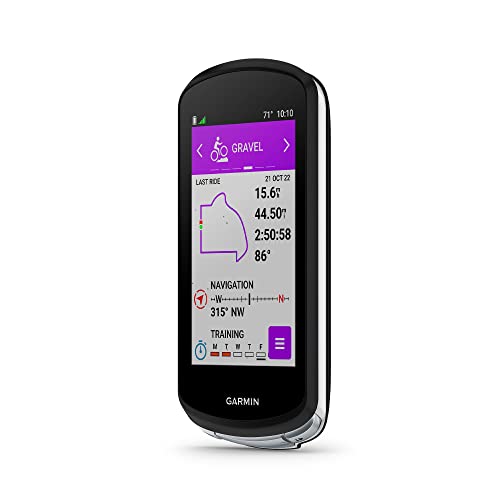
- Up to 100 hours in battery-saver mode
- Multi-band GNSS for challenging routes
- Advanced training and navigation tools
Best For: Long-distance cyclists and endurance training
Feature-Packed Value Pick

- 3.5-inch touchscreen with route navigation
- Dual-band GPS and five satellite systems
- Up to 35 hours of battery life
Best For: Connected route planning and climbing-focused rides
Compact Smart Training Computer
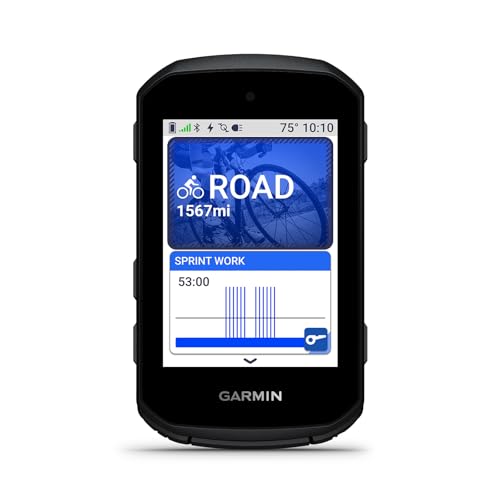
- Vivid touchscreen with button controls
- Maps for road, gravel, and trails
- Built-in speaker and smart ride alerts
Best For: Connected road, gravel, and trail riding
Best for Mountain Biking

- Rugged 2.1-inch color display with button controls
- Trailforks maps and Forksight trail guidance
- MTB metrics, multi-band GPS, and up to 26 hours in battery-saver mode
Best For: Technical trail, enduro, and downhill riders
Best Premium All-Rounder
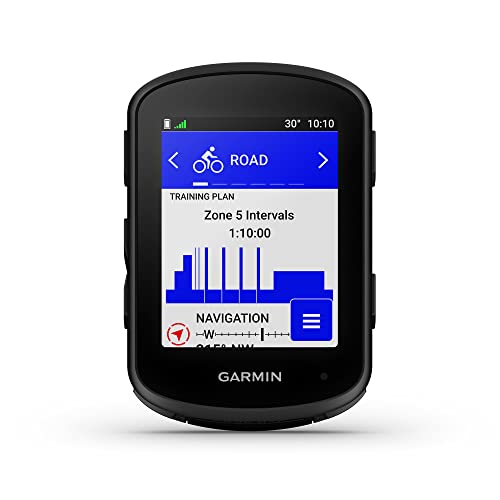
- 2.6-inch touchscreen plus physical button controls
- Adaptive training, ClimbPro, and multi-band GNSS
- Up to 26 hours normally or 32 hours in battery-saver mode
Best For: Training-focused cyclists who also want advanced navigation
Best for Long Battery Life

- Button controls and a 2.6-inch cycling display
- Up to 42 hours in battery-saver mode
- Advanced navigation and adaptive training support
Best For: Endurance riders who prefer physical controls
Top Premium Pick – Garmin Edge 1050
The Garmin Edge 1050 is a standout among premium bike GPS computers for riders who want advanced navigation, training tools, safety features, and smart connectivity in one device. Its large touchscreen, built-in speaker, and extensive performance features make it especially well suited to serious road cyclists and structured training.
Best For: Performance-focused cyclists who want the broadest set of navigation, training, and connected-riding features.
Pros:
- Large, vivid 3.5-inch touchscreen with on-device course creation and road-surface mapping.
- Advanced training tools include ClimbPro, power guidance, stamina insights, and adaptive coaching.
- Built-in speaker supports navigation prompts, a bike bell, and connected safety features.
- Battery life reaches up to 20 hours in demanding use or 60 hours in battery-saver mode.
Cons:
- Many connected features require a compatible smartphone, app, or additional sensors.
- Its extensive feature set may be more than casual riders need.
The Edge 1050 is the most feature-rich option here, combining a premium display with detailed training and navigation capabilities. Choose it if you will use its advanced ecosystem; otherwise, a simpler computer may offer better value.
Best Compact Navigator – Wahoo ELEMNT BOLT V3
The Wahoo ELEMNT BOLT V3 is a practical choice among premium bike GPS computers for riders who prioritize clear route guidance and a compact, button-controlled design. It supports turn-by-turn navigation, automatic route downloads, smart notifications, and ANT+ radar integration while keeping the interface straightforward.
Best For: Road cyclists who want dependable navigation and connected features in a compact handlebar computer.
Pros:
- Provides turn-by-turn prompts for imported routes and routes created on demand.
- Automatic route downloads and workout uploads work with several compatible services.
- ANT+ radar integration displays approaching vehicles and provides LED alerts.
- IPX7 protection and a claimed 20-hour battery life support regular outdoor riding.
Cons:
- The 2.3-inch display is smaller than those on the Garmin alternatives.
- Live tracking and smart notifications require riding with a compatible smartphone.
The BOLT V3 suits riders who prefer a focused navigation computer rather than a large touchscreen training platform. Its compact format and route-service integration are particularly useful for road rides and organized training.
Best Easy-Use Option – Garmin Edge Explore 2
The Garmin Edge Explore 2 is an approachable option among premium bike GPS computers, emphasizing simple setup, readable maps, and useful ride navigation. Its glove- and rain-friendly 3-inch touchscreen supports road, trail, and eBike routing without requiring the extensive training focus of higher-end models.
Best For: Recreational cyclists, touring riders, and eBike users who value simple navigation and everyday safety features.
Pros:
- 3-inch high-resolution touchscreen is designed for use with gloves and in rain.
- Preloaded activity profiles and ride-type maps make setup straightforward.
- Supports eBike battery, assist-level, and range information when compatible.
- Offers LiveTrack, GroupTrack, incident detection, and compatibility with Varia devices.
Cons:
- Its approximately 16-hour battery life is shorter than several alternatives here.
- Heart-rate, speed, cadence, and Varia accessories are sold separately.
The Edge Explore 2 is a sensible pick when navigation clarity and ease of use matter more than advanced performance metrics. It is especially appealing for mixed-surface exploration, touring, and compatible eBike rides.
Best for Exploring – Wahoo ELEMNT ROAM V3
The Wahoo ELEMNT ROAM V3 is a strong choice among premium bike GPS computers for riders who explore unfamiliar roads and want route guidance with enhanced positioning. Dual-band GPS, a larger 2.8-inch display, on-demand route generation, and a 25-hour battery make it well suited to longer rides and varied environments.
Best For: Adventure-minded cyclists who need reliable navigation and extended battery life for long rides.
Pros:
- Dual-band GPS is designed to improve accuracy in forests and dense urban areas.
- Turn-by-turn navigation supports common route files and multiple routing sources.
- On-demand routes can be created from the device or companion app.
- 25-hour battery life and IPX7 protection suit extended outdoor rides.
Cons:
- The supplied notes do not specify advanced training features or sensor metrics beyond compatibility.
- Route sharing and app-based functions depend on compatible connected services.
The ROAM V3 balances navigation capability, positioning confidence, and battery endurance. It is a compelling alternative to the smaller BOLT for riders who regularly venture beyond familiar routes or spend long days in the saddle.
Solar-Powered Navigation Leader – Garmin Edge 1040 Solar
The Garmin Edge 1040 Solar is a premium bike GPS computer built for riders who want long battery life, detailed navigation, and advanced training tools. Its solar-charging lens, multi-band GNSS, touchscreen, and broad sensor support make it especially capable for extended rides and demanding routes.
Best For: Long-distance cyclists, endurance training, and riders who prioritize navigation and battery longevity.
Pros:
- Solar charging can extend battery life to up to 100 hours in battery-saver mode or up to 45 hours in demanding use.
- Multi-band GNSS is designed to improve positioning accuracy in challenging environments.
- Offers power guidance, stamina insights, training prompts, ride-type-specific maps, and integrations with Strava, Komoot, and TrainingPeaks.
- Includes a 3.5-inch touchscreen, multiple mounts, a silicone case, and IPX7 water resistance.
Cons:
- Its extensive feature set may be more than casual riders need.
- Solar charging performance depends on available daylight and riding conditions.
The Edge 1040 Solar stands out among premium bike GPS computers for endurance-focused riders who want a feature-rich training and navigation platform with exceptional battery potential.
Feature-Packed Value Pick – iGPSPORT BiNavi Bike Computer
The iGPSPORT BiNavi brings several premium bike GPS computer features to a 3.5-inch color touchscreen, including route recalculation, dual-band GPS, climb planning, and music control. With 35 hours of stated battery life and 32GB of storage, it is a practical option for riders who want connected navigation without relying solely on a phone.
Best For: Route-focused cyclists who want touchscreen navigation, climbing tools, and broad satellite support.
Pros:
- Supports route imports from the iGPSPORT app, Strava, Komoot, and compatible road-book files.
- Automatically replans routes after going off course and can navigate to saved locations.
- Dual-band GPS supports GPS, BeiDou, GLONASS, Galileo, and QZSS satellite systems.
- Offers iClimb Pro, training analysis, music control, and up to 35 hours of battery life.
Cons:
- Map support is listed as road-focused, so trail riders should check whether the coverage suits their routes.
- Software update support is unspecified in the supplied details.
The BiNavi is an appealing choice for riders seeking a large touchscreen, flexible route handling, and useful connected features at a potentially accessible price point.
Compact Smart Training Computer – Garmin Edge 850
The Garmin Edge 850 is a compact premium bike GPS computer combining a vivid color touchscreen with button controls, mapped road and trail navigation, and advanced ride intelligence. Its built-in speaker, fueling alerts, weather overlays, and cycling-safety features make it a strong fit for riders who want a highly connected cockpit.
Best For: Road, gravel, and trail cyclists who value smart alerts, training guidance, and compact controls.
Pros:
- Preloaded road, gravel, Trailforks, and trail maps include Forksight information and road-surface details.
- Provides smart fueling alerts based on fitness, course demands, heat, and humidity when paired with compatible sensors.
- Multi-band GPS and automatic 5 Hz recording support detailed tracking during demanding downhill and enduro rides.
- Built-in speaker supports workout and navigation prompts, a bike bell, and connected safety features.
Cons:
- Battery life is rated at up to 12 hours in demanding use or 36 hours in battery-saver mode.
- Several weather, hazard, messaging, and safety features require a compatible smartphone and Garmin Connect.
The Edge 850 is a versatile compact option for cyclists who want sophisticated training and navigation features, especially when they are comfortable pairing the computer with sensors and a smartphone.
Best for Mountain Biking – Garmin Edge MTB
For riders comparing premium bike GPS computers for technical trails, the Garmin Edge MTB emphasizes rugged construction, trail navigation, and mountain-bike-specific performance data. Its color display, multi-band GPS, and dedicated enduro and downhill profiles make it particularly focused on off-road riding.
Best For: Mountain bikers who want detailed trail maps, downhill tracking, and MTB-specific metrics.
Pros:
- Rugged, compact design with scratch-resistant Corning Gorilla Glass and a 7-button interface.
- Preloaded Trailforks and TopoActive maps, plus Forksight information for upcoming trail forks.
- Tracks Grit, Flow, jump speed, hang time, and split times with automatic 5 Hz GPS recording.
- Offers up to 14 hours of battery life in demanding use or 26 hours in battery-saver mode.
Cons:
- Its 2.1-inch display is smaller than the screens on many general-purpose cycling computers.
- Some training, safety, and connected features require a compatible smartphone or additional sensors.
The Edge MTB is a specialized choice rather than an all-purpose road computer. Choose it when trail durability, navigation, and downhill or enduro data matter more than touchscreen control or maximum battery life.
Best Premium All-Rounder – Garmin Edge 840
The Garmin Edge 840 is a strong all-rounder among premium bike GPS computers, combining touchscreen and button controls with advanced navigation, training guidance, and smart connectivity. It is designed for cyclists who want detailed performance tools without giving up flexible control options.
Best For: Serious road and mixed-surface cyclists who want adaptive training, navigation, and touchscreen convenience.
Pros:
- Combines a 2.6-inch touchscreen with physical buttons for flexible operation.
- Multi-band GNSS, ride-type-specific maps, searchable points of interest, and ClimbPro support navigation.
- Provides suggested workouts, adaptive coaching, power guidance, stamina insights, and cycling-ability analysis when paired with compatible sensors.
- Offers up to 26 hours in demanding use or 32 hours in battery-saver mode.
Cons:
- Several advanced training features require a compatible power meter and heart rate monitor.
- Touchscreen controls may be less convenient in some riding conditions than buttons alone.
The Edge 840 is the most versatile option in this group for riders who want a premium feature set and two control methods. It makes the most sense for structured training and frequent navigation, especially when paired with cycling sensors.
Best for Long Battery Life – Garmin Edge 540
The Garmin Edge 540 delivers many of the premium bike GPS computer features found in Garmin’s advanced lineup while using straightforward button controls. Its long battery-saver runtime, multi-band positioning, and training tools make it a practical fit for endurance-focused cyclists.
Best For: Riders who prefer physical controls and want extended battery life for long training sessions or rides.
Pros:
- Button-based interface is simple and consistent for handlebar use.
- Battery lasts up to 26 hours in demanding use or up to 42 hours in battery-saver mode.
- Includes multi-band GNSS, ride-type-specific maps, ClimbPro, and searchable points of interest.
- Supports suggested workouts, adaptive coaching, power guidance, stamina insights, and course-demand analysis with compatible sensors.
Cons:
- It does not include the Edge 840’s touchscreen control.
- Many performance and coaching features require a compatible power meter and heart rate monitor.
The Edge 540 is a sensible choice for cyclists who value buttons, endurance, and advanced training support over touchscreen interaction. Its 42-hour battery-saver rating is especially useful for riders planning long outings between charges.
How We Picked the Best Premium Bike GPS Computers
We focused on cycling computers that offer a meaningful advantage over a phone, including dependable GPS tracking, turn-by-turn navigation, training metrics, climb awareness, route support, or extended battery performance. We also considered display usability, button and touchscreen controls, connectivity with sensors, weather resistance, mounting ecosystems, and the needs of road, gravel, touring, and mountain-bike riders.
The selection includes current Garmin and Wahoo models alongside a value-oriented iGPSPORT option. Because feature priorities vary widely, the best choice is not necessarily the most expensive or most advanced computer.
Quick Comparison
| Best For | Recommended Type | Prioritize |
|---|---|---|
| Advanced road training | Garmin Edge 1050 or 850 | Performance metrics, navigation, connectivity |
| Simple navigation | Garmin Edge Explore 2 | Readable maps and ease of use |
| Fast, compact training | Wahoo ELEMNT BOLT V3 or Garmin Edge 540 | Small size, buttons, structured workouts |
| Long-distance riding | Garmin Edge 1040 Solar | Battery endurance and route guidance |
| Large-screen navigation | Wahoo ELEMNT ROAM V3 or iGPSPORT BiNavi | Map visibility and route control |
| Mountain biking | Garmin Edge MTB | Trail durability and MTB-specific metrics |
Key Buying Factors for Premium Bike GPS Computers
Navigation and Display
Choose a larger, higher-resolution display if you frequently follow unfamiliar routes or need to read maps while riding. A compact screen saves space and weight but may require more frequent zooming. Touchscreens are convenient for map interaction, while physical buttons are often easier to operate in rain, gloves, or rough terrain.
Battery Life and Charging
Match battery capacity to your longest normal ride, not just your average outing. Ultra-distance riders and bikepackers should look for extended runtime or solar assistance. For shorter training sessions, a lighter computer with standard charging may be the more practical choice.
Training and Sensor Support
Serious training may require power-meter compatibility, heart-rate support, structured workouts, recovery insights, and advanced performance data. Check compatibility with ANT+, Bluetooth, electronic shifting, indoor trainers, and the sensors already on your bike.
Ride Type and Durability
Road and gravel riders may value route planning and climbing data, while mountain bikers should prioritize rugged construction, trail navigation, and discipline-specific metrics. Also consider mount security, water resistance, glove-friendly controls, and whether the device integrates with your phone and safety accessories.
Who Should Buy Which Premium Bike GPS Computers?
Choose the Garmin Edge 1050 or Edge 850 if you want a feature-rich training and navigation hub. Pick the Edge 1040 Solar for long rides where charging opportunities are limited. The Wahoo ELEMNT BOLT V3 suits riders who prefer a compact, button-controlled computer, while the ROAM V3 is better for riders who want a larger navigation-focused display.
The Edge Explore 2 is the strongest fit for cyclists who want straightforward route guidance without an intensive training interface. The Edge 540 and Edge 840 suit performance-minded riders who prefer compact computers, with the Edge 840 offering a richer control experience. Choose the Edge MTB for dedicated trail use, and consider the iGPSPORT BiNavi when a large touchscreen and core navigation features matter more than a deep premium ecosystem.
