
Testing a solar panel in the field is easier when your meter is compact, readable, and matched to the panel’s electrical output. The best lightweight solar panel testers can quickly reveal voltage, current, maximum power, and MPPT performance without requiring a bulky bench setup.
This roundup compares 10 portable PV testers across several power and voltage ranges, including options for RV systems, installers, technicians, and serious DIY users.
Best 10 Lightweight Solar Panel Testers Picks for 2026
Professional Pick
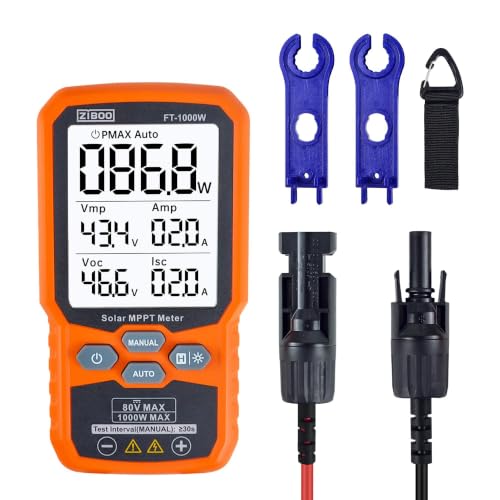
- Measures up to 1,000W, 80V, and 35A
- Backlit display with data hold
- Compact 10.4-ounce field-ready design
Best For: Professional panel testing and maintenance
Portable Value

- Battery-free operation powered by the panel
- Large LCD designed for sunlight readability
- Includes EVA case and two cable types
Best For: Portable and parallel-connected panel testing
High-Range Meter

- Manual and automatic MPPT testing
- Solar-powered with no batteries required
- Large multilingual display shows multiple results
Best For: Installers needing comprehensive panel diagnostics
Large-Display Option
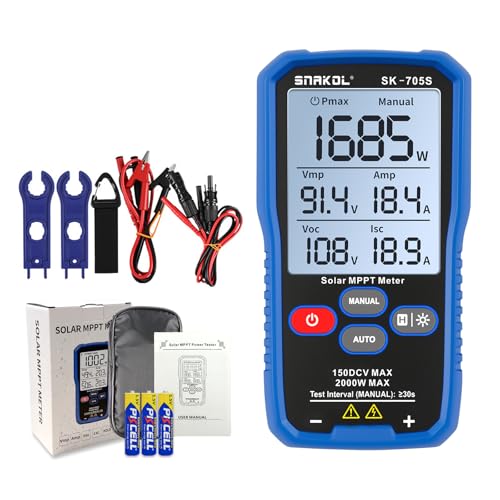
- 3.2-inch backlit LCD with data hold
- Automatic and manual MPPT modes
- Measures Voc, Isc, Vmp, Imp, and Pmax
Best For: Outdoor commissioning and maintenance checks
Feature-Rich Pick

- Tests Pmax, Voc, and Isc across a broad range
- Sunlight-readable 3.2-inch LCD
- Rechargeable design with multiple protections
Best For: RV, home, and off-grid solar testing
Battery-Free Pick
Solar-Powered MPPT Panel Tester
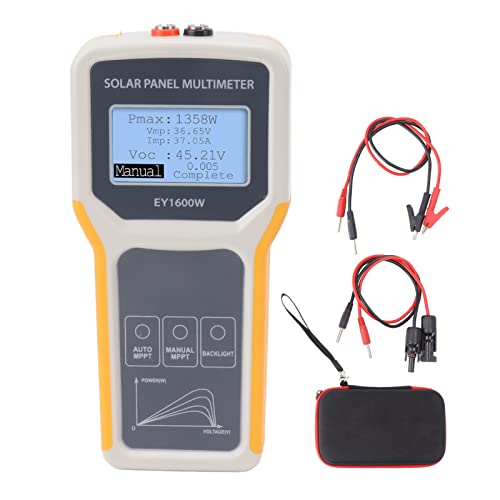
- Operates directly from the connected solar panel
- Displays Pmax, Vmp, Imp, and Voc
- Backlit LCD and portable foldable design
Best For: Portable solar, RV, boat, and roof-panel checks
Most Portable Pick

- Lightweight 193g body for onsite use
- Measures Pmax, Vmp, Voc, and Isc
- Includes pouch, leads, and MC4 tools
Best For: Installers and DIY users testing single panels
Top High-Capacity Pick
GladJoJoY 1800W MPPT Solar Panel Tester

- Tests up to 1800W, 120V, and 60A
- Supports series and parallel panels
- Large LCD with MC4 and clip cables
Best For: Higher-output arrays and complex solar-system troubleshooting
Best Portable Kit
EY1800W MPPT Solar Panel Multimeter
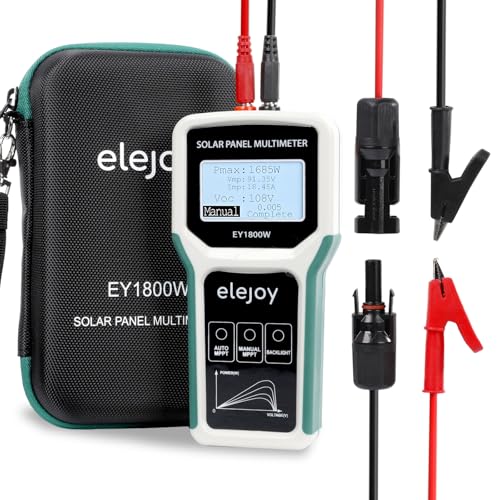
- Reads Pmax, Voc, Isc, and performance
- Supports up to 1800W, 120V, and 60A
- Includes EVA case, MC4 leads, and clips
Best For: Field diagnostics and portable PV testing
Best for Smaller Panels

- Supports 12–60V panels up to 400W
- Provides automatic and manual MPPT modes
- Backlit LCD and included testing accessories
Best For: Portable and small solar-panel setups
Professional Pick – ZIBOO FT-1000W MPPT Tester
For technicians comparing lightweight solar panel testers, the ZIBOO FT-1000W combines a compact 10.4-ounce design with MPPT measurements up to 1,000W. It reads Voc, Isc, Vmp, and current, while its backlit display and data-hold function help during field checks.
Best For: Solar professionals validating residential or commercial panels, including rooftop and maintenance work.
Pros:
- Measures up to 1,000W, 80V, and 35A with stated ±0.8% accuracy.
- Tracks maximum-power performance to help identify shading or panel degradation.
- Compact aluminum-bodied design includes a backlit LCD, data hold, and IP54 protection.
- Includes specialized leads, batteries, strap, and MC4-related wrench tools.
Cons:
- Its 80V and 35A limits may not suit higher-voltage or higher-current arrays.
- Uses supplied batteries rather than solar-only operation.
The ZIBOO is a strong fit when portability and professional measurement features matter. Its safety ratings and outdoor-oriented construction add confidence for technicians working around PV equipment.
Portable Value – FROGBRO 1600W MPPT Tester
The FROGBRO 1600W is one of the more practical lightweight solar panel testers for portable systems and routine inspections. Its large LCD is designed for sunlight readability, and it operates directly from the connected panel without batteries.
Best For: Testing portable, foldable, vehicle, boat, rooftop, and parallel-connected solar panels under 1,600W and 60V.
Pros:
- Measures panel voltage, current, and power while supporting automatic Voc readings.
- Battery-free operation simplifies field use.
- Includes an EVA case, MC4 cables, and alligator-clip cables.
- Provides over-voltage, over-current, over-temperature, and over-power protections.
Cons:
- Cannot measure multiple panels connected in series.
- Panels must be disconnected from other equipment or loads before testing.
- The 1,600W and 60V limits restrict use with larger systems.
This tester is appealing for portable solar owners and routine troubleshooting, especially if you value battery-free operation. Check system configuration and ratings carefully before connecting it.
High-Range Meter – UNI-T UT673PV Solar Tester
The UNI-T UT673PV is a portable option among lightweight solar panel testers, with a 1.2-pound body and solar-powered operation. It supports manual and automatic MPPT testing and displays key results, including maximum power, peak voltage, peak current, Voc, and Isc.
Best For: Installers, manufacturers, and end users who want broad measurement coverage and multilingual operation.
Pros:
- Measures Pmax, Vmp, Imp, Voc, and Isc with automatic or manual testing modes.
- Solar-powered design requires no batteries.
- Large screen can display multiple results simultaneously and supports eight languages.
- Includes an MC4 test lead, cloth bag, and wrench tool, with multiple protection systems.
Cons:
- The listed maximum operating voltage is 60V, despite the product listing’s broader range claims.
- At 1.2 pounds, it is less lightweight than the smallest meters in this roundup.
- The included test lead is rated CAT 0 60V, so users should verify suitability for their system.
The UT673PV offers a useful balance of portability, display convenience, and testing modes. Its 60V operating limit makes careful system matching essential before purchase.
Large-Display Option – SK-705S 2000W PV Tester
The SK-705S is a portable MPPT tester for buyers who prefer a larger screen and flexible testing modes. It measures Voc, Isc, Vmp, Imp, and Pmax, with automatic or manual operation and a backlit 3.2-inch LCD for outdoor work.
Best For: Installation, commissioning, inspection, and maintenance of residential or commercial photovoltaic modules.
Pros:
- Tests the main panel performance values, including Pmax, Vmp, Imp, Voc, and Isc.
- Offers automatic continuous measurements and manual single tests.
- Backlit 3.2-inch display includes data hold for easier reading outdoors.
- Comes with test leads, alligator clips, storage pouch, and manual.
Cons:
- Its supplied specifications are inconsistent, listing both 2,000W/150V/45A and lower 1,000W/80V/45A limits.
- The listed 30-pound item weight conflicts with its portable positioning and should be verified.
- Battery-powered operation requires keeping batteries available.
The SK-705S is worth considering for users who prioritize display size and mode flexibility. Because the supplied ratings conflict, confirm the actual limits and weight before relying on it for a specific PV installation.
Feature-Rich Pick – 2000W MPPT Solar Panel Tester
For shoppers comparing lightweight solar panel testers, this compact MPPT meter offers a broad testing range and an easy-to-read display. It measures Pmax, Voc, and Isc while supporting both automatic and manual modes, making it practical for installation, maintenance, and troubleshooting.
Best For: RV, home, and off-grid solar users who want a rechargeable tester with broad measurement capacity.
Pros:
- Measures Pmax, Voc from 3–90V, and Isc from 0–40A.
- Built-in MPPT tracking supports performance testing and system optimization.
- 3.2-inch sunlight-readable LCD shows voltage, current, and power together.
- Includes protection against over-voltage, over-current, reverse polarity, and overheating.
Cons:
- Its listed dimensions are larger than some ultra-compact testers.
- Battery-powered operation requires keeping the rechargeable unit charged.
Choose this model when measurement range and protective features matter more than having the smallest possible body. Its MC4 plug-and-play setup also makes it approachable for beginners.
Battery-Free Pick – Solar-Powered MPPT Panel Tester
This solar-powered option stands out among lightweight solar panel testers because it does not need a separate battery. Connect it to a compatible panel and use the backlit LCD to read maximum power point data, voltage, and current for portable or fixed solar setups.
Best For: Portable solar panels, RVs, boats, and users who prefer a tester powered directly by the panel.
Pros:
- Runs from the connected solar panel, so no battery is needed.
- Displays Pmax, Vmp, Imp, and Voc for useful performance checks.
- Large backlit LCD is designed for clear outdoor readings.
- Foldable, portable format suits solar kits, vehicles, boats, and roof panels.
Cons:
- Requires a solar panel connection to operate.
- Its operating range is limited to 12–60V and 5–1600W.
This is a practical choice for field kits where battery management is inconvenient. Confirm that your panel falls within the tester’s stated voltage and power range before buying.
Most Portable Pick – LODESTAR LD673PV Solar Tester
For buyers prioritizing portability, the LODESTAR LD673PV is one of the more compact lightweight solar panel testers in this group. It weighs 193g and measures Pmax, Vmp, Voc, and Isc on a single panel, with a backlit display and included accessories for onsite work.
Best For: Installers, electricians, and DIY users who need a compact single-panel tester with included MC4 accessories.
Pros:
- Lightweight 193g design is easy to carry between job sites.
- Measures Pmax, Vmp, Voc, Isc, and amp readings.
- Backlit multi-display shows key parameters simultaneously.
- Includes a protective pouch, test leads, MC4 connectors, and disconnect tool.
Cons:
- Designed for measuring one solar panel at a time, not series or parallel-connected panels.
- Its 1000W and 35A limits may not suit higher-output panels.
- Listed Voc range begins at 12V and extends to 80V.
This model makes the most sense when low carry weight and a ready-to-use accessory set are priorities. Its single-panel limitation should be considered before testing larger arrays.
Top High-Capacity Pick – GladJoJoY 1800W MPPT Solar Panel Tester
For buyers comparing lightweight solar panel testers for larger or more complex installations, this handheld MPPT multimeter offers a broad testing range. It supports 5W–1800W systems, 20V–120V voltage, and up to 60A, while measuring panel voltage, current, and power.
Best For: Testing series- and parallel-connected panels, portable solar setups, and higher-output solar arrays.
Pros:
- Supports panels from 5W to 1800W, up to 120V and 60A.
- Handles both parallel and series-connected panels.
- Large LCD, automatic Voc readings, and no battery requirement.
- Includes MC4 and alligator-clip cables plus multiple safety protections.
Cons:
- Panel power must not exceed 1800W.
- Panels must be disconnected from other devices or loads before testing.
This is the most capable option here for users who need broad system compatibility and high-current testing. Its compact handheld format adds portability, though its higher capacity may be more than small-panel users need.
Best Portable Kit – EY1800W MPPT Solar Panel Multimeter
Among lightweight solar panel testers, this 1800W MPPT multimeter stands out for field use because it includes an EVA tool kit and needs no batteries. It displays maximum power-point output, performance, open-circuit voltage, and short-circuit current for practical panel diagnostics.
Best For: Portable field testing, comparing panel performance, and troubleshooting PV systems up to 1800W.
Pros:
- Measures Pmax, performance, Voc, and Isc in real time.
- Supports up to 60A and 120V.
- Lightweight design with included EVA toolkit.
- Comes with MC4 connectors and alligator clips.
Cons:
- Its stated operating range begins at 20V.
- It is designed for solar-panel testing rather than general-purpose electrical measurement.
The included case and straightforward LCD interface make this a practical choice for technicians who carry testing equipment between sites. It offers the same high-capacity class as the first option while emphasizing portability and core diagnostic readings.
Best for Smaller Panels – EL400B Smart 400W MPPT Tester
For smaller systems, this compact tester is one of the more approachable lightweight solar panel testers. It covers 12–60V panels, up to 20A and 400W, and offers both automatic and manual MPPT modes with a backlit LCD for easier reading.
Best For: Portable, foldable, car, boat, and small rooftop solar panels rated up to 400W.
Pros:
- Compact design with backlit LCD display.
- Offers automatic and manual MPPT testing.
- Supports 12–60V panels, up to 20A and 400W.
- Includes MC4 cable, alligator clips, tool kit, and socket wrench.
Cons:
- Its 400W maximum is unsuitable for larger solar arrays.
- Its supported voltage range starts at 12V and tops out at 60V.
This model is a better match than an 1800W tester when you mainly work with portable or modest-size panels. The selectable MPPT modes provide useful flexibility, while the lower capacity keeps the tool focused on smaller installations.
How We Picked These Lightweight Solar Panel Testers
We focused on portable MPPT meters designed to test photovoltaic modules in real-world conditions. Selection criteria included maximum wattage, voltage and current limits, support for Voc, Isc, Vmp, and Pmax measurements, display readability, connector convenience, and suitability for field use.
Because the products cover different electrical ranges, a higher wattage rating does not automatically make one tester better. The right choice depends on the panels you plan to test and whether you prioritize portability, automation, or broader measurement capacity.
Quick Comparison
| Tester class | Typical capacity | Best suited to |
|---|---|---|
| Compact entry-level meters | Up to 400W | Small panels, portable power stations, and basic troubleshooting |
| General-purpose PV testers | Up to 1,000–1,600W | Residential, RV, and common portable solar panels |
| High-capacity MPPT meters | Up to 1,800–2,000W | Larger modules, installers, and advanced diagnostics |
Key Buying Factors for Lightweight Solar Panel Testers
Power, Voltage, and Current Limits
Check the tester’s maximum wattage, DC voltage, and amperage before buying. The limits should exceed your panel’s expected Voc and Isc, with enough headroom for safe testing. A meter rated for 400W may be unsuitable for a modern high-output panel even if its connectors fit.
Measurements and MPPT Operation
For useful performance testing, look for readings such as open-circuit voltage, short-circuit current, maximum power voltage, maximum power current, and Pmax. Automatic MPPT measurement is convenient, while manual modes can help experienced users investigate unusual readings.
Display and Field Usability
A large backlit LCD is valuable when testing outdoors or in shaded areas. Also consider button layout, foldable construction, battery requirements, measurement speed, and whether the unit retains readings clearly enough for comparisons.
Connectors and Compatibility
MC4 support can simplify testing common solar modules, but verify connector type and included adapters. Never assume a tester is compatible with every panel, extension lead, or system voltage without checking its specifications.
Who Should Buy Which Lightweight Solar Panel Testers?
Choose a compact lower-power tester if you mainly inspect small portable panels, RV accessories, or solar generators. A 1,000W to 1,600W model is the most versatile range for many homeowners, hobbyists, and general service tasks. Select an 1,800W or 2,000W unit when you work with larger panels or want additional measurement headroom.
Professionals and frequent installers should prioritize broad electrical limits, dependable MPPT testing, durable construction, and clear readings over the lowest price. Occasional users may get better value from a simpler meter that covers their panel’s output without paying for capacity they will not use.
