
A folding squat rack with a cable system can turn limited wall space into a surprisingly capable strength-training station. The best options support barbell work while adding pulleys for rows, pulldowns, presses, and accessory exercises.
We selected 10 racks with different approaches to storage, cable functionality, adjustability, and weight capacity so you can match the equipment to your training goals, available space, and installation requirements.
Best 10 Folding Squat Racks with Cable Systems Picks for 2026
Most Versatile
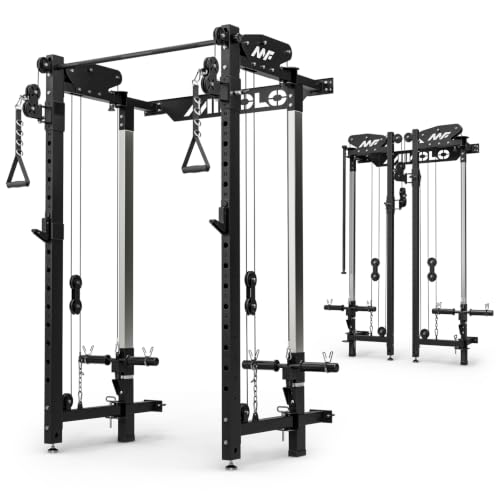
- Folds from 9.5 to about 3 square feet
- Five training and storage modes
- 1,000-pound rating with dual 1:1 pulleys
Best For: Compact home gyms needing rack and cable versatility
Best for Basic Barbell Training

- 92.5-inch tall squat stand
- 1,000-pound-rated padded J-hooks
- Includes bolt-on pull-up bar
Best For: Traditional squats, presses, and pull-ups
Highest Capacity

- Folds to 4.3 square feet
- Dual independent 1:1 pulley system
- Up to 2,000-pound stated rating
Best For: Compact training spaces needing extensive cable work
Best Footprint
Foldable Wall-Mounted Cable Rack
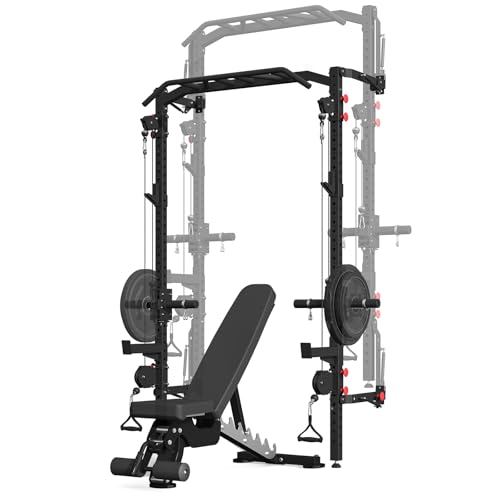
- Folds to a 46.5-by-6.5-inch profile
- 15-level dual pulley adjustment
- 1,000-pound capacity with spotter arms
Best For: Small home and garage gyms prioritizing storage depth
Best for Easy Setup
Mdeam Folding Squat Rack with Dual Pulley

- Dual 1:1 pulleys support independent cable movements
- Folds and offers seven adjustable angles
- Includes pull-up bar, J-hooks, and 360-degree landmine
Best For: Full-body home gyms and shared family workouts
Best Basic Space Saver
PRx Performance Murphy Folding Rack

- 1,000-pound maximum capacity
- Folds to approximately four inches from the wall
- Includes pull-up bar and J-cups
Best For: Traditional barbell training in compact rooms
Most Configurable
WM3-V4 Folding Rack with Dual Pulleys

- Five configurations cover rack and cable training
- Stores in a 4.3-square-foot footprint
- Offers dual independent pulleys and 15 height settings
Best For: Compact gyms needing flexible cable and strength training
Compact All-in-One Pick
Space-Saving Folding Cable Rack

- Folds from about 9.5 to 3 square feet
- Combines rack, crossover, pulldown, and pull-up functions
- 1:1 pulley ratio with 15 height positions
Best For: Compact home gyms needing versatile cable and rack training
Adjustability Upgrade
Cheetah 2.0 Folding Cable Rack

- Provides 28 pulley-height positions
- Uses dual cables with a 2:1 ratio
- Includes upgraded aluminum pulleys
Best For: Users wanting highly adjustable cable crossover training
Direct-Load Training Pick

- Uses a 1:1 pulley ratio
- Folds down to about 3 square feet
- Includes 15 cable-height positions and five modes
Best For: Home gyms wanting compact, direct-feeling cable training
Most Versatile – Mikolo Folding Cable Rack
The Mikolo is a strong choice for shoppers comparing folding squat racks with cable systems for a compact home gym. It combines a power rack, cable crossover, lat pulldown, pull-up bar, and functional trainer, while folding from a 9.5-square-foot training footprint to about 3 square feet for storage.
Best For: Home gym users who want broad exercise variety and a highly space-conscious folding design.
Pros:
- Five adjustable modes support rack, functional trainer, cable crossover, and storage configurations.
- Independent dual 1:1 pulleys support supersets, drop sets, and partner workouts.
- Includes 15 pulley height settings, a detachable pull-up bar, J-hooks, and adjustable ground supports.
- Uses 2-by-2-inch 14-gauge steel and is rated for up to 1,000 pounds.
Cons:
- At 150 pounds, it is a substantial piece of equipment to install and position.
- The wall-mounted design requires appropriate mounting and available wall space.
Choose the Mikolo if you want one rack to cover barbell training and a wide range of cable exercises without permanently occupying its full footprint. Its combination of folding storage and 80-plus listed exercises makes it particularly adaptable.
Best for Basic Barbell Training – Titan T-3 Tall Squat Stand
Titan Fitness T-3 Series Tall Squat Stand with Pull-Up Bar & J-Hooks, 1000 LB Rated
Check Price On AmazonThe Titan T-3 is worth considering if your priority is a tall, straightforward squat stand rather than a full cable machine. Among folding squat racks with cable systems, this model stands apart because the supplied information describes a fixed bolt-together stand with a pull-up bar and J-hooks, not an integrated cable system or folding frame.
Best For: Lifters who mainly need a stable squat stand, pull-up bar, and adjustable barbell support.
Pros:
- 92.5-inch height allows full-height functionality and a full range of motion for pull-ups.
- Heavy-gauge 2-by-3-inch steel uprights are designed for stability without floor bolting.
- UHMW-padded J-hooks protect the bar and are rated to support up to 1,000 pounds.
- Westside spacing through bench and clean-pull zones provides versatile bar placement.
Cons:
- It does not include a cable crossover, pulley system, or lat pulldown station.
- The supplied details do not identify it as a folding rack.
- Its 92.5-inch height may require a tall room or garage ceiling.
The T-3 makes sense for a traditional barbell setup, but it is not a direct match for shoppers specifically seeking folding squat racks with cable systems. Consider it when cable functionality and folding storage are secondary to a tall, sturdy squat stand.
Highest Capacity – WM3-V4 Folding Cable Rack
The WM3-V4 is built for shoppers looking at folding squat racks with cable systems and wanting a high stated load rating. Its wall-mounted frame folds to 4.3 square feet, opens to 12.3 square feet, and combines a power rack, dual cable crossover, lat pulldown, pull-up bar, and functional trainer.
Best For: Space-conscious lifters who want extensive cable functionality and the highest stated capacity in this comparison.
Pros:
- Five modes switch between folded storage, half rack, functional trainer, and cable crossover use.
- Dual independent 1:1 pulleys support simultaneous training, supersets, and partner workouts.
- Offers 15 pulley height positions and quick-swap accessories for more than 80 listed exercises.
- Has a stated maximum weight recommendation and tension-supported rating of up to 2,000 pounds.
Cons:
- Its expanded 12.3-square-foot footprint is larger than its folded storage footprint.
- As a wall-mounted system, it depends on suitable installation space and mounting.
- The supplied notes do not provide frame dimensions, weight, or detailed included accessory coverage.
The WM3-V4 is the most compelling option here for buyers who want a compact rack with substantial cable capability and a high stated capacity. Verify your wall, ceiling, and available training clearance before installation.
Best Footprint – Foldable Wall-Mounted Cable Rack
This wall-mounted model targets shoppers comparing folding squat racks with cable systems who want a clearly specified, compact footprint. It opens to 46.5 by 18.9 inches and folds flat to 46.5 by 6.5 inches, while adding dual pulleys, a pull-up bar, J-hooks, dip handles, spotter arms, and plate-storage compatibility.
Best For: Garage and home gym users who need a shallow folded profile and a broad set of cable and barbell exercises.
Pros:
- Folds flat and is described as saving up to 66% of floor space when stored.
- Independent dual pulleys use a true 1:1 ratio with 15 height adjustments.
- Supports pull-ups, lat pulldowns, rows, flys, curls, extensions, squats, and bench press work.
- Includes 17-inch safety spotter arms and is rated for up to 1,000 pounds.
Cons:
- The supplied notes do not specify whether weight plates or a bench are included.
- Wall mounting is required, so installation quality and wall suitability matter.
- Its 99-pound item weight may provide less overall mass than heavier rack systems.
This rack is a practical fit when storage depth is a major concern but you still want both cable and barbell training. Its compact folded dimensions and included spotter arms make it especially suitable for multipurpose home spaces.
Best for Easy Setup – Mdeam Folding Squat Rack with Dual Pulley
If you want folding squat racks with cable systems for a compact home gym, the Mdeam combines a wall-mounted power rack with a dual pulley setup, pull-up bar, landmine, and multiple adjustment positions. Its folding design is intended for garages, basements, and other space-conscious training areas.
Best For: Families or home-gym users who want a broad range of full-body exercises and the option for simultaneous cable training.
Pros:
- Dual 1:1 cable pulley system supports independent crossover movements.
- Seven adjustable angles and a folding frame help conserve space.
- Includes a multi-grip pull-up bar, J-hooks, cable system, and 360-degree landmine.
- 2×2-inch 14-gauge steel frame is rated for up to 1,000 pounds.
Cons:
- Its 151-pound package and wall-mounted design may require careful installation.
- The one-year warranty is relatively limited for a major home-gym purchase.
The Mdeam stands out when versatility is more important than a minimal setup. It packs several training stations into one foldable unit, although buyers should plan for a substantial installation and adequate wall space.
Best Basic Space Saver – PRx Performance Murphy Folding Rack
For shoppers comparing folding squat racks with cable systems, the PRx Performance Murphy Rack is a simpler wall-mounted alternative focused on barbell work rather than integrated cable training. It folds close to the wall and includes a pull-up bar and J-cups for a streamlined home-gym setup.
Best For: Lifters who already own a barbell and weights and primarily want a compact rack for squats, presses, pull-ups, and bench work.
Pros:
- Supports up to 1,000 pounds.
- Folds to about four inches from the wall when stored.
- Includes a pull-up bar and J-cups for barbell exercises.
- Steel construction has a black powder-coat finish.
Cons:
- It does not include an integrated cable system.
- Barbell, weights, and bench are needed separately for a complete setup.
- Folding requires substantial ceiling clearance: 108 inches is specified, or 95 inches with modified installation.
The PRx is best viewed as a space-saving rack rather than an all-in-one cable trainer. Its straightforward design makes sense for traditional strength training, but cable-focused buyers will need additional equipment.
Most Configurable – WM3-V4 Folding Rack with Dual Pulleys
The WM3-V4 is one of the more configurable folding squat racks with cable systems, combining a power rack, dual independent pulleys, lat pulldown station, pull-up bar, and cable crossover functions. It folds to 4.3 square feet for storage and expands to 12.3 square feet when deployed.
Best For: Users who want multiple rack and cable-training configurations in a compact apartment, basement, or garage gym.
Pros:
- Offers five modes, including folded, half-rack, functional-trainer, and cable-crossover setups.
- Dual 1:1 pulleys are designed for independent or simultaneous training.
- Fifteen pulley heights support a wide range of cable exercises.
- Includes quick-swap accessories such as J-hooks and safety arms.
Cons:
- The two-box shipment may make delivery and setup more involved.
- Installation is required, although an instruction manual is included.
- The supplied information lists a one-year warranty.
The WM3-V4 is a strong fit for buyers who value adjustability and exercise variety. Its compact storage footprint is appealing, but the numerous modes and accessories mean setup may take more planning than a basic folding rack.
Compact All-in-One Pick – Space-Saving Folding Cable Rack
For shoppers comparing folding squat racks with cable systems, this wall-mounted Mikolo model stands out for combining a power rack, cable crossover, lat pulldown, and pull-up bar in one space-conscious package. It folds from about 9.5 square feet when open to approximately 3 square feet when stored, making it practical for compact home gyms.
Best For: Home-gym users who want broad exercise variety, a 1:1 pulley ratio, and a rack that can be folded away between workouts.
Pros:
- Five configurations support power-rack, functional-trainer, cable-crossover, and storage setups.
- Independent pulley operation supports supersets, drop sets, and shared workouts.
- 2 x 2-inch, 14-gauge steel construction, wall mounts, and adjustable support feet are designed for stability.
- Offers 15 pulley-height positions and more than 80 listed full-body exercises.
Cons:
- Its wall-mounted design requires suitable installation and adequate space around the rack when opened.
- The included system weighs about 150 pounds, so setup may require more than one person.
This is a strong choice when storage efficiency matters as much as exercise coverage. The 1:1 cable ratio and integrated rack features make it particularly versatile, while the wall-mount and support-foot design should be planned carefully before installation.
Adjustability Upgrade – Cheetah 2.0 Folding Cable Rack
This Cheetah 2.0 version is a flexible option among folding squat racks with cable systems, pairing a wall-mounted power rack with a dual cable crossover, lat pulldown, and pull-up bar. Its five configurations and folding footprint suit users who need a multipurpose training station in a limited area.
Best For: Lifters who prioritize dual-sided cable training, upgraded aluminum pulleys, and more cable-height adjustment options.
Pros:
- Folds to about 3 square feet and opens to approximately 9.5 square feet.
- Offers five modes, including folded, semi-open, power rack, functional trainer, and cable crossover positions.
- Dual independent cables and a 2:1 pulley ratio support supersets, drop sets, and partner workouts.
- Includes 28 pulley-height options, a detachable pull-up bar, J hooks, and 2 x 2-inch, 14-gauge steel construction.
Cons:
- The 2:1 pulley ratio means the cable resistance differs from the selected load.
- As a wall-mounted system, it requires secure installation and suitable wall space.
With its 28 adjustment positions and upgraded aluminum-pulley configuration, the Cheetah 2.0 is the most adjustment-focused option in this group. It is well suited to households that want varied cable angles and exercises without giving up fold-away storage.
Direct-Load Training Pick – Black Folding Cable Rack
For a folding squat rack with cable systems and a direct-feeling 1:1 pulley setup, this black Mikolo model combines a wall-mounted rack, cable crossover, lat pulldown, and pull-up station. Its folding design helps preserve floor space while still supporting a wide range of full-body movements.
Best For: Home-gym users who prefer a 1:1 pulley ratio and want a black alloy-steel rack with multiple training modes.
Pros:
- Folds from approximately 9.5 square feet open to about 3 square feet when stored.
- Five modes provide power-rack, functional-trainer, cable-crossover, semi-open, and folded configurations.
- Independent cables with a 1:1 ratio support supersets, drop sets, and shared training.
- Includes 15 pulley-height settings, a detachable pull-up bar, J hooks, and adjustable ground supports.
Cons:
- The supplied specifications do not identify a separate cable weight stack, so users should plan to provide compatible loading equipment as needed.
- Wall mounting and the listed 1,000-pound supported tension require careful installation and safe setup.
This version makes sense for shoppers who value a 1:1 pulley ratio and a compact black finish. It delivers the same broad training concept as an all-in-one home-gym station, but buyers should verify their wall structure and loading setup before purchase.
How We Picked These Folding Squat Racks with Cable Systems
We focused on racks that combine a foldable or wall-mounted squat structure with a cable crossover, pulley, or lat-pulldown function. We compared the listed construction, rated capacity, pulley configuration, adjustment options, included accessories, storage profile, and overall versatility. Because installation quality strongly affects stability, we also considered whether each design appears to require substantial wall reinforcement and careful anchoring.
Product specifications can vary by configuration, so verify the current dimensions, hardware, attachment selection, and weight ratings before ordering. A rack’s advertised capacity does not replace proper installation or safe lifting practices.
Quick Comparison
| Feature | What to look for | Best suited to |
|---|---|---|
| Folding design | Compact storage depth and easy locking or hinging | Small rooms and multipurpose spaces |
| Cable system | Independent pulleys, smooth travel, and useful height positions | Full-body accessory training |
| Squat structure | Stable uprights, secure J-hooks, and suitable height | Barbell squats, presses, and pulls |
| Capacity | Clearly stated rack and cable ratings | Progressive strength training |
Key Buying Factors for Folding Squat Racks with Cable Systems
Wall Support and Installation
These racks transfer force into the wall, so identify the stud layout, wall material, required mounting hardware, and available clearance before buying. Concrete or properly reinforced framing is generally more suitable than unsupported drywall. Leave enough room to unfold the rack, load a bar, and move safely around the pulleys.
Folded and Working Dimensions
Measure both the stored depth and the fully open footprint. Account for the barbell’s length, cable handles, plates, bench placement, and ceiling height. A compact rack is only space-saving if it can be folded without moving other equipment.
Cable Versatility
Dual independent pulleys usually provide more exercise flexibility than a single fixed cable path. Check the number of height settings, whether the system includes a lat-pulldown attachment, and how easily the handles and carabiners can be changed. Smooth cable routing matters for controlled repetitions.
Strength, Safety, and Accessories
Compare the stated rack capacity with your expected working loads, and look for secure J-cups, safety arms or straps, pull-up options, and compatible attachments. Included accessories can significantly change the value of a package, but they should not outweigh sound construction and reliable anchoring.
Who Should Buy Which Folding Squat Racks with Cable Systems?
Choose a compact folding model if your gym doubles as an office, garage, or living area. Pick a design with independent pulleys if you want one station for strength work, cable accessories, and functional training. A taller, higher-capacity stand is better for lifters who prioritize heavy barbell training and pull-up clearance. If space efficiency is the main concern, favor a slim Murphy-style design; if exercise variety is more important, prioritize adjustable cable modes and a broader attachment package. Regardless of model, confirm fit, wall compatibility, and serviceable replacement parts before purchase.
