
Long-distance rides demand more from a camera mount than a short neighborhood loop. The best setup must hold steady over rough pavement, keep controls accessible, and remain compatible with your camera, bike, and preferred shooting angle.
This roundup compares 10 cycling camera mounts for long-distance rides, from compact computer-style brackets to extended selfie-stick and super-clamp systems. Use the guide below to narrow the options by stability, adjustability, camera compatibility, and installation needs.
Best 10 Cycling Camera Mounts for Long-Distance Rides Picks for 2026
Best for Panoramic Ride Footage
BRDRC Dual-Clamp Insta360 Mount

- 59-inch adjustable invisible selfie stick
- Dual padded clamps for flexible mounting
- Adapters for Insta360, DJI, and GoPro cameras
Best For: Creative panoramic footage on long rides
Best for Integrated Cockpits
Magene Aluminum Out-Front Mount

- 7075 aluminum construction
- Adjustable under-mount for lights or cameras
- Designed for integrated handlebars and quarter-turn computers
Best For: Organized road and gravel bike cockpits
Best for Extended Rear Views

- 43-inch twist-lock selfie stick
- 15–45 mm padded clamp range
- 360-degree ball head for adjustable framing
Best For: Third-person bike-vlogging footage
Best for Simple Clamp Mounting
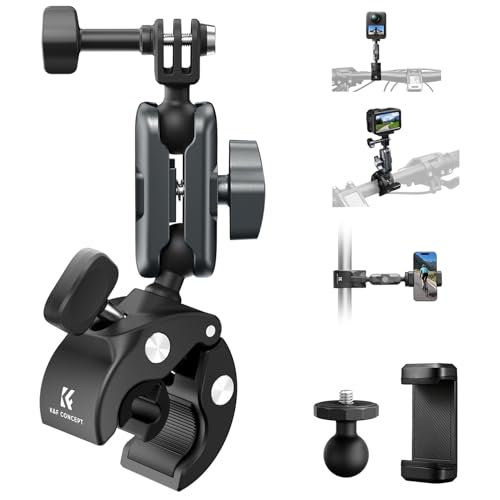
- Fits 8–40 mm tubular surfaces
- Tool-free 360-degree angle adjustment
- Includes camera adapters and phone clip
Best For: Flexible, compact mounting on bike tubing
Centered Aluminum Pick

- 6mm aluminum-alloy construction
- Centered camera and computer layout
- Waterproof, adjustable design
Best For: Long-distance riders seeking a centered cockpit setup
Threaded Versatility Pick
Niewalda 1/4-Inch Camera Clamp

- Fits 2–3.5 cm round tubes
- Includes a 1/4-inch screw adapter
- Supports cameras and other threaded accessories
Best For: Riders using varied 1/4-inch camera accessories
Adjustable Action-Cam Pick

- Fits 9–35 mm tubes and bars
- 360-degree angle adjustment
- Works with GoPro and many action cameras
Best For: Riders who want flexible angles and mounting locations
Best Integrated Setup
3-in-1 Aluminum Handlebar Extender

- Combines camera, computer, and headlight mounting
- Includes four cycling-computer base models
- Requires under-4.5-cm M5 stem-screw spacing
Best For: Riders seeking a tidy, centered multi-device cockpit
Best Adjustable Clamp
TELESIN 360° Super Clamp Mount

- Dual ball heads provide 360-degree positioning
- Clamps 22–38 mm tubes or 9–15 mm with gasket
- For action cameras; not DSLR or mirrorless gear
Best For: Action-camera riders needing flexible angles and tube compatibility
Best Simple Handlebar Mount

- Adjusts the camera angle through 360 degrees
- Uses anti-slip pads to help limit movement
- 1/4-inch screw supports compatible camera adapters
Best For: Riders seeking a basic adjustable action-camera handlebar mount
Best for Panoramic Ride Footage – BRDRC Dual-Clamp Insta360 Mount
For cyclists comparing cycling camera mounts for long-distance rides, the BRDRC stands out for its dual-clamp design and included 59-inch invisible selfie stick. It supports a broad selection of Insta360, DJI, and GoPro cameras, while its adjustable clamps can attach to handlebars, seatposts, and other tubular surfaces.
Best For: Riders who want elevated or rear-facing panoramic footage from a flexible, multi-camera mounting kit.
Pros:
- Includes a five-section, adjustable 15.74- to 59.05-inch selfie stick.
- Dual clamps with anti-slip padding provide flexible positioning and added grip.
- Supports Insta360 cameras plus included adapters for DJI and GoPro models.
- Can be used on bicycle handlebars, seatposts, motorcycle bars, and other pipes.
Cons:
- The long extension may be more equipment than riders seeking a compact cockpit mount need.
- Its extensive camera compatibility depends on using the appropriate included adapter.
This is a versatile choice for creative, panoramic perspectives rather than a minimalist computer-style mount. The adjustable stick and multiple clamp components make it especially useful when varied camera angles matter during extended rides.
Best for Integrated Cockpits – Magene Aluminum Out-Front Mount
The Magene is a streamlined option for riders choosing cycling camera mounts for long-distance rides, especially those using integrated handlebars. Its 7075 aluminum construction, anti-loosening hardware, and adjustable under-mount are designed to keep a bike computer, light, or action camera organized and stable.
Best For: Road and gravel cyclists who want a clean, centered cockpit with room for multiple accessories.
Pros:
- Made from 7075 aircraft-grade aluminum for a durable, lightweight structure.
- Anti-loosening screws and locking washers are intended for vibration-heavy riding.
- Adjustable under-mount helps position lights or action cameras for better weight distribution.
- Works with quarter-turn bike computers and GoPro-style accessories.
Cons:
- It is specially designed for integrated handlebars, limiting fit compared with universal clamps.
- The product is primarily a computer mount, so camera use requires a compatible GoPro-style interface.
For riders prioritizing a tidy, aerodynamic setup, the Magene offers a more integrated solution than a general-purpose clamp. Its accessory-focused design is well suited to long-distance rides where cockpit organization and vibration resistance are important.
Best for Extended Rear Views – WEWOGA 43-Inch Tail Mount Kit
The WEWOGA kit is built for cyclists seeking cycling camera mounts for long-distance rides with a dramatic rear or elevated perspective. Its 43-inch aluminum selfie stick uses a twist-lock mechanism, while the padded clamp fits surfaces from 15 to 45 mm and includes a 360-degree ball head for angle adjustment.
Best For: Bike vloggers and solo riders who want extended third-person footage from a handlebar, rack, or similar mounting point.
Pros:
- 43-inch pole uses a hardened twist-lock design and is rated for a 5 kg static load.
- Clamp expands from 15 to 45 mm and includes anti-slip rubber padding.
- 360-degree ball head allows flexible framing without changing the clamp position.
- Compatible with Insta360, DJI, and GoPro cameras through the listed adapters.
Cons:
- The extended stick and tail-mount setup are less compact than a standard handlebar mount.
- The phone clip is not included, despite universal phone compatibility being listed.
This kit makes sense when the goal is a distinctive trailing-camera view rather than a low-profile mount. Its long extension, broad clamp range, and claimed load capacity favor riders recording dynamic content on varied surfaces.
Best for Simple Clamp Mounting – K&F CONCEPT Super Clamp
For riders wanting straightforward cycling camera mounts for long-distance rides, the K&F CONCEPT Super Clamp offers a compact way to attach an action camera or phone to a bicycle or motorcycle. Its aluminum clamp fits many tubular surfaces, and the dual ball joints allow tool-free 360-degree angle adjustment.
Best For: Cyclists who want a versatile, lightweight clamp for handlebars, seatposts, frames, forks, or other tubular objects.
Pros:
- Fits tubular surfaces from 8 to 40 mm using the supplied silicone pads.
- Dual ball joints provide 360-degree positioning without tools.
- Aluminum construction and anti-slip pads support stable action-camera mounting.
- Includes both action-camera adapters and a universal phone clip.
Cons:
- It does not include an extended selfie stick for elevated or trailing perspectives.
- Compatibility with some cameras depends on selecting the appropriate adapter.
The K&F CONCEPT is a practical choice when portability and quick angle changes matter more than specialized long-reach footage. Its broad diameter range also makes it useful across different bike mounting points and tubular surfaces.
Centered Aluminum Pick – S16 Insta360/Garmin Mount
For cyclists comparing cycling camera mounts for long-distance rides, the S16 emphasizes a centered, extended out-front setup. Its 6mm aluminum-alloy construction is designed to support an Insta360 camera alongside a Garmin-compatible bike computer and other handlebar devices.
Best For: Long-distance riders who want a centered camera and bike-computer layout.
Pros:
- Centered design keeps the speedometer, lights, and camera positioned in the middle.
- 6mm aluminum alloy offers a lightweight build with enhanced load-bearing capacity.
- Waterproof construction and adjustable mounting design.
- Includes 12 months of after-sales support.
Cons:
- Buyers should verify mounting-hole spacing before purchase.
- Installation requires attention to the specified torque value.
- Its camera compatibility is specifically presented around Insta360-style use rather than every camera system.
The S16 is a strong fit when a clean, centered cockpit matters more than universal mounting flexibility. Measure your setup carefully before ordering to ensure the mount matches your handlebar accessories.
Threaded Versatility Pick – Niewalda 1/4-Inch Camera Clamp
The Niewalda is a flexible option among cycling camera mounts for long-distance rides, using a metal clamp and 1/4-inch adapter for cameras, selfie sticks, phone-holder clamps, and other threaded accessories. It fits round bars and tubes from 2 to 3.5 cm in diameter.
Best For: Riders who want one compact clamp for multiple 1/4-inch accessories.
Pros:
- Supports GoPro, SJCAM, XIAO YI, DJI, and other sports or threaded cameras.
- Fits handlebars and tubes measuring 2 to 3.5 cm in diameter.
- CNC-molded aluminum body and stainless-steel screw provide a sturdy build.
- Can connect to selfie sticks, microphone clamps, phone-holder clamps, and flashlight accessories with compatible threads.
Cons:
- The listed maximum weight capacity is 53 g.
- It uses a bar clamp rather than an extended out-front design.
- Compatibility depends on having a suitable 1/4-inch threaded interface or adapter.
This clamp stands out for accessory flexibility and a broad 2–3.5 cm fit range. Check both your handlebar diameter and camera weight before choosing it for extended rides.
Adjustable Action-Cam Pick – Sametop 360° Bar Mount
For cyclists seeking cycling camera mounts for long-distance rides, the Sametop offers a broad 9–35 mm diameter range and 360-degree rotation. Its non-slip interior is designed to help protect bars while the mount supports GoPro and many other action cameras.
Best For: Action-camera users who frequently change mounting angles or tube locations.
Pros:
- Fits handlebars, seatposts, ski poles, and other tubes from 9 to 35 mm.
- 360-degree rotation allows quick changes to shooting angles.
- Non-slip interior helps protect poles and reduce slipping.
- Compatible with all GoPro cameras and many listed action-camera brands.
Cons:
- It is listed as not water resistant.
- The 103 g weight is heavier than the Niewalda clamp listed in this roundup.
- The construction combines metal and plastic rather than aluminum alone.
The Sametop is the most angle-focused choice here, with the widest stated tube range and broad action-camera compatibility. For wet-weather touring, plan for additional protection because the mount itself is not rated water resistant.
Best Integrated Setup – 3-in-1 Aluminum Handlebar Extender
For cyclists comparing cycling camera mounts for long-distance rides, this JOYSOG extender combines a panoramic-camera port, cycling-computer support, and headlight space in one compact aluminum-alloy mount. Before buying, measure the two stem screw holes: they must be under 4.5 cm wide and use M5 screws, not M6.
Best For: Riders who want a centered cycling computer and a tidy setup for an Insta360 panoramic camera, headlight, and computer.
Pros:
- 3-in-1 design helps keep the handlebar organized.
- Top-mounted 1/4-inch thread accepts compatible panoramic cameras without an extra base.
- Includes four cycling-computer base models and installation hardware.
- Aluminum alloy construction is described as sturdy, shock-resistant, and rust-resistant.
Cons:
- Stem-mount installation only.
- Not compatible with M6 screws.
- The required screw-hole width must be confirmed before purchase.
This is the most useful option when computer visibility and accessory consolidation matter more than universal fit. Its mounting requirements are specific, so compatibility should be checked carefully before ordering.
Best Adjustable Clamp – TELESIN 360° Super Clamp Mount
For cycling camera mounts for long-distance rides, the TELESIN Super Clamp emphasizes adjustable positioning and a firm aluminum-alloy-and-nylon-fiber build. Its clamp fits 22–38 mm tubing, or 9–15 mm with the supplied silicone gasket, making it useful across compatible bicycle and motorcycle setups.
Best For: Action-camera users who need broad angle adjustment and the flexibility to mount on different tube sizes.
Pros:
- Dual 360-degree ball heads allow flexible shooting angles.
- Fits 22–38 mm tubes, with a gasket option for 9–15 mm diameters.
- Supports 1/4-inch camera mounts and includes a GoPro adapter.
- Can connect to separately purchased extension rods or selfie sticks.
Cons:
- Extension poles, selfie sticks, and phone holders are not included.
- Designed for action cameras only; DSLR and mirrorless cameras are specifically excluded.
- Its wide compatibility depends on using a suitable adapter for the camera.
This clamp is a strong choice for riders who value framing flexibility and cross-device compatibility. Follow the stated action-camera-only safety limitation and verify the tube diameter before installation.
Best Simple Handlebar Mount – 360° Aluminum Camera Clamp
This generic handlebar clamp is a straightforward option among cycling camera mounts for long-distance rides, pairing a 1/4-inch screw with 360-degree angle adjustment. Aluminum alloy, ABS, and double-layer anti-slip pads are intended to help hold compatible cameras securely on bicycle or motorcycle handlebars.
Best For: Cyclists wanting a basic adjustable handlebar mount for compatible GoPro, DJI, Insta360, or other action-camera setups.
Pros:
- 360-degree rotation helps adjust the shooting direction.
- Rubber and soft anti-slip pads are designed to reduce sliding and loosening.
- 1/4-inch screw supports compatible cameras and listed adapters.
- Made with aluminum alloy and ABS and described as waterproof and rust-resistant.
Cons:
- Camera compatibility may require a separate adapter.
- The supplied notes do not specify a handlebar diameter range.
- Despite the metal construction, the enclosure material is listed as plastic, so construction details are somewhat mixed.
This mount suits riders who need uncomplicated angle adjustment without a multi-device platform. Because the diameter range is not provided, confirm your handlebar fit and camera-adapter requirements before purchasing.
How We Picked the Best Cycling Camera Mounts for Long-Distance Rides
We focused on mounts designed for bicycles and motorcycles that support action cameras, 360 cameras, compact cameras, or combinations of cameras and cycling accessories. The selection covers several installation styles: out-front computer mounts, handlebar clamps, extended poles, tail mounts, and multi-purpose brackets.
For long-distance use, we prioritized practical factors such as material construction, mounting security, adjustment range, camera-interface compatibility, and whether the design leaves room for a bike computer or headlight. Because fit can vary by handlebar diameter and camera system, always confirm the specifications before ordering.
Quick Comparison
| Mount style | Best suited to | Main advantage |
|---|---|---|
| Out-front computer mount | Road and gravel riders | Clean cockpit integration |
| Super clamp | Large or unusual mounting areas | Strong, flexible attachment |
| Extended pole mount | 360-degree action-camera footage | Higher or rear-facing perspectives |
| Tail mount | Rearward recording | Captures the road and riders behind you |
| Multi-purpose extender | Riders carrying several devices | Supports cameras, computers, and lights |
Key Buying Factors for Cycling Camera Mounts for Long-Distance Rides
Handlebar Fit and Installation
Check the supported bar diameter and clamp clearance, especially if your cockpit has oversized, aero, carbon, or irregularly shaped bars. A mount that requires frequent retightening can become frustrating and unsafe on an all-day ride.
Camera Connection and Load
Verify whether the mount uses a GoPro-style interface, a 1/4-inch screw, a proprietary camera adapter, or several of these options. Larger cameras, extended sticks, and heavy accessories create more leverage and need a sturdier attachment than a small action camera.
Vibration Control and Positioning
Rigid aluminum mounts generally offer a stable platform, while adjustable ball heads make it easier to level the shot. Avoid positioning the camera where cables, brake levers, a bike computer, or your hands can interfere.
Ride Environment and Weather
For gravel, rough roads, or fast descents, favor short, rigid setups with secure locking points. Longer poles can produce more dramatic footage but are more exposed to vibration, branches, and accidental contact. Camera mounts are not automatically weatherproof, so protect connection points and camera equipment in wet conditions.
Who Should Buy Which Cycling Camera Mounts for Long-Distance Rides?
Choose an out-front or integrated computer mount if you want a low-profile setup that keeps the camera near the stem and preserves a tidy cockpit. A super clamp is better for riders who need broad positioning options or a mount that can move between bicycles and motorcycles.
Pick an extended pole or tail mount when the main goal is immersive 360-degree footage, rear-facing coverage, or a perspective above the rider. For riders carrying a computer, headlight, and camera together, a three-in-one extender can make better use of limited handlebar space. Finally, select a 1/4-inch or multi-adapter design if you switch between action cameras and compact devices. Before every long ride, test the clamp, tighten all fasteners, check camera clearance, and confirm that the recording angle has not shifted.
