
Fat tires need a lot of air, even when their riding pressure is relatively low. The right pump makes that volume easier to move and helps you stop at the pressure you actually want.
These 10 options span home floor pumps, portable hand pumps, and rechargeable inflators. The best choice depends on where you’ll use it, how much you value speed, and whether you need a gauge you can read at low pressures.
Best 10 Bike Pump for Fat Tires Picks for 2026
Lightest Electric Option
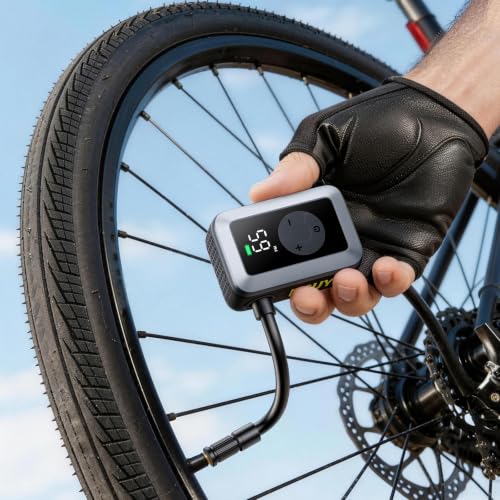
- 136 g compact design
- 27 L/min stated airflow
- Digital gauge with auto-stop
Best For: Portable roadside top-offs
Longest Continuous Run

- Up to 25 minutes continuous use
- Integrated rotating valve hose
- Automatic shutoff
Best For: Longer electric pumping sessions
Compact Pump With Pressure Memory

- 18 L/min stated airflow
- Remembers last pressure setting
- Gauge with automatic stop
Best For: Repeat pressure top-offs
Dedicated Fat-Bike Floor Pump

- Fat-bike gauge up to 30 PSI
- Oversized high-volume barrel
- Air-release pressure control
Best For: At-home fat-tire inflation
Best Portable Floor-Style Pump

- High-volume barrel for fat and plus-size tires
- Foot peg and hose support stable pumping
- Presta/Schrader chuck; 35 PSI maximum
Best For: Trailside fat-tire inflation with a floor-style stance
Best Compact Frame-Mount Option

- Dual-action strokes for large-volume tires
- Fits Presta, Schrader, and Dunlop valves
- Side-mount bracket; 60 PSI maximum
Best For: Frame-mounted off-road inflation
Best Home Pump for Mixed Bikes
Origin8 Airaid Maxi Plus HP/HV

- Switches between high-volume and high-pressure modes
- Gauge has a dedicated 0–35 PSI scale
- Presta/Schrader head and long hose
Best For: Home inflation across fat, mountain, and road bikes
Best Lightweight Trail Carry

- High-volume output for lower-pressure tires
- Presta/Schrader Flex Hose
- Aluminum core and included frame mount
Best For: Compact on-bike carry for MTB and gravel rides
Best Floor-Pump Leverage

- Fold-out foot pad for braced pumping
- Presta, Schrader, and Dunlop head
- High-volume design; 160 PSI maximum
Best For: Stable roadside inflation of wide tires
Best Pocket-Size Option

- 145 mm high-volume mini pump
- Presta/Schrader ABS Flex Hose
- Rebuildable CNC-aluminum construction
Best For: Pocket or saddle-bag carry on wide-tire rides
Lightest Electric Option – DSUY Mini Bike Tire Pump
If you want a compact electric bike pump for fat tires, the DSUY is a 136 g option with a stated 27 L/min airflow rate. It supports both Schrader and Presta valves and lets you set a target pressure on its digital gauge.
Best For: Riders who prioritize a small, rechargeable pump for tire top-offs and roadside use.
Pros:
- Digital pressure display and automatic stop at the set pressure.
- Includes valve adapters and a hose for less accessible valve positions.
- Small enough to pack easily, with a USB-C charging cable included.
Cons:
- The cited inflation times and per-charge counts are for narrow road tires, not fat tires.
- The motor may produce heat and noise during use.
Its portability is the main draw. If you regularly inflate a fat tire from flat, note that the supplied performance figures do not establish how long that larger-volume job will take.
Longest Continuous Run – Fanttik X9 Ace
The Fanttik X9 Ace is a rechargeable bike pump for fat tires worth considering when you want sustained operation rather than the smallest possible unit. Its stated cooling system supports up to 25 minutes of continuous use, while the integrated rotating hose switches between Presta and Schrader valves.
Best For: Riders who value continuous pumping time and an integrated valve setup.
Pros:
- 5000 mAh battery and a stated capacity of eight tires per charge.
- Hose and both valve fittings stay together in one unit.
- Set a target pressure and the pump shuts off automatically.
Cons:
- At 384 g, it is substantially heavier than the smallest mini pumps here.
- Its stated inflation speed is measured on a 700 × 23C road tire, not a fat tire.
The extended run-time claim makes this a practical candidate for larger inflation jobs, but its 10 L/min stated airflow and road-tire test do not give a fat-tire fill time.
Compact Pump With Pressure Memory – ETENWOLF S0 Mini
The ETENWOLF S0 is a palm-sized electric bike pump for fat tires with an 18 L/min stated airflow rate and a digital pressure gauge. It works with Schrader valves and includes a separate adapter for Presta valves.
Best For: Riders who want a compact electric pump that remembers their last pressure setting.
Pros:
- Automatically stops at the selected pressure and displays pressure in real time.
- Memory function recalls the previous pressure setting.
- Rotating hose helps reach valves at awkward angles.
Cons:
- Presta use requires attaching a separate adapter.
- Advertised inflation times and battery counts are not specified for fat tires.
The pressure memory is convenient for repeat top-offs. For a fully flat fat tire, treat its road-tire speed figures as a reference rather than an expected fill time.
Dedicated Fat-Bike Floor Pump – Topeak JoeBlow Dualie
Topeak JoeBlow Dualie Floor Pump – Dual Gauges for Fat Bike & MTB Tires with Oversized Barrel
Check Price On AmazonFor a bike pump for fat tires that stays at home, the manual Topeak JoeBlow Dualie is purpose-built around large, low-pressure tires. Its oversized barrel moves more air per stroke than a standard pump, and its dual-gauge design includes a fat-bike range up to 30 PSI.
Best For: Home inflation and pressure adjustment on fat-bike and mountain-bike tires.
Pros:
- Low-pressure gauge range is tailored to fat-bike tires.
- Barrel is stated to be 1.5 times larger than a standard pump barrel.
- Air-release button allows finer pressure adjustments.
Cons:
- At 1.9 kg and 37 inches long, it is not a practical on-bike carry option.
- Manual pumping requires more effort than an electric pump.
This is the most directly fat-tire-focused choice in the group: a floor pump with a dedicated low-pressure gauge rather than a miniature compressor whose published speed figures come from road tires.
Best Portable Floor-Style Pump – LEZYNE Micro Floor Drive XL
If you need a bike pump for fat tires on the trail, the LEZYNE Micro Floor Drive XL pairs an extra-large, high-volume barrel with a foot peg and flexible hose for floor-pump-style operation. Its 35 PSI ceiling is suited to fat and plus-size tires rather than high-pressure road setups.
Best For: Fat-bike riders who want a portable pump with a stable pumping stance.
Pros:
- High-volume barrel is designed to move more air per stroke than a typical mini pump.
- Stainless steel foot peg and flexible hose offer added stability and control.
- Threaded ABS Flip Chuck fits Presta and Schrader valves and includes an air bleed feature.
Cons:
- 35 PSI maximum limits its use for higher-pressure tires.
- At roughly 364 g, it is heavier than some compact hand pumps.
The trade-off is carrying more pump in exchange for easier high-volume inflation away from home.
Best Compact Frame-Mount Option – Topeak Mountain DA G
The Topeak Mountain DA G is a compact bike pump for fat tires when frame-mounted portability matters. Its dual-action mechanism moves air on both parts of the stroke, and its oversized aluminum barrel is designed for large-volume tires.
Best For: Riders who want a frame-mounted hand pump for off-road tire inflation.
Pros:
- Dual-action pumping delivers air on both the push and pull strokes.
- Supports Presta, Schrader, and Dunlop valves.
- Includes a side-mount bracket and a dust cap.
- Rated to 60 PSI for use beyond low-pressure fat tires.
Cons:
- Handheld operation lacks the stable foot-peg stance of a portable floor pump.
- No pressure gauge is listed in the supplied features.
This is the carry-friendly choice if you value a small mounted pump and broad valve compatibility over floor-pump-style leverage.
Best Home Pump for Mixed Bikes – Origin8 Airaid Maxi Plus HP/HV
For a bike pump for fat tires that can also handle higher-pressure bikes at home, the Origin8 Airaid Maxi Plus switches between high-volume and high-pressure modes. Its steel barrel and base provide a stable floor-pump platform, while the large gauge has separate 0–35 PSI and 35–140 PSI scales.
Best For: Households maintaining fat or mountain bikes alongside higher-pressure road bikes.
Pros:
- Switchable high-volume and high-pressure modes cover different tire needs.
- Four-inch analog gauge includes a dedicated 0–35 PSI scale.
- EZ-Touch head automatically adapts to Presta and Schrader valves.
- 1120 mm hose offers extended reach.
Cons:
- The 27-inch floor-pump format is not designed for carrying on rides.
- At 2.8 pounds, it is substantially heavier than the handheld options here.
Choose this one for a stable home setup with a readable low-pressure scale, not as an emergency pump for the trail.
Best Lightweight Trail Carry – LEZYNE Sport Drive HV
If you need a bike pump for fat tires on the trail, the LEZYNE Sport Drive HV offers high-volume manual inflation in a slim, frame-mountable design. Its stated 90 PSI maximum is aimed at lower-pressure MTB and gravel tires.
Best For: Riders who want a compact pump for wide tires without carrying a floor-pump-style model.
Pros:
- High-volume design suited to larger, lower-pressure tires.
- Flex Hose fits Presta and Schrader valves and reduces strain on valve stems.
- Machined aluminum barrel and piston; frame mount included.
Cons:
- 90 PSI maximum makes it less versatile for high-pressure tires.
- Handheld design lacks a foot pad for braced pumping.
The Sport Drive HV prioritizes packability and valve-friendly trail repairs over the leverage of a portable floor pump.
Best Floor-Pump Leverage – Topeak Mountain Morph
The Topeak Mountain Morph is a bike pump for fat tires when you want high-volume output with a more stable pumping setup. Its fold-out foot pad, flexible hose, and handle let you brace the pump on the ground rather than rely solely on a handheld grip.
Best For: Riders who favor easier braced inflation of wide MTB or gravel tires over minimum pump size.
Pros:
- High-volume design with a stated 160 PSI maximum.
- Fold-out foot pad and flexible hose support stable pumping.
- Head fits Presta, Schrader, and Dunlop valves without adapters.
- Butted aluminum barrel and on-bike mount bracket.
Cons:
- At 13.8 inches long and 250 g, it takes more space and adds more weight than the two LEZYNE mini pumps here.
- Foot pad needs a suitable surface to provide its intended support.
Choose the Mountain Morph if pumping stance and valve versatility matter more than fitting a pump into a small pocket.
Best Pocket-Size Option – LEZYNE Pocket Drive HV
For a bike pump for fat tires that can tuck into a small ride kit, the LEZYNE Pocket Drive HV pairs a high-volume design for plus-size and mountain tires with a stated 145 mm length. It is a compact manual option for on-the-go inflation rather than a substitute for a floor pump.
Best For: Riders prioritizing pocket or saddle-bag storage for a wide-tire emergency pump.
Pros:
- 145 mm design fits small carry setups; frame mount included.
- ABS Flex Hose connects to Presta and Schrader valves.
- CNC-machined aluminum body, knurled grip, and rebuildable design.
Cons:
- 90 PSI maximum limits high-pressure use.
- Compact handheld format lacks the braced leverage of a foot-pad pump.
Its chief advantage is easy carry: pick it when having a high-volume pump on every ride matters more than a larger pumping stance.
How We Picked the Best Bike Pump for Fat Tires
We focused on the practical differences that matter when inflating wide, high-volume tires: pump design, portability, stated pressure range, gauge availability, and valve compatibility where specified. The selection covers floor pumps for home use, manual pumps for rides, and battery-powered inflators for compact convenience. Manufacturer inflation-time claims can depend on tire size, starting pressure, and target pressure, so treat them as comparisons to investigate rather than guaranteed results on a fat bike.
Quick Comparison: Which Pump Type Fits Your Routine?
- Floor pumps: Best for regular inflation at home. A stable base and larger strokes generally make moving lots of air less tedious.
- Portable manual pumps: Best as a dependable ride backup. High-volume designs are the more relevant choice for fat tires, though filling a large tire by hand takes effort.
- Mini electric pumps: Best when you prioritize compact size and push-button operation. Check battery capacity and how many large-tire inflations a charge can support.
If you want one pump for routine maintenance and roadside use, weigh portability against the time and effort required to inflate a tire from flat. Many riders will be better served by a floor pump at home plus a compact backup on the bike.
Key Buying Factors for a Bike Pump for Fat Tires
Air Volume Matters More Than Maximum PSI
Fat tires typically run at much lower pressures than narrow road tires but contain substantially more air. A high-volume pump moves more air per stroke; a high maximum PSI alone does not tell you how quickly it will fill a wide tire. A dual-mode pump can be useful if you also maintain higher-pressure bikes.
Low-Pressure Control and Gauge Readability
Small pressure changes can noticeably affect traction and ride feel on fat tires. Look for a gauge with markings you can distinguish in your usual riding range. A digital display or automatic shutoff can simplify setting a target, but it is worth checking the pump’s stated accuracy and operating instructions before relying on either.
Valves, Hose, and Trail Practicality
Confirm that the pump head works with your tire’s Presta or Schrader valves; do not assume every listing includes both. A flexible hose can make it easier to connect a compact pump without putting sideways force on the valve stem. For on-bike carry, consider weight, mounting options, weather exposure, and whether a manual backup makes sense alongside an electric inflator.
Who Should Buy Which Bike Pump for Fat Tires?
Choose a floor pump if most inflation happens before rides and you want less effort per tire. Choose a high-volume portable hand pump if you need an on-trail option that does not depend on charging. Choose a mini electric pump if ease of operation is the priority, provided its stated battery performance suits your tire size. If you maintain both fat and narrower, higher-pressure tires, look closely at dual-mode models rather than choosing by maximum PSI alone.
