
The best portable trail cameras make it easier to monitor wildlife, property, and remote outdoor areas without frequent visits. The right model balances image quality, trigger speed, battery life, connectivity, and weather resistance.
This roundup compares 10 options, from affordable non-cellular cameras to solar-powered and cellular models with remote viewing. Use the guide below to narrow your choice by location, budget, and monitoring needs.
Best 10 Portable Trail Cameras Picks for 2026
Best Value 2-Pack

- Two-camera kit with included 16GB SD cards
- 0.3-second trigger and 60-foot detection range
- 48MP photos, 1080p video, and low-glow night vision
Best For: Covering multiple outdoor locations affordably
Best Cellular Option
Moultrie Edge 3 Cellular Trail Camera

- Cellular photo delivery with four-carrier auto-connect
- AI buck detection, alerts, GPS, and live aim
- 40MP photos, 1080p video, and 100-foot range
Best For: Remote deer scouting with app-based alerts
Best Solar-Powered Pick
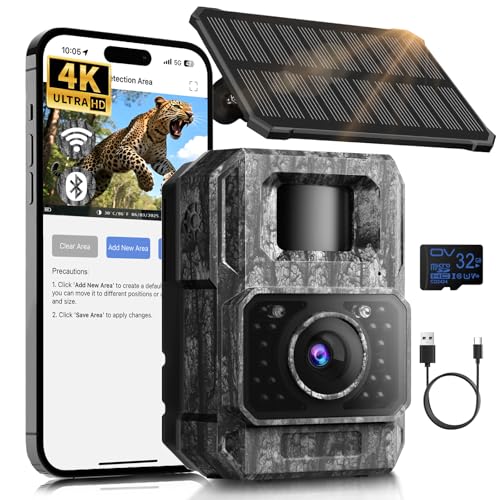
- 6000mAh battery with adjustable split solar panel
- 4K video, 64MP photos, and 0.1-second trigger
- Local WiFi/Bluetooth app connection with 32GB SD card
Best For: Long-term monitoring near a home, farm, or property
Best Non-Wireless Performance

- 0.1-second trigger with three PIR sensors
- 64MP photos, 1296p video, and 100-foot night vision
- IP66 housing with SD support up to 512GB
Best For: Offline wildlife recording without subscriptions
Best Connected Coverage
TKENPRO 4G LTE 360° Solar Trail Camera
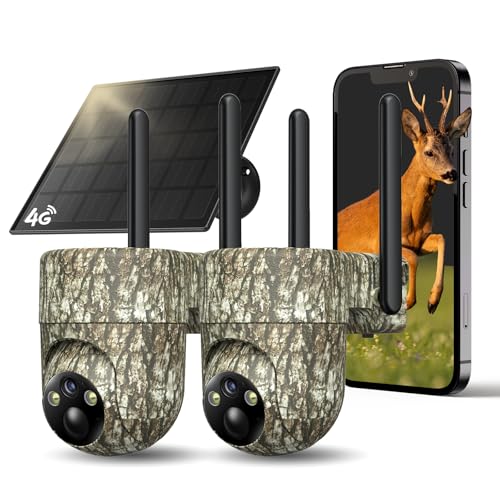
- 4G LTE app access with built-in SIM
- 355° pan and 120° tilt control
- Solar powered with 2K video
Best For: Remote properties needing live cellular monitoring
Best No-Subscription Value
WOSPORTS 4K 64MP Non-Cellular Trail Camera

- 64MP photos and 4K video
- 0.2-second trigger with 120° detection
- No-glow night vision and 2-inch LCD
Best For: Local recording for scouting and property monitoring
Best Easy-Setup Cellular Pick
4G LTE 2.5K 360° Solar Trail Camera

- App setup works without Wi-Fi
- 100MB complimentary data included
- Solar power with live feed and alerts
Best For: Quick remote monitoring of wildlife and property
Best Compact Pick

- 30MP photos and 1080P video
- Compact camouflage body with 850nm night vision
- IP66 water resistance and strap included
Best For: Portable wildlife, garden, and property monitoring
Best Connected Option
SPYPOINT FLEX-M Twin Cellular Camera

- Cellular photo transmission with free 100-photo plan
- App control and cross-carrier coverage
- Photo, video, time-lapse, and Time-Lapse+ modes
Best For: Remote scouting and property monitoring
Best Multi-Camera Value
WOSODA Mini Trail Camera 4 Pack

- Four compact cameras for wider coverage
- 30MP photos, 1080P video, and 0.3-second trigger
- Includes 16GB SD cards and 16 AA batteries
Best For: Multi-location wildlife and property monitoring
Best Value 2-Pack – WOSODA G200 Trail Cameras
For shoppers seeking portable trail cameras in a convenient multi-camera kit, the WOSODA G200 2-pack combines motion activation, low-glow night vision, and outdoor-ready construction. Each camera captures 48MP photos and 1080p video, and the package includes two 16GB SD cards and mounting accessories.
Best For: Monitoring multiple wildlife areas, gardens, or outdoor spaces on a budget.
Pros:
- Fast 0.3-second trigger with detection up to 60 feet.
- 48MP still photos and 1080p HD video.
- Two-camera package includes SD cards, batteries, straps, and mounts.
- IP65 waterproof housing and 850nm low-glow infrared night vision.
Cons:
- Non-WiFi design requires retrieving the SD card to view recordings.
- Uses eight AA batteries per camera, according to the included package details.
The WOSODA set is a practical choice when coverage matters more than remote access. Its two-camera format, quick trigger, and included accessories make it easy to deploy at separate locations.
Best Cellular Option – Moultrie Edge 3 Cellular Trail Camera
The Moultrie Edge 3 is one of the most capable portable trail cameras for remote scouting, sending photos and alerts to your phone through cellular connectivity. It adds AI buck detection, GPS mapping, live aiming, and automatic connection to the strongest available network among four major U.S. carriers.
Best For: Hunters who want real-time deer activity updates without visiting the camera frequently.
Pros:
- 40MP photos and 1080p HD video with low-glow infrared night vision.
- AI buck detection can help reduce irrelevant alerts.
- 0.5-second trigger and detection range up to 100 feet.
- Built-in GPS, live aim, app control, and multi-carrier connectivity.
Cons:
- Requires a cellular plan, with plans starting at $9.99.
- Rechargeable battery packs and solar panels are compatible options rather than included accessories.
The Edge 3 prioritizes convenience and actionable information. Its cellular delivery and hunting-focused features can save trips to remote properties, though ongoing service costs should be included in the budget.
Best Solar-Powered Pick – MAXDONE Solar Trail Camera
For buyers comparing portable trail cameras with reduced maintenance, the MAXDONE pairs a 6000mAh rechargeable battery with a flexible split solar panel. It records 4K video and 64MP images, connects to a phone through its own short-range WiFi and Bluetooth setup, and includes a pre-installed 32GB SD card.
Best For: Backyard, farm, and woodland monitoring where long-term solar operation is useful.
Pros:
- Solar, Type-C, and rechargeable power options support extended use.
- 4K video, 64MP photos, and 0.1-second trigger speed.
- Low-light infrared night vision reaches up to 65 feet.
- IP66 waterproof rating with motion detection, time-lapse, and scheduled shooting.
Cons:
- Its WiFi connection is a local camera hotspot, not home WiFi or cellular service.
- Phone connection range is limited, with the app recommending use within 10 feet.
The MAXDONE stands out for low-maintenance power and high-resolution recording. It is a strong fit for locations you can reach occasionally, but it is not designed for long-distance remote alerts over a cellular network.
Best Non-Wireless Performance – GardePro E5S Trail Camera
The GardePro E5S is a straightforward choice among portable trail cameras for shoppers who prefer local recording and minimal wireless complexity. It captures 64MP photos and 1296p video, uses three PIR sensors for a 0.1-second trigger, and supports SD cards up to 512GB.
Best For: Wildlife monitoring and hunting setups where reliable offline recording is the priority.
Pros:
- 0.1-second trigger speed with three PIR sensors.
- 64MP photos and 1296p HD video with sound.
- IP66 weather resistance and 100-foot no-glow night vision.
- Motion detection, time-lapse, hybrid mode, and support for SD cards up to 512GB.
Cons:
- Non-cellular and non-WiFi operation means recordings must be retrieved locally.
- Eight AA batteries and the SD card are not included.
- Optional solar panel is sold separately.
The E5S favors speed, storage flexibility, and efficient offline operation. It is a sensible option for users who can check the camera periodically and want to avoid subscriptions and wireless setup.
Best Connected Coverage – TKENPRO 4G LTE 360° Solar Trail Camera
For portable trail cameras that can monitor remote property without Wi-Fi, the TKENPRO combines 4G LTE access, solar power, and remote pan-and-tilt control. It records in 2K, supports live viewing through the app, and sends motion alerts to your phone.
Best For: Remote wildlife monitoring, farms, ranches, cabins, and properties needing cellular access and broad coverage.
Pros:
- Built-in SIM card connects to available 4G networks; seven days of unlimited data are included after activation.
- 355° pan and 120° tilt provide a broad remotely controlled viewing area, with up to 4x digital zoom.
- 5W solar panel, IP65 weather resistance, 2K video, and 85-foot infrared night vision support extended outdoor use.
- Fast 0.2-second triggering, phone alerts, two-way audio, and live streaming add useful monitoring features.
Cons:
- Wi-Fi is not supported, and the non-removable SIM is limited to use in the United States.
- Continued cellular service requires a paid data plan after the trial period.
This is a feature-rich choice when remote access matters more than a one-time setup. Its solar design and 360°-style control reduce routine visits, while the cellular plan adds an ongoing ownership cost.
Best No-Subscription Value – WOSPORTS 4K 64MP Non-Cellular Trail Camera
If you want portable trail cameras without cellular fees, the WOSPORTS G600 uses local storage and battery power for straightforward scouting. It captures 64MP photos and 4K video, triggers in 0.2 seconds, and includes a screen for checking footage in the field.
Best For: Deer scouting, wildlife observation, farm surveillance, backyard security, and buyers who do not need phone connectivity.
Pros:
- Captures adjustable-resolution photos up to 64MP and 4K video for detailed daytime and nighttime recording.
- 0.2-second trigger speed, 120° detection width, and 1–3 burst shooting help capture moving subjects.
- No-glow 940nm infrared LEDs provide discreet night operation, with an advertised range of up to 80 feet.
- Built-in 2-inch color LCD enables on-device previews, and a 16GB memory card is included.
Cons:
- It is non-cellular and non-Wi-Fi, so footage cannot be viewed remotely through a phone.
- Eight AA batteries are not included; rechargeable battery and solar-panel options are sold separately.
- Additional storage beyond the included card requires a separately purchased SD card.
The WOSPORTS is a practical field camera for users who prefer local recording and simple controls. Its screen and included memory card make initial setup convenient, but reviewing footage requires visiting the camera.
Best Easy-Setup Cellular Pick – 4G LTE 2.5K 360° Solar Trail Camera
For portable trail cameras that need quick cellular setup, this 4G LTE model connects to a phone through its app without Wi-Fi. It includes a pre-inserted SIM and 100MB of complimentary data, while solar power and live-feed access support ongoing outdoor monitoring.
Best For: Users who want app-based remote viewing, motion alerts, and solar-powered monitoring with minimal installation.
Pros:
- App-guided setup is designed to get the camera connected in a few steps without Wi-Fi.
- Pre-inserted SIM card and 100MB of free data allow initial testing before purchasing more data.
- Solar power, PIR motion alerts, and dual night vision support day-and-night outdoor surveillance.
- 2.5K live-feed capability and adjustable HD/SD recording provide flexible remote viewing and storage use.
Cons:
- A memory card is not included and must be purchased separately.
- Each camera requires its own data top-up; data cannot be shared between cameras.
- Ongoing remote access depends on cellular data service and app-based plan management.
This model is appealing when simple installation and phone alerts are priorities. The included starter data lowers the barrier to trying cellular monitoring, but multi-camera setups can require separate data plans and additional storage cards.
Best Compact Pick – WOSPORTS Mini Trail Camera
If you want portable trail cameras for basic wildlife or property monitoring, the WOSPORTS Mini Trail Camera emphasizes a compact, lightweight design without giving up 30MP photos, 1080P video, or day-and-night motion detection. Its camouflage housing and included mounting strap make it practical for discreet outdoor placement.
Best For: Deer scouting, backyard wildlife observation, garden monitoring, and compact outdoor surveillance.
Pros:
- Captures 30MP photos and 1080P HD video.
- 850nm infrared night vision supports low-light monitoring while reducing disturbance.
- Compact 0.73-pound design with camouflage housing is easy to conceal and carry.
- IP66 water resistance and an adjustable mounting strap support outdoor installation.
Cons:
- Requires four AA batteries and an SD card, which are not included.
- SD card storage is limited to cards up to 32GB.
- Its listed features focus on local recording rather than wireless phone access.
This is a sensible choice when portability and straightforward operation matter more than remote connectivity. It offers solid image resolution and flexible placement for users who are comfortable retrieving footage from the camera.
Best Connected Option – SPYPOINT FLEX-M Twin Cellular Camera
Among portable trail cameras, the SPYPOINT FLEX-M Twin stands out for cellular access and app-based control. It can transmit photos to a phone, tablet, or computer without Wi-Fi, while cross-carrier coverage and remote settings management simplify monitoring locations that are difficult to visit frequently.
Best For: Remote property monitoring, hunting-season scouting, and wildlife observation where cellular connectivity is available.
Pros:
- Includes a free plan for up to 100 transmitted photos per month.
- Supports photo, video, time-lapse, and Time-Lapse+ capture modes.
- Cross-carrier coverage avoids manual carrier selection or swapping.
- SPYPOINT app enables remote activation, settings changes, firmware updates, maps, and weather information.
Cons:
- Paid plans are required for transmission beyond the free monthly allowance.
- Solar panels are sold separately for extended autonomy.
- Video capture is listed at 720P, and the camera has IP65 rather than IP66 water resistance.
This model is the strongest fit for convenience-focused users who want images delivered remotely. Its cellular features add ongoing plan considerations, but they can substantially reduce trips to retrieve an SD card.
Best Multi-Camera Value – WOSODA Mini Trail Camera 4 Pack
The WOSODA four-pack is a practical way to cover several locations with portable trail cameras. Each compact unit records 30MP photos and 1080P video, and the bundle includes 16GB SD cards and AA batteries, helping reduce the extra purchases needed for initial setup.
Best For: Multi-location wildlife monitoring, farm safety, garden surveillance, and budget-conscious game scouting.
Pros:
- Four cameras provide broader coverage across trails, gardens, or property areas.
- Each camera captures 30MP photos and 1080P video.
- Fast 0.3-second trigger speed and 65-foot night vision range support motion capture.
- Bundle includes four 16GB SD cards and 16 AA batteries.
Cons:
- No phone connection or wireless access; footage must be retrieved from the SD card.
- Each camera uses four AA batteries, creating more batteries to manage across the pack.
- SD card support is limited to 32GB per camera.
This pack makes the most sense when coverage area matters more than remote viewing. It supplies multiple discreet cameras and basic storage and power accessories, though checking footage requires physically removing the cards.
How We Picked the Best Portable Trail Cameras
We compared these Portable Trail Cameras by focusing on the features that matter most in real outdoor use: trigger speed, image and video resolution, nighttime illumination, detection coverage, power options, connectivity, storage, weather protection, and setup requirements. We also separated cellular cameras from non-cellular models because they serve different monitoring styles.
Advertised megapixel and video figures are useful for comparison, but they do not tell the whole story. Sensor performance, infrared flash quality, lens placement, compression, and lighting conditions all affect the final footage. A fast trigger and reliable detection system can be more valuable than the highest stated resolution.
Quick Comparison
- Best for basic monitoring: Choose a non-cellular camera with an SD card and infrared night vision.
- Best for remote access: Cellular models can transmit photos or video without requiring a nearby Wi-Fi network.
- Best for extended deployments: Solar-assisted cameras can reduce battery changes, especially in locations with regular sunlight.
- Best for discreet placement: Mini cameras and no-glow infrared systems are easier to conceal and less noticeable at night.
- Best for broad coverage: Models with wide-angle or 360-degree views can monitor more area, but may require careful positioning.
Key Buying Factors for Portable Trail Cameras
Connectivity and Storage
Non-cellular cameras are typically simpler and cheaper, but you must retrieve the SD card to view recordings. Cellular cameras offer remote alerts and image access, though they require a compatible network, a data plan, and more power. Check whether a SIM card or photo plan is included before buying.
Trigger Speed and Detection Range
Fast trigger times help capture animals moving quickly across the frame. Detection range and recovery time also matter: a camera that detects distant motion but takes too long to reset may miss subsequent activity. For trails, feeders, and property entrances, match the detection area to the expected movement path.
Night Vision and Image Quality
No-glow infrared is preferable when minimizing visible flashes is important. Compare night range, infrared illumination, video resolution, and whether audio recording is supported. Higher resolution can provide more detail, but it may increase file sizes and battery use.
Power, Durability, and Installation
Look for battery access that is easy to reach, a secure mounting system, and weather protection suitable for long-term outdoor use. Solar charging is helpful but depends on sunlight and may not eliminate the need for backup batteries. Confirm the camera’s operating temperature and waterproofing claims for your environment.
Who Should Buy Which Portable Trail Cameras?
Buy a basic non-cellular model if you want affordable, occasional monitoring and do not mind collecting an SD card. Choose a cellular camera for remote land, security checks, or wildlife locations that are inconvenient to visit. A solar or solar-assisted model suits longer deployments where reducing maintenance is a priority.
Mini cameras are useful for discreet placements and compact setups, while wide-angle or 360-degree models make more sense when animals or activity can approach from multiple directions. Before ordering, verify network compatibility, subscription costs, included accessories, memory-card requirements, and the camera’s expected battery life for your recording settings.
